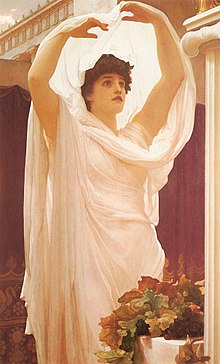
Vestals ( lat.virgo vestalis ) - priestesses of the goddess Vesta in ancient Rome , who were highly respected and respected.
Content
- 1 Features of the Vestals
- 2 Establishment of the Vestal Institute
- 3 Rite of passage
- 4 Service
- 5 Punishment of the Vestals
- 6 Liquidation of the Institute
- 7 The most famous vestals
- 8 See also
- 9 notes
- 10 Links
Features of Vestals
Their person was inviolable (therefore, many gave them their wills and other documents for storage).
Vestals were freed from paternal authority , had the right to own property and dispose of it at their discretion.
Offending in any way the vestal, for example, trying to slip under her stretcher, was punishable by death.
In front of the vestal was a lictor ; under certain conditions, the vestal had the right to ride in chariots . If they met a criminal led to execution on the way, they had the right to have mercy on him.
Vestal duties included maintaining the sacred fire in the Vesta temple , maintaining the purity of the temple, making sacrifices to Vesta and the Penates , guarding the palladium and other shrines. Plutarch , who left the most detailed description of the rules of service to Vesta, suggests that they also kept certain shrines and performed certain rites hidden from the eyes of the uninitiated.
Establishment of the Vestal Institute
The creation of the Institute of Vestals is attributed to Tsar Numa Pompilius , who finally ordered the whole system of state religion, which it remained as long as polytheism remained the religion of Ancient Rome.
“He chose the maidens to serve Vesta; this ministry comes from Alba and is not alien to the family of the founder of Rome. In order to keep them in charge of temple affairs all the time, Numa appointed them a salary from the treasury, and, having distinguished them with virginity and other signs of holiness, gave them universal respect and immunity ”(Livy, I, 20).
Already Plutarch , citing this fact in his Comparative Biographies [1] , could not clearly answer the question - why in the vestals they chose young girls and why they had to keep their “purity” for 30 years.
Plutarch rightly points out the relationship between the Roman and Greek rites of maintaining an inextinguishable fire, despite the fact that in Greece old virgins should have supported the fire, and if it happened to go out, it was possible to breed a new one exclusively in the ancient way - by lighting from the sun.
Plutarch himself tried to deduce the necessity of this forced virginity from a comparison with the "futility of fire." However, rather, this belief finds its explanation in the primitive "dedication to the deity" - characteristic, for example, for the priests of the goddess Cybele or for the Inca "solar maidens".
One way or another, Numa first dedicated Vesta to Heganius and Belief to serve the Eternal Fire , then added two more to them - Canulei and Tarpei . Servius Tullius brought the number of vestals to six, which remained unchanged to the end.
When a vacancy in the collegium of priestesses was vacated, a new vestal was elected (in the early epoch by the kings, under the republic and empire by the Great Pontiff ) by a draw of twenty girls.
The following criteria were required from candidates:
- the girls were of patrician descent;
- they should have been between 6 and 10 years old;
- girls should not have physical disabilities;
- both parents were supposed to live in Italy .
Rite of Consecration
The newcomers to the community were introduced primarily to the atrium of the Vesta temple , where they cut her hair and hung it as a donation to a sacred tree, which was over 500 years old in the era of Pliny the Elder .
Then they dressed the young vestal in all white, called her the name "Beloved" ( Latin Amata ), which was added to her nomenclature , and dedicated her to new duties.
Selected vestals came out of the bosom of the family and fell under the protection of the supreme pontiff .
From the duty of serving Vesta, a girl could be released only for special family circumstances.
The vestal vestment consisted of a long white tunic , and on the head there was a bandage ( lat.infula ).
Service
The service life was 30 years, divided in equal parts by training, direct service and training of others (mentoring).
After these years, the vestal became free and could get married.
However, the latter happened extremely rarely, since there was a belief that marriage with a vestal would not lead to good, and in addition, getting married, the former vestal lost her social and property status unique to a Roman woman and became an ordinary matron , completely dependent on her husband, which, of course, was unprofitable for her.
At the head of the vestals was the oldest of them, called the Great vestal ( lat. Vestalis Maxima ), who received orders directly from the supreme pontiff.
The main duty of the vestal was to maintain the sacred fire on the altar of the goddess Vesta. They extinguished the flame only once a year - on the first day of the new year; then they lit it again in the most ancient way - by means of friction of a tree against a tree.
Then the great vestal and the supreme pontiff offered a public prayer for the well-being of Rome, climbing the Capitol . It is this rite that acts as a symbol of the life of Rome and Roman civilization in the famous ode Exegi monumentum Horace :
crescam laude recens, dum capitolium
scandet cum tacita virgine pontifex
that is, “I will grow in glory, (forever) young, as long as the priest with the silent maiden ascends the Capitol.”
Vestals were very rich, mainly because of the possession of large estates, which gave a large income, in addition to which each personally received a significant amount from their family at the initiation and received generous gifts from emperors: for example, in 24 , when Cornelia joined Vestal, Tiberius gave her 2 million sisters .
Vestals of the Vestals
All the time the ministers of the vestal had to maintain a chaste lifestyle, its violation was strictly punished.
It was believed that Rome could not take on such a sin as the execution of the vestal, therefore they were punished by burial alive (on the Villainous Field , Latin Campus Sceleratus , located in the city at the Collins Gate on the Quirinale ) with a small supply of food, which was not formally the death penalty , and the seducer was spotted to death.
The vestal who was guilty of breaking the vow was put in a tightly closed and tied with a strap stretcher so that even her voices could not be heard, and carried through the forum.
All silently gave her the way and escorted her, without saying a word, in deep grief. For the city there was no worse event, there was no day sadder than that.
When the stretcher was brought to the appointed place, the slaves untied the belts. The High Priest recited a mysterious prayer, raised his hands to the sky before the execution, ordered the criminal to be brought up, with a thick blanket on his face, placed on the stairs leading to the dungeon, and then retired along with the other priests. When the vestal descended, the staircase went up, the hole was filled up with a mass of earth, and the place of execution became as flat as the rest of the surface .
The extinction of the sacred fire was considered a bad omen for Rome; to rekindle it again was possible only by the friction of two sticks.
If at some vestal the fire extinguished, then the Great Pontiff scourged it. In some cases, the offender was stripped in the dark of the donag and a single sheet of thin cloth was thrown over her. .
The vestal's accusation of adultery did not always end in her death; sometimes the priestesses managed to make excuses. In 418 BC e. Vestal Postumiya was acquitted before the court and was ordered to look “not pretty, but pious” .
Institute Liquidation
The Institute of Vestals lasted until about 391 , when Emperor Theodosius banned public pagan worship.
After that, the sacred fire was extinguished, the temple of Vesta was closed, and the institute of vestals was disbanded.
The most famous vestals
- Rhea Silvia ( lat. Rhea Silvia ) - mother of Romulus and Remus , founders of Rome;
- Tarpeia ( lat. Tarpeia ), treacherously opened the gates of the city besieging Rome Sabines ;
- Oppia , executed for wickedness in 483 BC. e .;
- Emilia ( lat.Aemilia );
- Cecilia Metella ;
- Licinia ( Latin Licinia ) - consul's sister 62 BC e. Lucia Murena ;
- Cornelia is the eldest vestal executed in the reign of imp. Domitian
- Aquillia Severa ( lat. Aquillia Severa ), married Emperor Heliogabal (Marcus Aurelius Antoninus) ;
- Celia Concordia ( lat. Coelia Concordia ), considered the last great vestal, about about 380 years ;
- According to legend, two vestals, Tuktsia ( lat. Tuccia ) and Claudius , were accused of violating chastity, but both were able to prove their innocence by performing miracles. Claudia, pulling the rope, pushed the ship deep into the silt, and Tuktsia was able to collect water in a sieve and brought water from the Tiber to the Forum , thereby proving her innocence.
See also
- Vestal House
Notes
- ↑ http://www.lib.ru/POEEAST/PLUTARH/likurg.txt Plutarch “Comparative biographies. Numa Pompilius. "
Links
- Vestals // Brockhaus and Efron Encyclopedic Dictionary : in 86 volumes (82 volumes and 4 additional). - SPb. , 1890-1907.
- Vestals are the legends and myths of Ancient Greece and Rome.
- Description of the Temple of Vesta and the House of Vestals in Rome .
- Vestals . - in Smith's Dictionary of Greek and Roman Antiquities.
- The Code of Patria Potestas
- House of the Vestal Virgins
- List of Famous Great Vestals