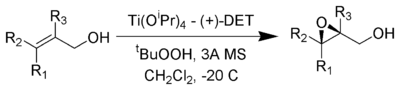
Stereoselective synthesis ( chiral synthesis , asymmetric synthesis , enantioselective synthesis ) is a chemical reaction (or sequence of reactions) during which stereoisomeric products ( enantiomers or diastereomers ) are formed in unequal amounts [1] . The methodology of stereoselective synthesis plays an important role in pharmaceuticals , since different enantiomers and diastereomers of the same molecule often have different biological activity .
Content
- 1 Concept
- 2 Performance Characteristic
- 3 Approaches Used
- 3.1 Use of a chiral substrate
- 3.2 Use of chiral auxiliary agents
- 3.3 Using a chiral catalyst
- 4 Alternatives
- 5 notes
- 6 Literature
Concept
In general, a chemical reaction between two achiral compounds results in a racemic product, that is, a mixture of stereoisomeric forms in the same ratio. In order to predominantly form only one of the stereoisomeric forms, the presence of a stereo directing factor is necessary. Such a factor, as a rule, is a certain chiral element (for example, a chiral atom), which does not directly participate in the reaction, but carries out asymmetric induction , directing the formation of a new stereo center towards the formation of one or another stereoisomer, and such an element can be located in a substrate, so in the reagent or catalyst.
Performance Characteristics
The selective effectiveness of the asymmetric reaction is distinguished from the magnitude of the enantiomeric excess ( Eng.enantiomeric excess , ee ), if the resulting products are enantiomers, or diastereoselective excess ( Eng.diastereomeric excess , de ), if they are diastereomers. These values are found by calculating the difference between the numbers of stereoisomers, dividing by their total number [2] . In the best case, ee and de are 100% (in the absence of one of the stereoisomers). For a non-stereoselective reaction, ee and de are 0.
Approaches Used
In stereoselective synthesis, three main approaches are used:
- use of chiral substrate
- use of chiral auxiliary reagent
- use of a chiral catalyst
Sometimes it’s advisable to combine several approaches to get a better result.
Use of a chiral substrate
This approach is the simplest. The chiral substrate is subjected to successive chemical transformations under the action of various achiral reagents, which preserve the chirality of the starting compound at each stage, which ultimately leads to a chiral product. Compounds that are naturally enantiomerically pure, such as amino acids or sugars , are conveniently used as a chiral substrate. The disadvantage of this approach is the limited choice of chemical reactions, since some of them can violate the chirality of substances, and therefore cannot be used in stereoselective synthesis.
Since stereo centers are introduced into the system together with the substrate, and do not arise during chemical transformations, it is not entirely correct to attribute this approach to stereoselective synthesis.
Use of chiral auxiliary reagents
If there is no stereo directing chiral atom in the substrate, a chiral auxiliary reagent can be used that forms an adduct with the substrate. In this case, the substrate itself becomes chiral, and further processes with its participation proceed enantioselectively. Upon completion of the synthesis, the auxiliary reagent is removed. The disadvantage of this approach is the need for two additional steps for the introduction and removal of a chiral auxiliary reagent. In addition, the auxiliary reagent itself is used in stoichiometric amounts, which can significantly increase the cost of synthesis [3] .
Using a chiral catalyst
In this approach, the catalyst plays a stereo-guiding role, which is used in small quantities and allows to obtain a large amount of enantiomerically pure (or enantiomerically enriched) product [4] . There are several types of chiral catalysts:
- metal complexes with chiral ligands
- chiral organocatalysts
- biocatalysts
- Lewis chiral acids .
The first methods were developed by W. Knowles and R. Noori . In 1968, Knowles replaced the achiral triphenylphosphine ligands in the Wilkinson catalyst with a chiral phosphine ligand, obtaining the first chiral catalyst [5] . This methodology was developed by enumerating various phosphine ligands to increase the enantiomeric excess and was used in the industrial synthesis of L-DOPA [6] .
In the same year, Noyori published results on the enantioselective cyclopropanation of styrene in the presence of a chiral catalyst [7] .
Organocatalysis involves the use of small organic molecules (for example, proline derivatives, imidazolidinone) as chiral catalysts [8] [9] . Biocatalysis uses natural enzymes for stereoselective transformations.
Alternatives
There is another approach to the synthesis of individual stereoisomers of compounds, which consists in the cleavage of the racemate — the separation of the resulting racemic product into individual stereoisomers using various methods. This can be useful when both enantiomers find their application [10] .
Notes
- ↑ IUPAC Gold Book - stereoselective synthesis . Date of treatment February 3, 2013. Archived February 14, 2013.
- ↑ IUPAC Gold Book - enentiomeric excess . Date of treatment February 3, 2013. Archived February 14, 2013.
- ↑ Gnas Y., Glorius F. Chiral Auxiliaries - Principles and Recent Applications (Eng.) // Synthesis. - 2006. - No. 12 . - P. 1899-1930 . - DOI : 10.1055 / s-2006-942399 .
- ↑ Heitbaum M., Glorius F., Escher I. Asymmetric Heterogeneous Catalysis (Eng.) // Angew. Chem. Int. Ed. - 2006. - Vol. 45 , no. 29 . - P. 4732–4762 . - DOI : 10.1002 / anie.200504212 .
- ↑ Knowles WS, Sabacky MJ Catalytic asymmetric hydrogenation employing a soluble, optically active, rhodium complex (Eng.) // Chem. Commun. (London). - 1968. - No. 22 . - P. 1445-1446 . - DOI : 10.1039 / C19680001445 .
- ↑ Knowles WS Application of organometallic catalysis to the commercial production of L-DOPA (Eng.) // J. Chem. Educ. - 1986. - Vol. 63 , no. 3 . - P. 222 . - DOI : 10.1021 / ed063p222 .
- ↑ Nozaki H., Takaya H., Moriuti S., Noyori R. Homogeneous catalysis in the decomposition of diazo compounds by copper chelates: Asymmetric carbenoid reactions (English) // Tetrahedron. - 1968. - Vol. 24 , no. 9 . - P. 3655-3669 . - DOI : 10.1016 / S0040-4020 (01) 91998-2 .
- ↑ List B. Introduction: Organocatalysis (Eng.) // Chem. Rev. - 2007. - Vol. 107 , no. 12 . - P. 5413-5415 . - DOI : 10.1021 / cr078412e .
- ↑ Dalko PI, Moisan L. In the Golden Age of Organocatalysis (Eng.) // Angew. Chem. Int. Ed. - 2004. - Vol. 43 , no. 39 . - P. 5138-5175 . - DOI : 10.1002 / anie.200400650 .
- ↑ Potapov, 1988 , p. 47-71.
Literature
- Potapov V.M. Stereochemistry. - 2nd, rev. and add. - M .: Chemistry , 1988 .-- 464 p. - ISBN 5-7245-0376-X .
- Morrison, J., Mosher, G. Asymmetric Organic Reactions. - M .: Mir , 1973.- 509 p.