Spent nuclear fuel (SNF, also irradiated nuclear fuel) - fuel elements (TVEL) extracted from the active zone or their groups, fuel assemblies of nuclear reactors of nuclear power plants and other facilities (research, transport and others). Fuel is classified as spent if it is more unable to effectively maintain a chain reaction [1] .
In most modern reactors, the fuel element is a thin-walled tube made of various zirconium alloys , in which there are "tablets" of uranium compounds (most often uranium dioxide ) of various degrees of enrichment , 3 m long (for WWER ) and about 1-3 cm in diameter, equipped with ends with plugs ensuring the tightness of the fuel rod and its fastening in the fuel assembly.
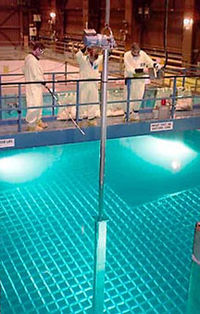
Spent nuclear fuel, unlike fresh fuel, has significant radioactivity due to the content of a large number of fission products (for WWER reactors about 300,000 Ci in each fuel rod) and tends to self-heat in air to high temperatures (just recovered to about 300 ° C ) and after extraction from the reactor core is maintained for 2-5 years in the holding pool ( WWER ) or on the periphery of the reactor core ( BN-600 reactor). After reducing the residual energy of the fuel, it is sent for storage , disposal or reprocessing of spent nuclear fuel [2] .
See also
- Radioactive waste
- Nuclear fuel
- Nuclear reactor
- Nuclear power plant
Notes
- ↑ Spent nuclear fuel / Glossary / NRC Library . US NRC (November 22, 2013). Date of treatment November 29, 2013.
- ↑ IAEA published a review report on the current state of spent nuclear fuel reprocessing technologies. Atominfo.ru, 03.03.2009
Links
- What is Spent Nuclear Fuel? // Idaho National Laboratory
- Storage of Spent Nuclear Fuel // IAEA 2012, ISBN 978-92-0-115110-0
- Long Term Storage of Spent Nuclear Fuel - Survey and Recommendations // IAEA, 2002