Albert Friedrich Benno Dulk ( German: Albert Friedrich Benno Dulk ; June 17, 1819 , Königsberg (now Kaliningrad ) - October 29, 1884 , Stuttgart ) - German writer , playwright , philosopher , freethinker , revolutionary , socialist .
| Albert Dulk | |
|---|---|
| him. Albert dulk | |
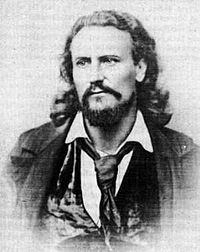
 Albert Dulk in 1867 | |
| Birth name | Albert Friedrich Benno Dulk |
| Date of Birth | June 17, 1819 |
| Place of Birth | Königsberg |
| Date of death | October 29, 1884 (65 years old) |
| A place of death | Stuttgart |
| Citizenship |  |
| Occupation | , |
| Language of Works | Deutsch |
Content
- 1 Biography
- 2 Creativity
- 3 Selected Works
- 4 Literature
- 5 Links
Biography
The son of a chemist and a pharmacist. During his student days he met with a group of so-called “free” Bruno Bauer , Louise Aston and Max Stirner and was inspired by ideas of free thought. In Leipzig joined the society of democratically-minded students.
In 1845, he was expelled from Saxony for speaking with Robert Blum and writer Wilhelm Jordan at the funeral of those killed in the riots in Leipzig.
An active participant in the revolutionary events of 1848 in Königsberg . Created a working association there . Due to the ensuing repression, he was forced to leave Prussia and travel around Italy, Egypt and Arabia.
Creativity
The main political and philosophical writings of A. Dulk, in which he appears as the implacable enemy of the Christian worldview, is “Stimme der Menschheit; christliche Glaubenslehre ”(1875-1880), ended up in a Heilbronn prison, where he was imprisoned for 14 months for blasphemy and socialist propaganda.
Author of works:
- Der Tod des Bewusstseins (1863);
- "Patriotismus und Fr ö mmigkeit" (1871), sharply condemning hatred of the French and demanding an end to the war;
- "Tier oder Mensch" (1872);
- “Was ist von der christlichen Kirche zu halteu?” (1877);
- Der Irrgang des Lebens Jesu (1884–83) and others.
A distinctive feature of Dulk’s dramatic works (Orla, Simson, Jesus der Christ, Lea, the political comedy Die Wände, the tragedy Konrad II) is a striving for effect to the detriment of the depth of feeling.
From the descriptions of his travels, the notes Fahrten durch Norwegen (1877) stand out.
Selected Works
- Lichter aus Frankfurt. Der Briefwechsel Friedrich Stoltzes mit Albert Dulk 1867-1884 . Weimar: VDG. 2004. ISBN 3-89739-426-X
- Der Briefwechsel zwischen Albert Dulk und Paul Heyse 1860-1882. Mitget. von Ernst Rose . New York: Columbia Univ. Press 1929.
- Orla. Dramatische Dichtung . Mannheim: Grohe. (1844)
- Lea. Drama in 5 Akten . Königsberg: Samter & Rathke. (1848)
- König Enzio. Große Oper in vier Akten. Musik von Johann F. Abert . Stuttgart: Blum und Vogel. (ca. 1863)
- Kaiser Konrad der Zweite. Historisches Schauspiel in drei Handlungen . Leipzig: Brockhaus. 1867.
- Willa Schauspiel in drei Handlungen . Wien: Rosner. 1875.
- Gedichte . Stuttgart: Dietz. 1892. 2. Aufl.
- Sämmtliche Dramen, hrsg. von Ernst Ziel . Stuttgart: Dietz. 1893/94.
Literature
- Dulk, Albert-Friedrich-Benno // Brockhaus and Efron Encyclopedic Dictionary : in 86 volumes (82 volumes and 4 additional). - SPb. , 1890-1907.