
Patu is a short, flat Polynesian war club with a thickened grip made of wood, polished stone or whale bone [1] . In addition to direct use, it is also used as a symbol, it is believed that they have mana [2] .
In Maori, different types of patu have their own names: stone ones were called “patu-oneva” ( Maori patu ōnewa ) , bone ones were called “patu-paraoa”, an eighth-shaped patu is called “kotyate”, an asymmetric patu with a human figure is called “wahaika” [1 ] [3] . Patu-oneva was made from brown sandstone , volcanic rocks, including pumice, and also from green (green stone, jade ) [4] . Patu made of pounam are called “least” or “least-pounam”; they were a symbol of power and almost always belonged to the leaders of the ievi [1] [5] . Like all other weapons, the Maori were given their own names for the long-used staple. For example, a pata called “Bloody Hand” ( Maori Te Ringa Toto ) is known [6] .
The production of wooden sticks (always decorated with carvings) and polished stone required a lot of time and effort and could take more than a year, which is why they were used in a special way in a sparing manner, never striking them like an ax [6] [5] [2 ] ] . For example, green stone, for example, was chipped off with pieces of durable sandstone or slate , and then polished with quartz sand [4] . A hole was usually drilled in the handle of the finished stitch, through which a tourniquet was passed, and then wrapped around a brush holding a club; the other hand held a wicker shield. The warrior tried to grab the enemy by the hair and hit him in the temple with a sharp blow or a poke of a club, or stick a club under the ribs [7] .
In the 21st century, military use of the patu ceased, but they were often used in dancing and singing , as well as at events [8] . In addition, the measure is depicted on the flag of “Kohitanga” along with the scroll of the Waitangi agreement . Historically warring tribes exchanged at least poemama as a sign of peace, an example of such a symbol is the Maori Hine-nui-o-te-paua measure , transmitted to the tribe from the tribe [9] .

Wahaika
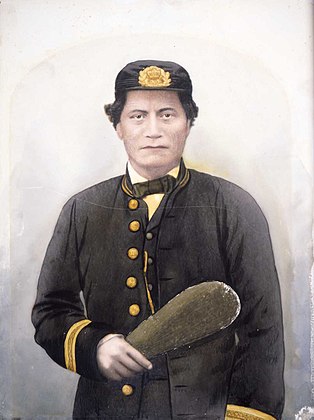
Chieftain Raviri Puah with a patu

Mere Pounamu


Notes
- ↑ 1 2 3 Keane .
- ↑ 1 2 Pounamu , p. five.
- ↑ Collection, 1963 , p. 82.
- ↑ 1 2 Moore & McFadgen .
- ↑ 1 2 Collection, 1963 , p. 97.
- ↑ 1 2 Matamua , p. one.
- ↑ Matamua , p. 2.
- ↑ Matamua , p. 3.
- ↑ Pounamu , p. 7.
Literature
- Basil Keane. Rākau Māori - Māori weapons and their uses // Te Ara - the Encyclopedia of New Zealand . - Ministry for Culture and Heritage . Retrieved February 21, 2017.
- Rangi Matamua. Mau rākau - Māori use of weaponry // Te Ara - the Encyclopedia of New Zealand . - Ministry for Culture and Heritage . Retrieved February 21, 2017.
- Phil Moore and Bruce McFadgen. Kōhatu - Māori use of stone // Te Ara - the Encyclopedia of New Zealand . - Ministry for Culture and Heritage . Retrieved February 21, 2017.
- Basil Keane. Pounamu - jade or greenstone // Te Ara - the Encyclopedia of New Zealand . - Ministry for Culture and Heritage . Retrieved February 21, 2017.
- Collection of the Museum of Anthropology and Ethnography (Russian) . - Science, Leningrad Branch, 1963. - (Collection of the Museum of Anthropology and Ethnography).