The Armenian Secret Army for the Liberation of Armenia ( Eng. Armenian Secret Army for the Liberation of Armenia (ASALA) , armenian .
| Armenian Secret Army for the Liberation of Armenia (ASALA) | |
|---|---|
| arm Հայաստանի ազատագրության հայ գաղտնի բանակ | |
 | |
| Ideology | Armenian nationalism |
| Ethnicity | Armenians |
| Motto | “Armed struggle and the right political line are the path to Armenia” and “Long live the revolutionary solidarity of the oppressed peoples” [1] . |
| The leaders | Hakob Hakobyan , Gevorg Achemyan, Tigran Khachaturian |
| Headquarters | Beirut , Lebanon |
| Active in | Europe , Middle East |
| Date of formation | 1975 |
| Dissolution date | |
| Allies | Suspected of having links with the Palestinian gang Abu Nidal , Kurdish separatists and Syria [2] |
| Number of members | Hiding |
| Large stocks | Operation VAN , an explosion at Orly airport , others ... |
In some sources it is called terrorist [5] [6] [7] [8] [9] [10] [11] [12] [13] [14] [15] [16] [17] , in others it is partisan [ 18] [19] [20] [21] or an armed [22] organization. ASALA was included in the list of terrorist organizations by the US State Department in the 1980s, but was subsequently removed from the list [23] .
The attacks and killings of ASALA killed 46 and injured 299 people. ASALA’s stated goals were “to force the Turkish government to publicly acknowledge its responsibility for the deaths of 1.5 million Armenians, pay reparations and cede the territory of historical Armenia” [24] . The main goal was the restoration of historical Armenia, which would include the territory of eastern Turkey and the Armenian SSR [25] . These lands, Wilson’s Armenia , were promised to Armenians in 1920 by US President Woodrow Wilson under an unratified Sevres Peace Treaty [26] . The group declared Marxist-Leninist views, the head of the group was Hakob Hakobyan (Harutyun Tagushyan), who was killed on the threshold of his own house in Athens in 1988.
Content
Goals
Armed actions were motivated by the need to force Turkey to recognize the genocide of the Armenian people during the First World War .
Among the goals of the organization were:
- the use of revolutionary violence to end the "exploitation, repression and terror of Turkish colonialism", as well as the "imperialism" of NATO and Zionism [2] .
- attacks on Turkish representations and institutions around the world, as well as those countries that support it.
- affirmation of “scientific socialism” as a political doctrine of the recreated Armenian state
- turning Armenia into a base for a revolutionary struggle against Turkey [2] .
Initially, the organization launched attacks on Turkish diplomats to draw attention to the Armenian problem. Subsequently, ASALA carried out a number of operations against representatives of Western countries: attacks on airline offices, as well as attacks on official representatives of the countries that held ASALA militants in custody. Partly this goal was achieved: the number of publications on the Armenian Genocide in the media has increased many times.
Area of Operations: Europe , Middle East , Lebanon , Turkey , USA , Canada , France , Greece , Switzerland , Spain , Austria , United Kingdom , Italy , Iran , Hungary , etc.
The names were also used: “Gurgen Yanikyan Group”, “Organization on October 3”, “Organization on June 9”, “September France”, “Orly Organizations”, etc.
History
The organization was officially formed in 1975 in Beirut by Lebanese Armenian Hakob Hakobyan, who took part in the activities of Palestinian armed organizations in the early seventies. However, prior to its official formation, there were separate attacks [27] :
- in 1972, the mailbox of the Turkish Embassy was mined;
- January 27, 1973 in Santa Barbara ( USA ) at the Baltimore Hotel, 78-year-old Gurgen Yanikyan killed 13 Turkish consul and vice consul with 13 shots. He was convicted, and 11 years later released due to a deadly disease;
- in 1974, an explosion occurred at the Turkish embassy in Beirut.
According to some reports, Hakobyan was a member of the Popular Front for the Liberation of Palestine (PFLP), and PFLP helped finance the Armenian group. [28] It is also suggested that ASALA was sponsored by the Soviet Union as a means of pressure on Turkey, in order to reduce its importance in the North Atlantic Alliance. [13]
The first ASALA attack was an explosion in the office of the World Council of Churches on January 20, 1975 in Beirut , under the name "Prisoner Group Gurgen Yanikyan ", which a few months later changed its name to the Armenian Secret Army for the Liberation of Armenia. [29] There were no injuries. [28]
By 1980, the creation of training camps in Lebanon made it possible to build a more permanent organizational structure for ASALA [15] .
On October 3, 1980, after a premature bomb explosion in a Geneva hotel, ASALA members Alek Enigomshyan and Suzy Makhseredzhyan were first arrested. A year later, Hakob Taraghchyan died of cancer, in 1975-80. completed dozens of bombings in Turkey. Among the most famous ASALA attacks are the 15-hour seizure of the Turkish consulate in Paris (09.24.1981), the capture of Esenboga Airport in Ankara (08/07/1982), the explosion at the Istanbul indoor market (06.16.1983), the explosion of the Turkish branch of Orly Airport "In Paris (1983), a series of 4 explosions in Tehran (March, 1984) and others. The Times magazine in 1983 wrote: “In the last decade, 36 Turkish diplomats have been killed in various countries, four of them in the United States. The combat groups seem highly professional: since its creation in 1975, the most famous of them, the Marxist Armenian ASALA, trained at the bases of the Palestine Liberation Organization in Beirut ” [30] . By 1981, the organization was involved in at least 40 attacks in 11 countries around the world. [13]
Over the entire period of activity, more than 30 members of ASALA died, several dozen were arrested. The first was released by Alek Yenigomshyan, the last - Varuzhan Karapetyan (in 2001).
From 1980 to 1997 the official body of ASALA was published - the multilingual illustrated magazine “Hayastan” (“Armenia”). Various branches of the Armenian Popular Movement (IDA) supporting ASALA’s activities issued periodicals “Kaydzer”, “Hay Paykar”, “Azat Ay”, “Nor Serund” and others.
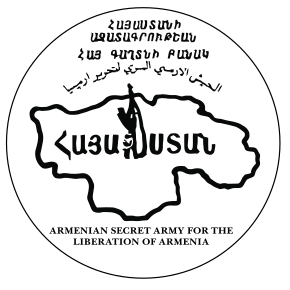
Coat of arms of ASALA - map of Armenia under the Sevres agreement with a hand holding a Kalashnikov assault rifle. The organization’s motto is “Armed struggle and the right political line - the path to Armenia” and “Long live the revolutionary solidarity of the oppressed peoples” [1] .
Israel's invasion of Lebanon in 1982 put an end to ASALA's successful operations. The organization was forced to partially move to Syria , significantly losing its combat potential.
In 1983, the organization split over the admissibility of sabotage leading to mass casualties. The immediate cause of the discussion was the operation at the Paris Orly Airport, which killed seven people. In April 1983, the Armenian National Movement (France) and the Armenian organizations of Great Britain and the United States made a plan to form a Democratic Front as opposed to ASALA . The newly emerged ASALA-Mouvement Révolutionnaire , ASALA-RM (leader Monte Melkonyan , who died during the Armenian-Azerbaijani conflict in Nagorno-Karabakh in June 1993 ), considered “blind” terror as harmful to the cause of the Armenian liberation. After the split, ASALA was subsequently subject to internal conflicts, which led to a reduction in activity.
The last attack ASALA is suspected of carrying out is a bomb blast at the Turkish embassy in Brussels in 1997.
Orly Group
The Orly Group , or Orly Organization , was created in 1981 by Armenian youth living in France with the aim of releasing the arrested members of the ASALA Armenian combat organization. From 1981 to 1982, it conducted several explosions, as a result of which it achieved the fulfillment of specific requirements. Until 1987, the group carried out more than 10 terrorist attacks at airports in different countries, leading to dire consequences. In the ranks of ASALA itself, the attitude towards the organization was extremely opposite, which led to a split in 1983.
Resumption of hostilities
On April 3, 2015, ASALA (Armenian Secret Liberation Army of Armenia) issued a statement warning:
| The organization by the Turkish side and, in particular, by the President of Turkey Erdogan of the festivities on April 24 is perceived both as a challenge to the whole civilized society and as an insult to the memory of 1.5 million dead Armenians. Representatives of those states that on the day of the 100th anniversary of the Armenian Genocide - April 24, 2015 - will attend the celebration planned by Erdogan, in fact, encourage the organizer of the Genocide and the policy of genocide against the peoples. We call on the whole free-thinking society of Turkey and all peoples to oppose this provocation of Erdogan. In the event that Erdogan’s holiday takes place, the Armenian Secret Army for the Liberation of Armenia will immediately discuss a program for resuming hostilities against Turkey. Military Council of the Armenian Secret Army for the Liberation of Armenia [31] |
Basic Operations
The following is a list of ASALA's largest operations from 1970 to the 1990s (see the full list here ):
| date | Region | Operation | Other groups involved in the killing |
|---|---|---|---|
| The explosion of the headquarters of the World Council of Churches. Motive: assistance provided to Lebanese Armenians in emigration to third countries. | |||
| Turkish Ambassador to France Ishmael Erez was killed in his own car near the embassy. During the attack, ambassador driver Talin Ener was also killed. At first, the JSAG took responsibility. Subsequently, someone who called the France Presse agency stated that the murder was the work of ASALA. | |||
| Three militants, bursting into the Turkish Embassy in Vienna, killed the Turkish ambassador Tunaligil and his driver. The militants who managed to escape were armed with automatic weapons fired in Israel, Britain and Hungary. ASALA and the Fighters for justice in relation to the Armenian Genocide (JSAG) took responsibility for the deed. | |||
| The missile bombardment of the Turkish Embassy in Beirut entailed significant damage. | |||
| Numerous sabotage attacks on military and economic objects. | |||
| The first secretary of the Turkish Embassy in Beirut, Octar Syrite, was killed by an ASALA fighter while he was sitting in the reception room on Hamra Street. The gunman hid. | |||
| Three Armenian militants armed with automatic weapons attacked the car of the Turkish ambassador (Zeki Kuneralp) as soon as he left the territory of the embassy. At the same time, the wife of Ambassador Nekla Kuneralp and retired ambassador Besir Bals-oglu were also killed. The driver, Antonio Torres, a Spaniard by nationality, was injured and died during operations in the hospital. On June 3, an anonymous person announced over the telephone that ASALA was taking responsibility for the attack. Later, the same was recognized by the JSAG. | |||
| The bomb was planted in the car of the Turkish consul in Geneva, Niazi Adali. And although he himself was not injured, two other cars were damaged and two Swiss passers-by were easily injured. ASALA claimed responsibility for the explosion. | |||
| Two Armenian militants opened fire on Roshat Morali (labor attaché at the Turkish Embassy in Paris), Teselli Ari (responsible person for religious affairs at the embassy) and Ilkay Karakosh (representative of Anadol Bank in Paris) at the time they left from Moral and got into their cars. The first bullet overtook Teselli Ari. Morales and Karakosh tried to flee. Morale, who wanted to hide in a cafe, was pushed into the street by the owner and shot dead by militants, while Karakosh managed to escape. The militants, who were seen by many people passing by, disappeared. Teselli Ari, who was seriously injured at the very beginning of the attack, died the next day in a Paris hospital. The ASALA Shaan Natalie group claimed responsibility for the killing. | |||
| A group of militants attacked the Turkish embassy in Tehran; two escorts were killed. Two of the militants were captured by local authorities and later executed. | |||
| Operation VAN | |||
| As a result of the explosion, the buildings of the Main Post Office and the City Court of Geneva were destroyed. It turned out that the trial was to take place in this court in the murder case committed by one of the members of ASALA. Responsibility for the explosion, in which one person was slightly injured, was claimed by a group from ASALA on June 9th. | |||
| An Armenian militant attempted assassination of the second secretary of the Turkish Embassy in Rome, Göckber Ergenekon. Ergenekon, wounded in the arm, got out of the car and returned fire at the gunman. The gunman, being wounded, managed to escape from the scene. ASALA claimed responsibility for the assassination attempt in honor of the September 24th Suicide Squad, that is, in honor of the Armenian fighters from ASALA who occupied the Turkish Consulate in Paris. | |||
| At the Paris station "Gare de Lyon" there was an explosion in which one person was injured; Luggage storage facilities were significantly damaged. Subsequently, the responsibility for the explosion took the Armenian organization, calling itself "Orly Organization." | |||
At the same time, bombs exploded in front of three French institutions in Beirut:
In this case, no one was hurt, only significant material damage was inflicted. The Orly Organization claimed responsibility (named after an Armenian arrested at the French Orly airport on charges of using false documents) and demanded the immediate release from custody of Monte Melkonyan, an Armenian of American descent detained in France, who was accused of sabotage. | |||
| Ankara Esenboga Airport was attacked, in which two Armenian militants, armed with a pistol and grenades, opened fire in the waiting room, where a detachment of Turkish military personnel was located. At the airport restaurant, one of the militants seized more than 20 hostages, while the other, meanwhile, was seized by the police. During a shootout with a fighter taking hostages, 9 people were killed (among them there is one American and a citizen of Germany). 82 people were injured. ASALA claimed responsibility for the attack. The gunman Zohrab Sargsyan died. The detained gunman Levon Ekmekjyan was subsequently prosecuted, found guilty and hanged by the Turkish authorities. A poem by Silva Kaputikyan “Rain is coming, son!” Is dedicated to him. | |||
| A French detachment defused a bomb found near a call center in the Paris "seventeenth district." The responsibility was assumed by the Orly Organization. | |||
| Explosions were carried out in front of the cultural and information centers of the Turkish Embassy, as well as the Turkish Travel Bureau (Marmara) in Brussels. The director of travel agencies, an Italian by nationality, was injured in the explosion. | |||
| Operation "Hakob Hakobyan": Armenian militant Mkrtich Madaryan took an action in the world famous "indoor Istanbul market". He was armed with hand grenades and automatic weapons. As a result of this action, they died: several Turks and Madaryan himself, 21 people were injured. | |||
| The attache at the Turkish Embassy in Brussels, Dursun Aksoy, was shot dead in his car. Three groups - ASALA, JSAG and the hitherto unknown organization "Armenian Revolutionary Army" took responsibility for this murder. | |||
| At the box office of Turkish Airlines in Paris at Orly Airport , eight people died as a result of an explosion. Among them are four Frenchmen, two Turks, one American, one Swede. In addition, 60 people were injured. A twenty-nine-year-old Syrian-Armenian named Varujan Karapetyan, who is the head of the ASALA French branch, under pressure admitted his participation in the organization of the explosion, as well as the fact that the bomb was supposed to be detonated on board the aircraft. | |||
A series of planned assassination attempts against Turkish diplomats in the Iranian capital Tehran was undertaken. The following incidents occurred:
| |||
| The attack on the Turkish ambassador to Hungary. | |||
| The explosion at the Turkish Embassy in Brussels. An unknown person reported by telephone that the attack was carried out by the “Gurgen Yanikyan’s military group”, the name used by ASALA. It remains unknown whether the attack was carried out by ASALA itself, by Armenians who are not members of terrorist organizations, or by another terrorist group, for example, the Kurdish Workers Party, which could use Yanikyan’s name for cover |
Memory
A monument to the Secret Army of the Liberation of Armenia was erected in the capital of Armenia, Yerevan, at the central military cemetery Erablur .
Literature
- Ternon Y. La cause Armenienne. Paris, 1983;
- Caspard Armand. Le combat armenien. Entre terrorisme et utopie. Lausanne, 1923-1983. Lausane, 1984;
- Gunter Michael. Pursuing the just cause of their people. A study of contemporary Armenian terrorism. Westport, Connecticut, 1986.
See also
- Terrorist attack in Armenian parliament
- Operation Nemesis
- Bus Explosion Tbilisi - Agdam
- Armenian revolutionary army
- ASALA List of Terrorist Operations
- Fighters for justice regarding the Armenian Genocide
- JSAG terrorist operations list
- Terrorism of Armenian Nationalists
- New Armenian Resistance
Notes
- ↑ 1 2 “Azg” newspaper (Yerevan), Jan 20, 2005
- ↑ 1 2 3 Terrorist Group Profiles. DIANE Publishing, 1989. ISBN 1-56806-864-6, 9781568068640, p. 32
- ↑ Hunsicker. Understanding International Counter Terrorism . - Universal-Publishers, 2006. - P. 431. - ISBN 1-58112-905-X .
- ↑ Roy, Olivier. Turkey Today: A European Nation? p. 170. Roy suggests that the Orly incident led to "dissension end [ing] in the settling of scores in which ASALA militants killed each other in their camp at Bekaa (Al-Biqa, Lebanon) ... (It) practically disappeared. "It resurfaced once again, however, to assassinate important members of the Lebanese section of the Dashnak Party (March 1985 - May 1986)."
- ↑ John E. Jessup. An encyclopedic dictionary of conflict and conflict resolution, 1945-1996. Greenwood Publishing Group, 1998. ISBN 0-313-28112-2 , ISBN 978-0-313-28112-9 , p. 39
- ↑ Michel Wieviorka, David Gordon White. The making of terrorism. University of Chicago Press, 1993. ISBN 0-226-89650-1 , ISBN 978-0-226-89650-2 , p. 256
- ↑ Bruce Hoffman. Inside terrorism. Columbia University Press, 2006. ISBN 0-231-12699-9 , ISBN 978-0-231-12699-1 , p. 71
- ↑ Arthur E. Gerringer. Terrorism: From One Millennium to the Next. - 2002. - S. 239. - 548 p. - ISBN 0595242863 , 9780595242863.
ASALA is an ethnic terrorist organization founded in 1975 on Marxist-Leninist ideology and has generated associations with leftist and separatists groups worldwide, to include the Abu Nidal Organization and the Red Army Faction
- ↑ Rouben Paul Adalian. Historical Dictionary of Armenia. - Scarecrow Press, 2010 .-- S. 169. - 750 p. - ISBN 9780810874503 .
Armenian Secret Army for the Liberation of Armenia (ASALA). Clandestine terrorist organization.
- ↑ Terrorist Group Profiles . - DIANE Publishing, 1989 .-- S. 32 .-- 131 p. - ISBN 9781568068640 .
- ↑ Gérard Chaliand and Arnaud Blin. The History of Terrorism from Antiquity to Al Qaeda. - University of California Press, 2007. - S. 38. - ISBN 978-0-520-24533-4 .
- ↑ Harvey W. Kushner. Encyclopedia of Terrorism. - Sage Publications, 2003 .-- S. 46. - ISBN 0-7619-2408-6 .
- ↑ 1 2 3 Sean K. Anderson, Stephen Sloan. Historical Dictionary of Terrorism. - The Scarecrow Press, Inc., 2009. - S. 48. - ISBN 978-0-8108-5764-3 , 978-0-8108-6311-8.
- ↑ Thomas de Waal. Great Catastrophe: Armenians and Turks in the Shadow of Genocide. - Oxford University Press. - S. 265.
- ↑ 1 2 Laura Dugana, Julie Y. Huang, Gary LaFree, Clark McCauley. Sudden desistance from terrorism: The Armenian Secret Army for the Liberation of Armenia and the Justice Commandos of the Armenian Genocide. - Taylor & Francis, 2008 .-- S. 231-249.
- ↑ Bonnie Cordes, Bruce Hoffman, Brian M. Jenkins, Konrad Kellen, Sue Moran, William Sater. Trends in International Terrorism, 1982 and 1983. - RAND , 1984. - S. 5.
- ↑ Anthony Kellett, Bruce Beanlands, James Deacon. Terrorism in Canada 1960-1989. - S. 65-66. - ISBN 0-662-18303-7 .
- ↑ Political dissent: an international guide to dissident, extra-parliamentary, guerrilla, and illegal political movements, by Henry W. Degenhardt, Alan John Day, Gale Research Company, 1983, p. 489
- ↑ Remembring with Vengeance, by Pico Iyer // Time magazine, No. 32, 8 Aug, 1983
- ↑ The Caucasus: an introduction, by Frederik Coene, 2009—238 pages, p. 221
- ↑ The history of Turkey, by Douglas Arthur Howard - 2001—241 pages, p. 161
- ↑ Untold Histories of the Middle East, by Amy Singer, Christoph Neumann, Selcuk Somel - 2010—240 pages, p. 27
- ↑ United States Department of State. Patterns of Global Terrorism Report: 1989 , p 57
- ↑ US Department of State. Appendix B // Patterns of Global Terrorism Report - 1996 .
- ↑ Terrorist Group Profiles. DIANE Publishing, 1989. p. 32
- ↑ Pitman, Paul M. Turkey: A Country Study . Washington, DC: The Federal Research Division of the Library of Congress, 283, 354–355
- ↑ Armenian Secret Army for the Liberation of Armenia (ASALA) Archived July 15, 2015.
- ↑ 1 2 Harvey W. Kushner. Encyclopedia of terrorism. SAGE, 2002. ISBN 0-7619-2408-6 , 9780761924081, p. 47
- ↑ The Spyurk magazine (Beirut, in Armenian), No. 1-12, 2005, p. 3
- ↑ Pico Ier, Remembering Revenge // The Times Magazine (USA), No. 32, Aug 8, 1983
- ↑ ASALA threatens with actions against Turkey // First Armenian Information Channel.
<ref> with the name "autogenerated1" defined in <references> is not used in the previous text.