Nastia , or persistent movements (from other Greek: σπαθητός 'condensed') - movements of the dorsoventral organs of plants, which are caused by the characteristics of the plant itself and are manifested when exposed to environmental factors (temperature, light, humidity, etc.). Unlike tropisms , nastia are faster and occur in response to undirected, dispersed in the environment stimuli [1] . A common cause of Nastia is a change in the concentration of calcium and chlorine in plant tissues.
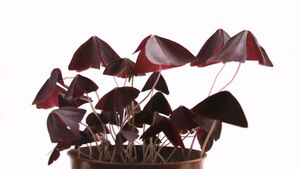 Play media file
For example, saffron and tulip flowers open and close in response to a change in ambient temperature (thermonastia). In heat, the growth of the inner side of the petals is accelerated - and the flowers open, and in cold weather, the growth of their outer side is accelerated - the flower closes.
The daily rhythms of opening and closing flowers and inflorescences are directly related to nastia. For example, goat breeder's baskets opened early in the morning usually close by 10–11 o’clock, and the flowers of a white water lily , on the contrary, are open only during the day. Corresponding infusions are caused by changes in temperature and humidity occurring during the day [2] .
Infusions not associated with tissue growth processes are caused by changes in the cells themselves. An example is the so-called "sleep of leaves" of sour ; its triple leaves under diffused light are located in a horizontal plane, but when exposed to sunlight, they quickly add up to an "umbrella" (photonastia and thermonastia). The leaves of the shy mimosa are folded with various kinds of tremors (seismic) and even with a light touch; while petioles of complex cirrus leaves of this plant wilt. Seismonastia not only protects the organs of the plant, but can also have important adaptive value: the opening of tobacco flowers in the evening is caused by the appearance of insects pollinating these plants, and in the insectivorous sundew the nasal movements of the leaf plate covered with mucus secreting glandular hairs occur upon landing on this the insect plate, and after it has stuck to the mucus, the leaf edges quickly close, and the process of digesting the victim begins (this is how the sundew gets nitrogenous food) [2] .
Nastia is usually divided into positive and negative. In the mornings, under bright sunlight, dandelion inflorescences-baskets open, and when the illumination decreases, they close (positive photonasty). The flowers of fragrant tobacco open in the evening, with a decrease in illumination. This phenomenon is called negative photonastia.
Classification
For various types of nastic movements, specific terms are used:
- Autonomies are spontaneous rhythmic movements of leaves that are not associated with changes in external conditions.
- Niktinastias are plant movements associated with a combined change in both light and temperature. Such a combined effect occurs during day and night shifts. An example is leaf movement in some legume species.
- Seismonastia - movements caused by touch, concussion, etc.
- Thermonastia - movements that are caused by changes in temperature.
- Turgor movements - are associated with a change in turgor . These include nictinistic leaf movements. So, the leaves of many plants are also characterized by rhythmic movements associated with a change in turgor in the cells of leaf pads.
- Photonastia - movements that are caused by a change in illumination.
See also
- Plant movements
- Taxis
- Tropisms
Notes
- ↑ Lotova, 2001 , p. 15-16.
- ↑ 1 2 Lotova, 2001 , p. sixteen.
Literature
- Biological Encyclopedic Dictionary. / Ch. ed. M.S. Gilyarov; Editorial: A.A. Babaev et al. - 2nd ed., rev. - M .: Owls. Encyclopedia, 1986.
- Biology. Modern illustrated encyclopedia. / Ch. ed. A.P. Gorkin. - M.: Rosman, 2006.
- Lotova L.I. Morphology and anatomy of higher plants. - M .: Editorial URSS, 2001 .-- 528 p. - ISBN 5-8360-0140-5 .