Red-necked caterpillar [1] ( lat. Conopophaga lineata ) is a species of passerines from the caterpillar family (Conopophagidae) [2] . It lives in the undergrowth and shrubs in eastern Brazil from the north of the state of Rio Grande do Sul to Ceara . Its range also extends to eastern Paraguay and northeastern Argentina , and has recently been noted in Uruguay . This bird is often difficult to catch and notice, but it is more common and less shy than other caterpillars .
| Red-necked Caterpillar |
 |
| Scientific classification |
|---|
| No rank : | Bilateral symmetric |
| Suborder : | Screaming passerines |
| View: | Red-necked Caterpillar |
|
| International Scientific Name |
|---|
Conopophaga lineata
( zu Wied-Neuwied , 1831 ) |
| Security status |
|---|
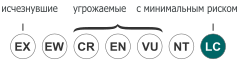
Least concernIUCN 3.1 Least Concern : 22734381 |
|
The Red-throated Caterpillar is a small, plump bird, 13 cm long, with a short tail and rather long legs. The plumage is mostly reddish brown. Above the eye there is a white (gray in females) strip, which ends at a tuft of feathers. Voice - a series of quiet squeaks, which gradually become fast and loud. At dusk and dawn, the males, using their feathers, create a buzzing sound as they fly over their territory.
Red-necked caterpillar hunts, rapidly moving from one height to another through the undergrowth at the surface of the earth. When a bird notices an insect , it makes a short flight down to the ground or near the upper leaves to catch it.
The nest is built from branches and moss on a tree in the form of a bowl. The female lays two dark-colored eggs of oval or slightly conical shape.
The number of subspecies is unclear, but, as a rule, three are generally recognized: Conopophaga lineata lineata , Conopophaga lineata vulgaris and Conopophaga lineata cearae . The latter subspecies lives in the northeast of Brazil, and differs from other birds in both vocalization and morphology . It has a darker, orange-yellow color and there is no (or almost no) white crescent visible on the upper chest of the remaining subspecies. In the 21st century, it is considered as an independent [2] species of Conopophaga cearae .