Thyroid cecropia , tubular tree ( lat. Cecropia peltata ) is a fast-growing tropical tree , a type species of the genus Cecropia of the Nettle family ( Urticaceae ).
| Thyroid cecropia |
 |
| Scientific classification |
|---|
|
| International scientific name |
|---|
Cecropia peltata L. , 1759 |
| Synonyms |
|---|
- Ambaiba humboldtiana ( Klotzsch ) Kuntze
- Ambaiba peltata ( L. ) Kuntze
- Ambaiba propinqua ( Miq. ) Kuntze
- Ambaiba schiedeana ( Klotzsch ) Kuntze
- Ambaiba surinamensis ( Miq. ) Kuntze
- Cecropia arachnoidea pittier
- Cecropia argentea Vis.
- Cecropia asperrima pittier
- Cecropia dielsiana Snethl.
- Cecropia goodspeedii Cuatrec.
- Cecropia hondurensis Standl.
- Cecropia humboldtiana Klotzsch
- Cecropia propinqua Miq.
- Cecropia scabrifolia varicht.
- Cecropia schiedeana klotzsch
- Cecropia surinamensis Miq.
- Coilotapalus peltata britton
|
|
Content
The plant naturally grows in tropical regions of America from areas of southern Mexico through all of Central America to the northern regions of South America, found on the islands of Trinidad and Tobago , in Jamaica . The plant was imported to Africa, Asia and the Pacific. This species has been named one of the hundred worst invasive alien species. [2]
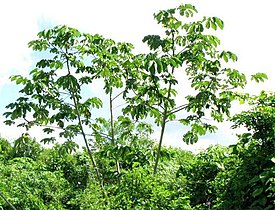
Evergreen trees with an upright hollow trunk up to 15 meters high (in some cases, the plant can reach 25 meters in height) and with an umbrella-shaped crown.
The leaves are whitish, shiny, planted on long (20-50 cm) petioles, leaf blades 7-10-palmately divided lobed, large, usually 20 × 20 cm in size. The lower surface of the leaves is covered with small hair. The branches of green are covered with hard hairs.
The plant is dioecious , male flowers are small (1-1.5 mm), female are larger (3-5 cm in length).
Native Americans have traditionally used plant stems to make wind tubes . In this connection, the plant is known under the second non-botanical name trumpet tree . Tree trunks split in half are used as gutters.
The plant is among the myrmecophiles . Ants often settle in the cavities of the branches and trunks of the plant, and at the same time feed on the juice and soft tissues of the plant, but in return provide plant protection from pests.
