Terrence Mitchell Riley [1] ( born Terry Riley ; born June 24, 1935 , Colfax ) is an American composer and musician whose work is classified as minimalism [2] . A significant influence on him had jazz and Indian classical music .
| Terry Riley Terry iley | |
|---|---|
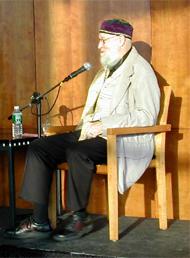 | |
| basic information | |
| Full name | Terrence Mitchell Riley |
| Date of Birth | June 24, 1935 (84 years old) |
| Place of Birth | Colfax , California , USA |
| A country |  USA USA |
| Professions | musician , composer |
| Years of activity | since 1964 |
| Instruments | electric organ , saxophone , piano |
| Genres | minimalism |
| Labels | CBS Records, Elision Fields, Cortical Foundation |
| Awards | Guggenheim Fellowship |
| terryriley.net | |
Biography
Terry Riley was born in Colfax , USA. He studied at Shasta College , the University of San Francisco and at the San Francisco Conservatory , then received a Master of Arts degree from the University of California, Berkeley ( USA ).
He took part in the San Francisco Tape Music Center experimental Center for Film Music, working with Morton Sabotnik, Steve Reich , Pauline Oliveros and Raymond Sender. However, the greatest influence was exerted on him by Pandit Pran Nath, a master of classical Indian singing. While studying with the latter, Riley repeatedly traveled to India to learn to play and accompany on the scoreboard , tambour and learn to sing. In the 1960s, he also traveled extensively in Europe, moonlighting as a taper [3] [4] . Since 1971 he taught Indian classical music at Mills College , the California Institute of Arts, New Delhi. In 2007, Riley received an honorary doctorate in music from Chapman University .
In the 1960s, Riley gave his famous “all-night concerts”, in which he performed mainly improvisations, from evening until dawn, using the old harmonium and a vacuum cleaner connected to it so as not to pedal the fur, as well as the saxophone. When, after many hours of playing, he needed a break, he included fragments of a saxophone record with a delay . Riley gave such concerts for several years in a row. Spectators visited their families, bringing with them folding chairs and sleeping bags.
Riley mentions John Cage and “really outstanding chamber ensembles of John Coltrane and Miles Davis , Charles Mingus , Bill Evans and Gil Evans ” [5] , as influenced by his work, which testifies to the combined influence of the music of the East, Western avant-garde and jazz music.
Many years of collaboration with the Kronos Quartet began when Riley met the founder of the band, David Harrington, at Mills College. During his career, Riley has written 13 string quartets for the Kronos Quartet, among other works.
Riley wrote his first composition for the orchestra, Jade Palace in 1991, and subsequently wrote to order several more compositions for the orchestra.
Currently, Riley performs and teaches both as a solo piano player and as an Indian raga singer. In May 2011, he was invited by Animal Collective to perform at the All Tomorrow's Parties festival [6] .
Terry Riley has a son, Gian, who plays the guitar [7] .
Music Style
His early work was influenced by Karlheinz Stockhausen , but after his first acquaintance with the works of La Monte Young , in whose Theater of Eternal Music he later played in 1965-1966, his style changed. The String Quartet (1960) was the first work in a new style; later a string trio followed, where he first used cyclical short musical phrases. This composition is considered the first in which for the first time in a notated text a rehearsal of short phrases is introduced as an element of the minimalism technique [8] .
In the 1950s, he already worked with “ tape loops ” ( English tape loops ), then still a new technology, and later did not stop working with magnetic tape to create musical effects both in the studio and in live performances. In his early “film” play The Gift ( “Gift” , 1963), the pipe of Chet Baker sounds. He composed both plays in a natural order and microtonal plays.
In addition to working with the Kronos Quartet , Terry Riley at various times collaborated with Rova Saxophone Quartet , Pauline Oliveros ( English Pauline Oliveros ) and ARTE Quartett .
Terry Riley’s creativity and numerous ideas have influenced many other musicians, including John Adams , Brian Eno , Robert Fripp , Philippe Glass , Mike Oldfield , Frederic Rzewski, Tangerine Dream and The Who .
In C (1964)
Riley’s music is characterized by improvisation with sequences of musical phrases of various lengths. For example, the play In C (1964), the idea of which was born in San Francisco on the bus on the way to work [9] , consists of 53 separate parts (phrases), most of which are equal to one measure, each of which contains its own musical drawing, but each, as the name implies, is played "in tone up".
One of the performers, setting the tempo, is responsible for the even pulsation of the “do” note on the piano keyboard. The remaining musicians, the number of which, as well as the number of instruments, are not intentionally specified, play the musical sequences described above, following perhaps the mean notes to the text. Performed one after another, 53 phrases are superimposed, merged and echoes in the course of the performance of the work.
For the first time, the play In C was performed by Steve Reich , John Gibson, Pauline Oliveros and Morton Sabotnik.
Published in 1968 on the Columbia Records label , the play In C became the foundation on which minimalism in music was built [9] .
A Rainbow in Curved Air (1967)
The famous electronic album A Rainbow in Curved Air (recorded in 1967–1968, released in 1969) inspired many of the later electronic music pieces, including the synthesizer parts of Pete Towndsen in The Baba O'Riley and Won't Get Fooled Again by The Who , who were later dedicated to Terry Riley and Meher Babe , [10] as well as the composition of Tubular Bells (1973) by Mike Oldfield .
Using the effect of "overlay" ( English overdubbing ), in the title play, Riley uses an electric organ , electro - harpsichord , darbuku and tambourine . Starting with a minimalistic buzz, the composition quickly develops into an exciting complex game of musical phrases and drawings. In the second play of the album, Poppy Nogood and the Phantom Band , Riley plays the soprano saxophone .
The album had a significant impact on the formation of minimalist music, the development of ambient , progressive rock , new age , and preceded electronic jazz fusion by Miles Davis , Herbie Hancock and others.
The title track of the album sounds in the computer game Grand Theft Auto IV ( The Journey radio station). Partially, the music from the album was used in the radio show " Hitchhiker 's Guide to the Galaxy " by Douglas Adams on BBC Radio 4 .
Discography
- 1963: Music for The Gift
- 1965: Reed Streams
- 1969: A Rainbow in Curved Air
- 1968: In C
- 1970: Church of Anthrax , with John Cale
- 1972: Persian Surgery Dervishes
- 1975: Descending Moonshine Dervishes , Kuckucku Records
- 1978: Shri Camel for organ -solo in - game with delay
- 1984: Terry Riley: Cadenza on the Night Plain , together with Kronos Quartet
- 1985: No Man's Land
- 1986: The Harp of New Albion , for piano in kind
- 1987: Chanting the Light of Foresight , with Rova Saxophone Quartet in- kind
- 1989: Salome Dances for Peace for Kronos Quartet
- 1998: Piano Music of John Adams and Terry Riley , performed by Gloria Chen
- 2002: Sun Rings for Kronos Quartet
- 2004: The Cusp of Magic , with Kronos Quartet
- 2008: Banana Humberto , piano concert with the Paul Dresher Ensemble ( English en: Paul Dresher )
- 2010: Two Early Works , the first recording of Riley’s two early writings by Calder Quartet
- 2012: Aleph
Filmography
Notes
- ↑ Family Tree Legends
- ↑ B. Grebenshchikov considers Riley the founder of minimalism. See Boris Grebenshchikov. Serious Music . Aerostat No. 109 (June 17, 2007). Date of treatment January 25, 2013. Archived on February 6, 2013. .
- ↑ A virtuoso keyboard player, Riley supported himself as a composer until the late 1960s mostly by playing in piano bars. Cit. By: Strickland E. Riley // The New Grove Dictionary of Music and Musicians . Vol. 21. L .; NY, 2001.
- ↑ Unable to win any prizes or grants to study in Europe, Riley went there, nevertheless, in 1962. He lived briefly in Spain and then for almost two years in Paris, composing little, playing in bars and air force officers' clubs and serving as a driver and accompanist for carnival-like variety shows. ibidem
- ↑ Like a Rainbow in Curved Air. Terry Riley . Bluefat.com Date of treatment January 25, 2013. Archived on February 6, 2013.
- ↑ ATP: All Tomorrow's Parties
- ↑ Terry And Gyan Riley: Together IN C: NPR . Date of treatment January 28, 2013. Archived on February 6, 2013.
- ↑ ... the String Trio (1961), in which the repetition of short phrases was for the first time introduced into notated minimalism. ibidem
- ↑ 1 2 Kristen Grimshaw. Terry Riley . AllMusic.com. Date of treatment January 25, 2013. Archived on February 6, 2013.
- ↑ Notes on The Who: The Ultimate Collection by The Who, pp. 12. MCA Records, 2002.
Links
- Official site
- Terry Riley . Date of treatment January 25, 2013. Archived on February 6, 2013. (eng.)
- Terry Riley . Date of treatment January 25, 2013. (English)
- Terry Riley in UbuWeb Sound unopened . Date of treatment January 25, 2013. Archived on February 6, 2013. (eng.)
- Terry Riley: sheet music by International Music Score Library Project
- Boris Grebenshchikov. Serious Music . Aerostat No. 109 (June 17, 2007). Date of treatment January 25, 2013. Archived on February 6, 2013.
- Library of Babylon IV - Music of the Void. My discovery of Terry Riley (June 5, 2008). Date of treatment January 25, 2013. Archived on February 6, 2013.
- Andrey Gorokhov. Terry Riley (2005). Date of treatment January 25, 2013. Archived on February 6, 2013.
- Terry Riley . Long Hands Records. Date of treatment January 25, 2013. Archived on February 6, 2013.
- Oteri, Frank J. Terry Riley: Obsessed and Passionate About All Music . NewMusicBox - People & Ideas in Profile (1 June 2001). - interview of February 16, 2001, (with video). Date of treatment January 25, 2013. Archived on February 6, 2013.
- Gammal Haggerty, Ammon Haggerty. Terry Riley “Rhythmos” (October 9, 1992). Date of treatment January 25, 2013. Archived on February 6, 2013.
- Ekaterina Biryukova. Break away from the piano . Izvestia (October 12, 2005). Date of treatment January 28, 2013. Archived on February 6, 2013.