Zhu Haogu ( Chinese 朱 好 古 ; worked at the end of the 13th - first half of the 14th centuries) is an outstanding Chinese monumental artist.
| Zhu Haogu | |
|---|---|
| Chinese 朱 好 古 | |
| Date of Birth | 13th century |
| Place of Birth | Xianglin |
| Date of death | XIV century |
| Nationality | China |
| Genre | monumental artist |


Content
Historical Information
The name of this master was forgotten for a long time, and rediscovered only in the 20th century. In 1938, the Canadian scholar William White (1873-1960) sent two students to explore the Chinese Xinghua Monastery , on the wall of which they read the inscription mentioning “Zhu Haogu huihua daizhao” (Zhu Haogu, an artist - daizhao) [1] , which was one of authors of the murals of the monastery.
Later, researchers found his name in four messages from various local newspapermen . In Xiangling Xianzhi, for example, the following is reported: “Zhu Haogu, a native of this district, was adept at portraying landscapes and human figures. He, Zhang Maoqing and Chan Yunzhui, also natives of this district, were known for their paintings, which people collected and cherished as treasures. ”
Pingyang Fuji, the newspaper journalist of Pingyang Prefecture, to which Xianglin County belonged, puts Zhu Haogu in first place in the Yuan Four (that is, among the four celebrities of the prefecture, one of whom was the well-known soothsayer Tian Zhongliang (1243–1317), the other the doctor Liang Zhoutai, who became famous for his art, had the status of the Medical Director of the Pinyang District in the Zhizheng era (1341–1367), and the third, Sun Gu, was a Confucian who excelled in a variety of commercial affairs, for which he received the nickname “Mr. Knowing Everything”), the newspaperman reports: "Zhu Ha Gu, a native of Xiangling, was skilled in landscape painting and figure painting.His skillfully executed works were filled with lively spirit.He and two other natives of this district - Zhang Maoqing and Yang Yunzhui were known for their paintings, which (people) collected and cherished as sacred disks “bi.” They became famous as “Three Masters of Painting from Xiangling.”
In the Shanxi Tungzhi newspaper, Zhu Haogu is the third on a list of twenty-two personalities who have become famous for a wide variety of talents in Shanxi Province. His name also appears when it comes to local monasteries: “(monastery) Xuzhen guan is located on a high embankment near the South Gate in Taiping County. Its walls are painted with figures executed by the yuan Zhu Haogu. "His brush is so divine and magnificent (that it seems he is capable of) depicting a dragon that will fly away if his eyes are drawn."
This is all that is known about the artist from written sources. The dates of his birth and death are not known. Moreover, the period of his creative activity does not have a firmly established time frame. Students read the inscription on the wall of the Xinghua Monastery so that Zhu Huagu and his disciple Zhang Boyuan finished painting in the "eighth month of the Qinsheng of the Great Yuan State." This corresponded to 1238, but was erroneous, since the state of Yuan did not exist in 1238. In the future, the error was corrected, as it turned out that we are talking about the "Year of the Great State of the Yuan", which, according to experts, in any case fell on the period until 1321 (presumably in 1298). Later, an American researcher Nancy Steinhardt published an article in which she claimed that “the year of usui” corresponds to 1358, since there are inscriptions in the famous Yongleong Temple that mention the artist’s name under this date. Steinhardt's argument boiled down to the fact that since the painting of this temple was completed in 1358, then Zhu Haogu could hardly be a mature artist in 1298 to have a student and paint the Xinghua Monastery - a lag of 60 years is too big. On the other hand, she doubted that the Xinghua Monastery was painted in 1298, since in 1303 there was a strong earthquake that destroyed the nearby monasteries, and therefore the murals were sure to die, while they were well preserved [2] . The curator of the Chinese department of the Royal Ontario Museum, Ka Bo Tsang, who dedicated a special study to Zhu Haogu (1992), believes that the master worked in the last two decades of the XIII and the first two decades of the XIV century, as the newspaper journalist Pinyang Fuji mentions him among the celebrities who lived precisely in this period [3] . Chinese expert Meng Xihui, who studied the frescoes of the Taoist Yongleong Temple (2007), concluded that Zhu Haogu worked in the first half - mid-14th century.
Creativity
From Zhu Haogu not a single pictorial scroll was preserved, either on silk or on paper. No landscape works of the artist were preserved, and therefore it is impossible to determine what stylistic tradition in the landscape he followed. All that is today is preserved monumental paintings of temples and monasteries with images of Buddhist and Taoist deities, performed by Zhu Haogu himself with his students, or his workshop, or followers. His absolute originals are the murals of the Taoist temple of Xuzhenguan in Taiping County and the Xinghua Buddhist monastery in Jishan. Since he took on large orders, he probably had a rather large workshop. The story has preserved eight names of his followers, six of which came from different areas of the southwest of Shanxi province (they are mentioned on the southern wall of Chunyandyan - Hall of Pure Joy in the Taoist Yongleong Temple in Richeng, Shanxi Province): Li Hongyi from Richeng, Wang Shiyan from Longmen, Wang Chun from Gufeng, Zhang Zongli from Jianyang, De Xin from Xintian, and Cao Demin from Dongxiang. The geography of these names reflects the fact that Zhu Haogu's work in Shanxi is widely known. He probably painted many temples in this province during his life, but today it is impossible to establish either their number or their names.
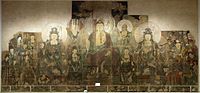
The Xinghua Monastery, in which an inscription with the name Zhu Haogu was found, was destroyed, but before that, William White, the curator of the Chinese department of the Royal Ontario Museum in Toronto, was able to take out a large mural depicting "Paradise Maitreya." It was sawn into 63 fragments, in 1928 it was transported by ship to Canada, and by 1933 it was restored and exhibited in the museum (its size is 5.02 x 11.01 m). Zhu Haogu wrote it together with a student Zhang Boyuan. Maitreya , the Buddha of the Future, is depicted surrounded by arhats , bodhisattvas and guardians of the doctrine. The fresco also depicts a king, with his head shaved, accepting Buddhism. Another large composition from this monastery before its destruction was sent in the same manner to the Beijing Gugun Museum, it depicts the "Cathedral of the Seven Buddhas." The dating of these frescoes is not exactly established. Experts in the 1980s-1990s believed that they were created in 1298. The Chinese scholar Meng Xihui, a specialist in Chinese mural painting, in a work published in 2007, argues reasonably that the murals of this monastery should not be attributed to 1298, but to the period of approx. 1320 year.
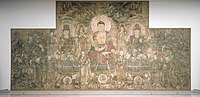
Based on the style of these works, experts came to the conclusion that two frescoes from the lower monastery of Guangshengs in Prov. Shanxi also belong to the brush of Zhu Haogu, or, at least, made by the artists of his workshop. Like the Canadian Maitreya Paradise, these murals were sawn into pieces, loaded onto a ship and sent to the United States. One of them, Bhaysajyaguru Paradise, is located in the Metropolitan Museum of Art , New York, and is 7.52 x 15.11 m in size, and the other, Tejaprabhi Buddha Paradise, is housed in the Nelson Atkins Museum , Kansas City (14.6 x 7 m). Both works are ceremonial portraits of a deity surrounded by a retinue of celestials: in the first case, the Buddha of Healing, in the second Buddha of Bright Light. Despite the fact that both frescoes were located in the same hall of the temple, traditionally these deities were not interconnected, so researchers have no answer to the question why Zhu Haogu placed them next to each other. According to the established iconography, Maitreya Buddha is surrounded by Avalokiteshvara , Chintamanichakra , Chandraprabha , Suryaprabha , etc., worshiping believers, defender generals, apsaras , and less significant entourage figures. Represented in a fresco from the Nelson-Atkins Museum, the Buddha Tejaprabha , according to Buddhist texts, is associated with the constellations and five planets of Chinese astronomy, so he is surrounded by figures symbolizing different celestial bodies; in particular, the bodhisattvas to his right and left symbolize the sun and moon. Buddha Tejaprabha was a protector from natural disasters, and therefore worshiping him in Shanxi province, in which devastating earthquakes occurred in the 14th century, made special sense. Both paintings, according to experts, were performed between 1309 and 1320.
Zhu Haogu is credited with creating frescoes in the famous Taoist Yongleong Temple, the largest Taoist mural monument in China. The total area of painting on its walls is 880 m². The temple consists of four halls, which are built on the same axis: Wuji, Sanqing, Chunyang and Chunyang. Two of them are best known for their paintings - Sanqing (Hall of the Three Most Pure) and Chunyang (Hall of Pure Joy). In the Hall of the Three Cleanest on all four walls, a large frieze depicts a procession of Taoist deities. Researchers have counted in these divine assemblies about 290 different characters of the Taoist pantheon . It is believed that this painting is the most complete “group portrait” of Taoist deities, preserved from the Yuan era.
The Hall of Pure Joy is painted with stories on the life of the Taoist immortal Lu Dongbin (Yongleong Temple was built on the site where the shrine of Lu Dongbin used to be, so a separate hall is dedicated to it). The walls depict a variety of stories from the life of a Taoist saint, accompanied by cartouches with explanations. In the same room there is an inscription left by the artists, which says that the paintings were completed in 1358 by Zhang Zunli and Li Hongyi, members of the workshop of Zhu Haogu. In the fourth hall - Chongyang (Hall of Double Joy) there are no inscriptions with the names of artists, however, the date of the stele is 1368. It is believed that this is the end date of all the paintings in the temple. The degree of participation of Zhu Haogu himself in these paintings is unknown, which causes discussions about whether he was alive in the 1350s-1360s or not, whether he could manage his workshop during these works, or not, etc. .
Zhu Haogu was an outstanding master of monumental painting in Shanxi, the creator of the local school of painting, which dominated the region throughout the fourteenth century. However, this school did not have influence in the rest of the Yuan Empire. Imperial art, subsidized and supported by the Mongol dynasty, spread in a powerful stream from the capital Dadu and penetrated into the most remote corners of the empire. Not far from Shanxi in the mountains of Uta, the leading court architect Anige, who came from Nepal, built temples in the capital's court style. Paintings made in the Yuan metropolitan style penetrated Shanxi, however, it did not seem to have a noticeable effect on local art. During the reign of the Mongols in the capital of religious painting, the strong influence of modern art of Nepal was cultivated, which in turn was based on the Indian tradition of Buddhist art of the late period of the Pala Sen dynasty of the 11th-12th centuries. In contrast, the style of the Zhu Haogu school was based, on the one hand, on the old tradition of depicting deities coming from Wu Daozi (680-740), on the other hand, relied on the art of the Khitan dynasty Late Liao (907-1125) and the Jurchen Jin dynasty ( 1115-1234), which before the conquest by the Mongols ruled in the north of China. In fact, the art of Zhu Haogu School was the last wave of influence of the artistic tradition of Liao and Jin in Chinese painting, the latest in time, but not in terms of results.
Notes
- ↑ The term “daijao” was coined during the Han Dynasty (206 BC - 220 AD); then they were designated the scientists who were gathering on the Golden Horse Bridge in order to give advice to the emperor when he needed their advice. During the Tang Dynasty (618–907), daijao was called one of the highest ranks at the Hanlin Academy . Under Southern Tang (937–75) and the Five Dynasties (907–960), a painting department was established, which became a division of Hanlin Academy. During the Song Dynasty (960–1279), this position was preserved and the term “daijao” began to designate an artist of high rank. In the Yuan period (1271–1368), the Hanlin Academy was reformed, renamed Hanlin, Guoshi Yuan (Hanlin Institute of National History), and the term “daijao” disappeared from official documents. But it began to be used in everyday language to express respectful attitude to the masters of their craft: artists, geomancers, doctors, etc. In Chinese literature, there are cases when even blacksmiths were called “daichao”.
- ↑ Steinhardt, Nancy S. Zhu Haogu Reconsidered: A New Date for the Rom Painting and the Southern Shanxi Buddhist-Daoist Style. Artibus Asiae. (1987) Volume XLVIII (1/2) pp. 5-38
- ↑ Ka Bo Tsang. Further Observations on the Yuan Wall Painter Zhu Haogu and the Relationship of the Chunyang Hall Wall Paintings to "The Maitreya Paradise" at the ROM Artibus Asiae Vol. 52, No. 1/2 (1992), pp. 94-118
Sources
- Anning Jing. The Yuan Buddhist Mural of the Paradise of Bhaisajyaguru. Metropolitan Museum Journal. (1991) Volume 26, pp 147–166
- William Watson. The Arts of China 900-1620. Yale University Press 2000, pp. 161–173
- Watt, James CY The World of Khubilai Khan. Chinese Art in the Yuan Dynasty. NY - London, 2010. pp 89–90, 143, 139–140.
- Lennert Gesterkamp The Heavenly Court: Daoist Temple Painting in China, 1200-1400 published with Brill in Leiden, 2011
Bibliography
- Lippe, Aschwin. 1965. Buddha and the Holy Multitude. The Metropolitan Museum of Art Bulletin. 23 (9): p. 325-335.
- Ka-bo, Tsang. 1979. Royal Ontario Museum, Far Eastern Department. Arts of Asia. 9 (2): Chinese Paintings.
- Steinhardt, Nancy S. "The Chinese Rotunda." Arts of Asia. 2008.38 (5): pp 83–95.
- Steinhardt, Nancy S. 1987. Zhu Haogu Reconsidered: A New Date for the Rom Painting and the Southern Shanxi Buddhist-Daoist Style. Artibus Asiae. Volume XLVIII (1/2)
- Jing, Anning. The Yuan Buddhist Mural of the Paradise of Bhaisajyaguru. Metropolitan Museum Journal. 1991. Volume 26: 147-166.
- Baldwin, Michelle. Monumental Wall Paintings of the Assembly of the Buddha from Shanxi Province: Historiography, Iconography, Three Styles, and a New Chronology. Artibus Asiae. 1994.54 (3/4): 241-267.
- Ka Bo Tsang The Paradise of Maitreya: A Yuan Dynasty Mural from Shanxi Province, Orientations, Volume 37 Number 3, April 2006.