Madagascar shepherds [1] [2] [3] , or mesitic [1] , or mesitic [2] ( lat. Mesitornithidae ) , is a small family of birds , the only one in the order of mesitiform [1] (Mesitornithiformes). All species are endemic to the island of Madagascar .
| Madagascar shepherds |
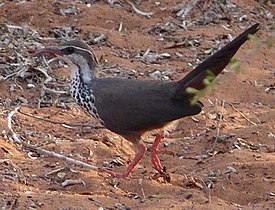
Monia male |
| Scientific classification |
|---|
| No rank : | Bilateral symmetrical |
| Squad: | Mesitoid ( Mesitornithiformes ) |
| Family: | Madagascar shepherds |
|
| International scientific name |
|---|
Mesitornithidae Wetmore , 1960 |
|
Currently, Madagascar shepherds, relying on molecular data , are singled out in an independent squad. Previously, they were either attributed to the shepherd's family (Rallidae), or were classified as chicken (Galliformes). The mesitic ones have a partial anatomical similarity to shepherd's ones (manifested, for example, in the structure of the sternum). However, there are differences between these families - for example, the presence of five pairs of bundles of powder fluff, not characteristic of shepherd’s, and the absence of permeable nasal openings. Like other animals of Madagascar, Madagascar shepherds were the result of an ancient evolutionary branch from other species and for a long time developed separately.
All three mesitic species are included in the International Red Book as rare species. The population decline is due to a decrease in area and a deterioration in the quality of natural habitats.
Content
The average size of the bird, of the length is 30-32 cm. The physique is somewhat unusual for birds - a cylindrical shape, with a magnificent under-tail plumage and a long, wide tail . The wings are short, rounded; legs are well developed. The beak is curved. Sexual dimorphism (visible differences between a female and a female) is expressed only in the monium species ( Monias benschi ).
All three species of Madagascar shepherds are endemic to the island of Madagascar in the Indian Ocean . The largest population is the one-color Madagascar shepherd ( Mesitornis unicolor ), settling in a low humid wooded area in the east of the island. The white-chested Madagascar shepherd ( Mesitornis variegate ) is found in islands of dry deciduous forest in the west and north of the island, and monia ( Monias benschi ) in thickets of thorny shrubs in a small strip between the southeast coast and hills 80 km from the coast.
Madagascar shepherds lead a land, daytime lifestyle. Their habits, in particular, the swaying gait, resemble pigeons . When danger approaches, they try to quickly escape or make small flights. They fly extremely rarely and reluctantly, apparently, their ability to fly practically reduced. They live in groups from 3 (in the white-breasted and plain Madagascar shepherds) to 10 (in the monia). The voice repertoire is varied, Madagascar shepherds often have two voices of male and female.
Birds feed on insects , seeds and small fruits of plants. They can often be seen delving into fallen leaves in search of food.
It is believed that monia is a polygamous bird - they may have polygyny or polyandry . [1] Madagascar shepherds are monogamous. The nest of all three species is built on stunted shrubs or in a fork in a tree at an altitude of 0.6-3 m above the ground. Clutch consists of 1-3 eggs; The breeding season lasts from October to April. Chicks of brood type, at birth covered with reddish-brown fluff. At first they try to stay together with their parents.
- Rod Monia ( Monias )
- Genus Madagascar Cowgirls ( Mesitornis )
- Plain Madagascar Cowgirl ( Mesitornis unicolor )
- White-breasted Madagascar Shepherd ( Mesitornis variegatus )
- ↑ 1 2 3 Atemasova T. A. Systematics of birds. - Kharkov: KhNU named after V.N. Karazin, 2012 .-- 191 p. - S. 35.
- ↑ 1 2 Koblik E. A. Variety of birds (based on materials from the exposition of the Zoological Museum of Moscow State University). - M .: Publishing house of Moscow State University, 2001. - Part 2. - P. 81-82. - 400 p. - 400 copies. - ISBN 5-211-04072-4 .
- ↑ Boehme R. L. , Flint V. E. The Bilingual Dictionary of Animal Names. Birds. Latin, Russian, English, German, French / Ed. ed. Acad. V. E. Sokolova . - M .: Rus. lang., "RUSSO", 1994. - S. 66. - 2030 copies. - ISBN 5-200-00643-0 .
