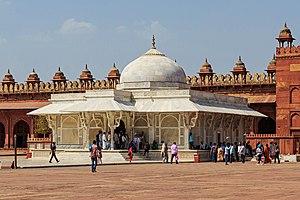

The mausoleum of Sheikh Salim Chishti is one of the characteristic examples of Mughal architecture , created in 1580-1551 as part of an imperial temple complex. Located next to the mausoleum of Zenan Rauza face in the southern gate of Buland Darvaza in the courtyard of the mosque Jama Masjid . [1] A descendant of the famous Sufi saint Muinuddin Chishti of Ajmeria, known Sufi saint Salim Chishti rested in the mausoleum (1478 - 1572) from Chishti Tarikata , who lived in one of the ridge caves in Fatehpur Sikri . [2] The mausoleum was erected by Akbar the Great, the Mughal Empire, as a sign of his appreciation to a Sufi saint who predicted the birth of his son, Prince Salim Nuruddin Jahangir, named after Salim Chishti. [one]
Content
Mausoleum Device
The mausoleum is built on a platform- base whose height is about 1 meter. A five-step staircase leads to the portico . The tomb itself is hidden from all sides by marble partitions with openwork carving - jali . Mausoleum crowned with a single dome . The basement platform is inlaid with inlays of black and yellow marble in the form of a fancy floral pattern. Ebony chhaparhats (columns) ( English chhaparkhat ) are located on the sides of the cenotaph , which is usually covered with a green veil (the color of Islam). The wooden canopy is encrusted with nacre in the form of a mosaic . [3]
The entrance to the main room is richly decorated with arabesques and Koranic calligraphy in the form of suras and ayahs . Quranic verses made of blue marble are framed by frames of brown marble. The walls of the tomb itself are covered with carvings and paintings , and the white marble floor is encrusted with multi-colored stones.
Believe
Pilgrims come to pray to St. Salim Chishti and ask him for help. It is believed that openwork carving ("ligature", "plexus", "thread", "knot") on partitions serves as a constant reminder of the saint about the prayers of the worshipers. Thus, unlike many other similar holy places, the pilgrim does not need to return to unleash when the wish is fulfilled.
Notes
- ↑ 1 2 Fatehpur Sikri // Imperial Gazetteer of India . - Oxford .: Clarendon Press , Oxford University Press . - Vol. 12 - p. 85
- ↑ "World Heritage Sites - Fatehpur Sikri (1986), Uttar Pradesh". Archival copy of September 5, 2011 on the Wayback Machine // Archaeological Survey of India
- Empire Indian Empire // Imperial Gazetteer of India . - Oxford: Oxford University Press . - Vol. 2 - P. 126


Literature
- Zhukovsky V.I. , Koptseva N.P. Art of the East. India: Training. allowance. - Krasnoyarsk: Krasnoyarsk. state Univ. , 2005. - 402 p. - ISBN 5-7638-0575-5 .