The submarine shelter Valentin ( German U-Boot-Bunker Valentin , Eng. Valentin submarine pen ) is an extremely large submarine bunker built by Kriegsmarine in 1943-1945. Built on the river Weser . It was intended for assembly from submarines of type XXI subunits delivered from factories and protection of submarines under construction from air raids. March 27, 1945 was heavily damaged by the bombing of British aircraft and not restored. Survived to our days.
| Bunker submarine "Valentine" | |
|---|---|
| him U-Boot-Bunker Valentin | |
 Aerial view of the Valentin bunker (2012). | |
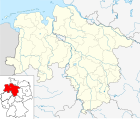
Lower Saxony Land of Germany Bremen State | |
| Location | port Farge (river Weser , Bremen ) |
| Affiliation | |
| Type of | bunker |
| Coordinates | |
| Years built | February 1943 - March 1945 (unfinished) |
| Materials | reinforced concrete |



History
By 1942, due to the Allied bombings , the pace of submarine construction at the German shipyards slowed down significantly. The protection of these plants (as opposed to forward bases ) was initially not given special attention, since the shipbuilding enterprises were located on the Baltic coast of Germany and were well covered by fighter aircraft. But by the middle of the war, the prevailing predominance of Anglo-American aviation in the air led to the fact that the Baltic ports were subjected to intense bombardment.
As a way out, German engineers proposed reforming the construction of submarines. Sections of submarine hulls were to be manufactured at enterprises dispersed throughout the German territories, and then delivered to well-protected coastal assembly plants for assembly and launch. Thus, the most vulnerable part of the process - the slipway assembly - took the least time. It was assumed that the berthing assembly will be carried out in fortified bunkers (resembling those that have already been used for the repair and maintenance of submarines at the forward bases subject to frequent air raids).
At the beginning of 1943 a draft of a giant assembly plant was drawn up, entirely located in a fortified bunker. The bunker, codenamed “Valentin,” was supposed to be built on the Weser River, near Bremen , in the depths of Germany. It was assumed that such a complex, connected by a railway network with enterprises manufacturing submarine sections, would be able to maintain the submarine launching pace regardless of the situation.
Construction
The huge bunker had a length of 426 meters, a width in the widest part of 97 meters and a height of up to 27 meters. Its roof was assembled from a variety of huge reinforced concrete arches, manufactured on site. The average thickness of the roof was 4.5 meters, but in some parts it reached 7 meters due to additional reinforcements (undertaken before the end of construction). The construction of the bunker was planned to spend up to 500 thousand cubic meters of concrete .
Inside the bunker there were 13 separate assembly units, in each of which one of the stages of the submarine assembly process was performed sequentially. Delivered sections from the factories were connected by a conveyor method, the assembled boat passed from block to block.
Blocks 9 and 10 had higher ceilings (special projections were made in the roof of the bunker over them so as not to reduce its thickness), since they were used to install felling and periscopes on submarines.
The last block, No. 13, was a dry dock connected by a waterproof gate to the channel leading to the Weser. Completed by assembly in block 12, the submarine was delivered to the 13th, where it descended into the water . After checking for the absence of leaks and engine tests, the submarine was led out through the opening gates to the outside, and sailing through the channel, went out to the Weser.
In addition to the assembly units, there were also warehouses of component parts, repair shops, tanks with fuel and lubricants in the bunker.
It was assumed that the bunker, regardless of the severity of the bombing, by April 1945 would be able to assemble three submarines of the newest type XXI per month. By August 1945, it was intended to reach the project pace and launch 14 submarines a month. These indicators have never been achieved.
Construction
Construction of the bunker began in February 1943. Most of the 10,000 workers were prisoners of the Nazi concentration camps , forced to erect strategic facilities in Germany by the Todt organization . To accommodate the workers around the bunker were built seven concentration camps. Unlike other similar objects, the Valentin bunker was entirely under the control of the Kriegsmarine and the functions of the warders were performed by the fleet personnel. It is believed that more than 6 thousand workers died during construction - more than all the losses of the population of the neighboring city of Bremen from the bombing of the entire war.
By March 1945, the construction of the bunker was completed by 90%, and it was assumed that the production of submarines could begin two months later.
Allied Air Bunker Bombing
On March 27, 1945, the Royal Air Force attacked the bunker area. 135 Avro Lancaster heavy bombers took part in the attack, followed by 90 North American P-51 Mustang fighters . Not only the bunker was attacked, but also the surrounding area, including the fuel base in the village of Schwanewede.
Directly on the bunker struck 20 "Lancaster", equipped with super-heavy concrete bombs. Seven of them carried Tallboy 5-ton bombs , the other 13 - giant 10-ton Grand Slam bombs. Two dropped 10-ton bombs in the roof of the bunker, and plunged into the concrete by almost four meters, before detonating.
The explosions of giant bombs in the thickness of the concrete caused a large-scale collapse of the affected sections of the bunker roof, nearly 1000 tons of debris collapsed into the shops located below. The workers who were at the time of the raid in the bunker survived by happy coincidence - none of them was in the affected sections. In addition, a power plant and a cement plant outside the bunker were destroyed. Post-war analyzes have shown that cracks started from the detonations of bombs in the thickness of the concrete roof, and subsequent attacks would probably completely destroy the bunker.
Three days later, on March 30, the US Air Force attacked the bunker with its new weapon, the Disney missile bombs . 60 charges were dropped, but only one of them hit the bunker. However, this bomb caused some damage as it broke through the roof of the structure and exploded inside. In addition, damage was caused to structures outside the bunker.
Shortly after these raids, work on the bunker was stopped. The command of Kriegsmarine made sure that the allies had weapons capable of striking even protected concrete structures. Four weeks later, the bunker was captured by the advancing British forces.
After the war
After the war, the bunker was actively used by the US and British Air Forces to develop weapons and methods for defeating protected objects. About 140 sorties were flown, but the bunker was not completely destroyed.
After completion of the test was supposed to destroy the bunker undermining. But the public opposed this decision, fearing that an explosion of such a massive structure could cause heavy damage to neighboring villages and hydroelectric power plants. Various ideas were put forward to use the bunker - right up to the equipment in the nuclear power plant - but as a result, in the 1960s, the German Navy used the bunker as a warehouse.
In 2008, the German government put up a bunker for sale. Currently, the bunker has been bought by a group of private investors who want to turn it into a museum and a memorial to the victims of the Nazi regime.
In 2012, part of the roof was given for the installation of solar panels.
Links
- Of site of the bunker museum "Valentin" (him)
- Die U-Boot-Bunkerwerft "Valentin" (German) Site Relikte.com, relics of the lands of Lower Saxony and Bremen