Orthogonal trajectories are lines intersecting a given family of curves at right angles. If a {\ displaystyle y_ {1} '}  Is the angular coefficient of the tangent to the orthogonal trajectory, and {\ displaystyle y_ {2} '}
  Is the angular coefficient of the tangent to the curve of this family, then {\ displaystyle y_ {1} '} and {\ displaystyle y_ {2} '} must at each point satisfy the condition of orthogonality :
- {\ displaystyle y_ {1} '= - {1 \ over y_ {2}'}}

Suppose we have a family of curves {\ displaystyle g (x, y) = C}  where {\ displaystyle C}
  Is a constant. Then orthogonal trajectories can be found by solving a system of differential equations :
- {\ displaystyle \ nabla f (x, y) \ cdot \ nabla g (x, y) = 0}

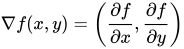
Using the definition of a gradient , you can write:
- {\ displaystyle \ nabla f (x, y) = \ left ({\ frac {\ partial f} {\ partial x}}, {\ frac {\ partial f} {\ partial y}} \ right)}
In this way:
- {\ displaystyle \ nabla f (x, y) \ cdot \ nabla g (x, y) = \ left ({\ frac {\ partial f} {\ partial x}}, {\ frac {\ partial f} {\ partial y}} \ right) \ cdot \ left ({\ frac {\ partial g} {\ partial x}}, {\ frac {\ partial g} {\ partial y}} \ right) = {\ frac {\ partial f} {\ partial x}} \ cdot {\ frac {\ partial g} {\ partial x}} + {\ frac {\ partial f} {\ partial y}} \ cdot {\ frac {\ partial g} {\ partial y}} = 0}

Suppose we have a family of straight lines passing through the origin given by the equation {\ displaystyle y = kx} . Differentiating this equation in a variable {\ displaystyle x} we get:
- {\ displaystyle y '= k = const}
Exclude the parameter {\ displaystyle k} from the system:
- {\ displaystyle ~ \ mathrm {{\ begin {cases} y = kx \\ y '= k \ end {cases}} \ Rightarrow y' = {\ frac {y} {x}}}}
Replace {\ displaystyle y '} on {\ displaystyle \ left (- {\ frac {1} {y '}} \ right)} :
- {\ displaystyle - {\ frac {1} {y '}} = {\ frac {y} {x}} \ Rightarrow y' = - {\ frac {x} {y}} \ Rightarrow {\ frac {dy} {dx}} = - {\ frac {x} {y}}}
We got a typical differential equation with separable variables. Integrating, we get:
- {\ displaystyle ydy = -xdx \ Rightarrow \ int {ydy} = - \ int {xdx} \ Rightarrow {\ frac {x ^ {2}} {2}} + {\ frac {y ^ {2}} {2 }} = C}
This equation is nothing but the equation of a circle of radius {\ displaystyle {\ sqrt {2C}}} . Really:
- {\ displaystyle R ^ {2} = 2C \ Rightarrow x ^ {2} + y ^ {2} = R ^ {2}}
Elsgolts L. E. Differential equations and calculus of variations. M .: Nauka, 1969. (p. 23, Example 8)