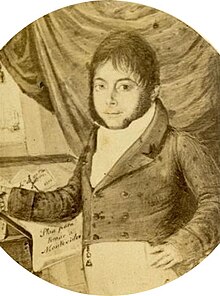
Juan Larrea ( Spanish: Juan Larrea , June 24, 1782 , Mataro , Spain - June 20, 1847 , Buenos Aires , Argentina ) - Spanish and Argentine businessman, military and political figure, participant in the failed and the successful May Revolution . He worked in the city council of Buenos Aires , then joined the First Junta of Argentina - the first independent government. In this body, he was one of two members born in Spain, along with .
| Juan Larrea | |||||||
|---|---|---|---|---|---|---|---|
| Juan larrea | |||||||
 | |||||||
| The president | |||||||
| President of the First Junta | |||||||
| |||||||
| |||||||
| Birth | June 24, 1782 Mataro , Spain | ||||||
| Death | June 20, 1847 ( 64) Buenos Aires , Argentina | ||||||
| Father | Martin Ramon de Larrea | ||||||
| Mother | Thomas Espeso | ||||||
| The consignment | |||||||
| Activities | Entrepreneur | ||||||
| Autograph |  | ||||||
| Military service | |||||||
| Affiliation | Vice Kingdom of Rio de la Plata | ||||||
| Rank | Captain | ||||||
| Commanded | Legion of Catalan volunteers | ||||||
| Battles | British invasion of the viceroy kingdom of Rio de La Plata | ||||||
Biography
The early years
Juan's father, Martin Ramon de Larrea, served at the customs of the city. Mother's name was Thomas Espeso. Juan Larrea studied mathematics and shipping and decided to become a merchant. His father died in 1793, and Juan became the new head of the family. He moved the family to the capital of the Viceroyalty of Rio de la Plata, Buenos Aires, and opened a warehouse where wine, leather and sugar were stored. Larrea traded with Peru , , Paraguay , Chile and Portuguese Brazil . By 1806, Larrea became a respected merchant and member of the . He was entrusted with the role of the representative of Buenos Aires at the court of Madrid [1] .
British invasions
During the British invasions of the Rio de La Plata, Juan Larrea stayed in Buenos Aires . Due to the lack of support from Spain, Viceroy called on all residents of the capital who are able to hold weapons, organize troops and resist the invasion. Larrea, together with Jaime Nadal and Guarda, Jaime Lavallol and organized a squad of Catalan volunteers. Larrea himself was appointed captain of this military unit. Some time later, after several defeats, the British were forced to leave the Viceroyalty [1] .
Buenos Aires City Council Jobs and May Revolution
Larrea's business continued to grow successfully, and in 1808, the Buenos Aires City Council appointed him the curator of a naval patrol designed to combat smuggling. This gave Larrea the opportunity to demonstrate his skills in the field of navigation. In addition, Juan Larrea regularly attended meetings of opponents of Spanish rule in South America and in 1809 joined the . The uprising failed, but the revolutionary inhabitants of the Viceroyalty continued to gather strength, and in 1810 during the May Revolution, Viceroy was removed from his post. Despite the fact that Larrea did not participate in public meetings of the Buenos Aires City Council, at which the future of the Viceroyalty was determined, he was appointed a member of the First Junta - the first independent government of Argentina [2] .
Member of the First Junta
The reasons why Larrea was included in the new government have not yet been conclusively established. However, this applies to most of the other members of the First Junta . One of the factors that influenced such a decision could be the influence of Juan Larrea as a businessman. It is also possible that Larrea was introduced to the government for a balance between the supporters of , who included the businessman, and the adherents of Carlota Joaquina , the Spanish Infanta, who wanted to proclaim her monarch of Rio de la Plata [3] . Larrea refused the salary of a member of the junta and collected resources for the upcoming war for independence . Together with he drafted new laws governing entrepreneurship in Argentina . Larrea also succeeded in ousting the former Viceroy of Baltasar, Hidalgo de Cisneros , and, as a precaution, bribed the captain of the ship carrying the Spanish governor so that the ship avoided any land on its way to the Canary Islands . Juan upheld the death penalty of , who attempted a . In the junta, Larrea became a supporter of and, together with him, opposed the government president [4] . The businessman voted to include deputies from other cities in the junta, although at first he was against this proposal. It was conceived by Saavedra to reduce Moreno's influence in the government [5] .
The proposal was supported by a majority of the members of the First Junta, which was renamed . Mariano Moreno was soon forced to resign and died after some time, but this did not weaken the conflict between the Moraine and the Saavdrist. The last of April 5–6, 1811, raised an uprising with the aim of dismissing all the remaining Moraineists, including Larrea [6] , who was accused of threatening public safety and was sent first to Luhan and then to San Juan [7] .
XIII Assembly
Larrea was forced to leave politics and began to engage in entrepreneurial activity in San Juan . But the brought the Morenists back to power, and Larrea was able to return to Buenos Aires . Larrea became a member of from Cordoba [7] .
In the Assembly, Juan passed a new customs law that established taxation on almost all imports to the United Provinces of South America . The only exceptions were the import of machine tools, scientific instruments, books, weapons and military supplies. He also organized the local mint and aid to the . The President of the Assembly was constantly changing; Larrea occupied this post held from April 30 to June 1, 1813. During this time, a law was passed prohibiting torture, all titles of nobility were abolished and the anthem of Argentina was approved [8] .
Larrea also worked briefly in the , replacing as Minister of Finance. On January 31, 1814, this body transferred power to the Gervasio Antonio de Posadas , who concentrated all power in his hands. The new head of state was concerned about the problem of Montevideo , located near Buenos Aires, which was still under the control of the royalists. Due to its proximity to the capital of the republic, the main city of supporters of royal power posed a constant threat. The new Supreme Ruler, Carlos Maria de Alvear, supplemented the siege of Montevideo that had already begun with a naval blockade, in which Juan Larrea played a large role thanks to his great experience. Alvear developed a strategy, and Larrea dealt with the financial side of the issue. The merchant compiled a report on the nature, cost and strength of the proposed fleet, as well as on the necessary sailors and captains. Larrea also appointed Irish Admiral William Brown to command the attack. The royalists were finally defeated in June 1814 [9] [10] .
Larrea did not get along with Brown, who constantly accused Juan of quarrels, lack of supplies and even discontent among sailors. Buenos Aires at that time did not have a long naval tradition, so most of the people involved in the Navy were foreigners. As a result, they did not have much desire to fight. After the capture of Montevideo, Larrea ordered Brown to report directly to the Minister of War , and not to negotiate with him. However, the disagreement between them continued. Due to the economic crisis that began after the war, Larrea sold all the captured ships and ships that were then owned by the state. The sailors claimed that they did not receive their salary, reward for victory and commissions from the sale of the fleet. Larrea resigned after signing an order to create an infantry and cavalry regiment for the Andean army . Alvear was forced to leave the post of Supreme Ruler after the rebellion of Ignacio Alvarez Thomas, and all members of the administration were put on trial. Larrea was charged with abuse of power, fraud and theft of funds from the state treasury. All the merchant’s property was confiscated, and he himself was expelled from the country [11] [12] .
Recent years
After the deportation, Larrea moved to France to the city of Bordeaux and went into business there along with some old partners. He continued his long-standing correspondence with the future president of Argentina, Bernardino Rivadavia, and in 1818 moved to Montevideo , which then belonged to the United Kingdom of Portugal, Brazil and the Algarve . Already in 1822, Larea was given the opportunity to return to Buenos Aires thanks to a new law implying a general amnesty [13] .
When Larrea returned to Buenos Aires, he decided not to engage in political activity and concentrate on commerce. Juan organized a mail service between the capital of the United Provinces and the French city of Le Havre , but this venture failed. Then Larrea took up livestock farming in Montevideo and Buenos Aires. He was appointed Consul of the United Provinces and Head of the Argentine Confederation Manuel Dorrego . Juan again moved to Bordeaux, where he tried to improve the economic ties between Argentina and France [13] .
Larrea left the post of consul in 1830 shortly after the appointment of Juan Manuel de Rosas as governor of Buenos Aires and again returned to private enterprise. However, he failed and was subsequently forced to constantly change his place of residence. At various times he lived in Montevideo, the Colonies del Sacramento and Bordeaux, but after a while he again settled in Buenos Aires. On June 20, 1847, Juan Larrea committed suicide as the last surviving member of the First Junta [14] .
Notes
- ↑ 1 2 National ..., p. 263
- ↑ National ..., p. 264
- ↑ Luna, p. 39
- ↑ National ..., pp. 264-265
- ↑ Galasso, p. 113
- ↑ Galasso, p. 128
- ↑ 1 2 National ..., p. 265
- ↑ National ..., pp. 265-266
- ↑ National ..., pp. 266-267
- ↑ Ratto, pp. 33-73
- ↑ National ..., pp. 267—269
- ↑ Ratto, pp. 75-93
- ↑ 1 2 National ..., p. 269
- ↑ National ..., pp. 269-270
Literature
- Galasso, Norberto. Mariano Moreno - El sabiecito del sur. - Buenos Aires: Colihue, 2004 .-- ISBN 950-581-799-1 . (Spanish)
- Luna, Félix. La Independencia argentina y americana. - Buenos Aires: Planeta, 2003 .-- ISBN 950-49-1110-2 . (Spanish)
- National Academy of History of Argentina. Revolución en el Plata. - Buenos Aires: Emece, 2010 .-- ISBN 978-950-04-3258-0 . (Spanish)
- Ratto, Héctor. Historia del Almirante Brown. - Buenos Aires: Instituto de publicaciones navales, 1999 .-- ISBN 950-9016-49-7 . (Spanish)
Links
- Wikimedia Commons has media related to Juan Larrea
- Juan Larrea (Spanish) (link not available) . elhistoriador.com.ar. Date of treatment January 9, 2013. Archived January 28, 2013.