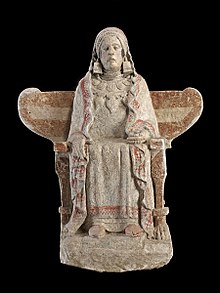
The lady from Basa ( Spanish: la Dama de Baza ) is a famous example of the Iberian sculpture ( English Iberian sculpture ), executed by bastulas . The work is a woman's figure made of limestone , with traces of color on a plastered surface. The sculpture was discovered by archaeologist Jose Presdo Velo on July 22, 1971 in the city of Basa , on a high mountain plateau in the province of Granada . It dates from the first half of the 4th century. BC e. [1] The Ibero-Roman city of Basti was located on the site of modern Basa, and the Lady of Basa was discovered in one of the two necropolises of this city. The statue depicts a woman sitting in an armchair, and on the side of the figure there is free space where, according to experts, the cremation dust was located. [2]
The name of the sculpture connects it with another famous work of Iberian culture - the Lady of Elche , with whom she is exhibited at the National Archaeological Museum in Madrid .
Notes
- ↑ Portal for the promotion of Spanish culture
- ↑ Analyses of the sculpture were published by F. Presedo in “La necrópolis de Baza” (Madrid) 1982 pp 317-19 and plate, and by A. García y Bellido, Arte Ibérico en España (Madrid 1980) pp 52-56.