In number theory, a unique prime number is a certain kind of prime number . A prime p ≠ 2, 5 is called unique if there is no other prime q such that the length of the decomposition period into the decimal fraction of the reciprocal , 1 / p , is equal to the length of the period 1 / q . Unique primitives were first described by Samuel Yates in 1980.
It can be shown that a prime p is unique with period n if and only if there exists a positive integer c such that
- ,
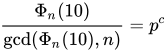
where Φ n ( x ) is the nth circular polynomial . Currently, more than fifty unique simple or possibly simple are known. However, only twenty three unique primes less than 10,100 are known. The table below shows 23 unique primes less than 10 100 (sequence A040017 in OEIS ) and their periods (sequence A051627 in OEIS ):
| Period length | Simple |
|---|---|
| one | 3 |
| 2 | eleven |
| 3 | 37 |
| four | 101 |
| ten | 9,091 |
| 12 | 9,901 |
| 9 | 333,667 |
| 14 | 909,091 |
| 24 | 99,990,001 |
| 36 | 999,999,000,001 |
| 48 | 9,999,999,900,000,001 |
| 38 | 909,090,909,090,909,091 |
| nineteen | 1,111,111,111,111,111,111 |
| 23 | 11,111,111,111,111,111,111,111 |
| 39 | 900,900,900,900,990,990,990,991 |
| 62 | 909,090,909,090,909,090,909,090,909,091 |
| 120 | 100,009,999,999,899,989,999,000,000,010,001 |
| 150 | 10,000,099,999,999,989,999,899,999,000,000,000,100,001 |
| 106 | 9,090,909,090,909,090,909,090,909,090,909,090,909,090,909,090,909,091 |
| 93 | 900,900,900,900,900,900,900,900,900,900,990,990,990,990,990,990,990,990,990,991 |
| 134 | 909,090,909,090,909,090,909,090,909,090,909,090,909,090,909,090,909,090,909,090,909,091 |
| 294 | 142,857,157,142,857,142,856,999,999,985,714,285,714,285,857,142,857,142,855,714,285,571,428,571,428,572,857,143 |
| 196 | 999,999,999,999,990,000,000,000,000,099,999,999,999,999,000,000,000,000,000,009,999,999,999,999,900,000,000,000,000.001 |
A prime with a period of 294 is similar to the inverse of 7 (0.142857142857142857 ...)
The twenty-fourth unique prime not shown in the table contains 128 characters and a period of length 320. It can be written as (9 32 0 32 ) 2 + 1, where index n means n consecutive copies of the digit or group of digits before the index.
Although unique primes are rare, there is a hypothesis of an infinite number of unique primes based on the study of simple single-digit primes (any simple reunite is unique).
For 2010, the reunite (10 270343 -1) / 9 is the largest known possibly unique prime number. [one]
In 1996, the largest tested unique prime was (10 1132 + 1) / 10001, or, using the record used above, (99990000) 141 + 1. Its period is 2264. The record has since been improved several times since. By 2010, the largest verified unique prime number was 10,081 characters. [2]