Jean-León Gerome ( fr. Jean-Léon Gérôme ; May 11, 1824 , Vesoul , Haute-Saone - January 10, 1904 , Paris ) - French artist , painter and sculptor, representative of academism (sometimes attributed to the style of " Greek "). He painted paintings of various contents, mainly depicting the life of the ancient world and the East ; at the end of his life he was also engaged in sculpture, plastically realizing the images of his paintings. Having gained fame in monarchical France, he entered the opposition to the Impressionist movement and became a kind of symbol of the inertia of academic art. After his death in 1904 he was almost forgotten, his work was mentioned only in a negative way. After the revival of interest in salon-academic art in the 1970s, he was recognized as a classic of the 19th century, his works are kept in a permanent exhibition of the largest museums in the world. The encyclopedic exhibition, reflecting the features of his art, opened only in 2010.
| Jean-Leon Jerome | |||
|---|---|---|---|
| Jean-Léon Gérôme | |||
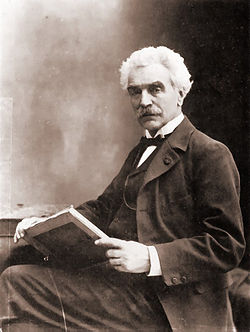 Photograph of the beginning of the XX century | |||
| Date of Birth | May 11, 1824 | ||
| Place of Birth | Vesoul , Upper Sona | ||
| Date of death | January 10, 1904 (aged 79) | ||
| A place of death | Paris | ||
| Citizenship |  France France | ||
| Genre | historical painting , orientalism | ||
| Study | Paul Delaroche | ||
| Style | academism | ||
| Awards |
| ||
| Ranks | full member of the Institute of France (1865) Academician of the Royal Academy of Arts (1869) | ||


Content
- 1 Becoming
- 2 career upgrade
- 2.1 Debut
- 2.2 The 1848 Revolution
- 2.3 Salon work 1848-1850 years
- 3 The heyday of creativity
- 3.1 "Age of Augustus"
- 3.2 Orientalism
- 3.3 Academic work at the turn of the 1850-1860s
- 3.3.1 "Phryne in front of the Areopagus"
- 3.4 Academism and Realism
- 4 Creativity of the 1860s
- 5 Genre works of the 1870-1880s
- 5.1 The evolution of creativity
- 5.2 Relations with students. Transition to genre painting
- 5.3 Jerome and animalistic
- 6 Late work
- 6.1 Jerome and impressionism. Death
- 7 Legacy. Memory
- 8 Awards
- 9 Comments
- 10 notes
- 11 Literature
- 12 Links
Beginning
The artist’s father was jeweler Pierre Gerome from Vesoul , who in April 1823 married the daughter of a shopkeeper - Francoise Vilmo. May 11, 1824 was born their firstborn, named Jean-Leon. At the age of 9, he entered the local gymnasium, where he showed artistic inclinations and began to learn the technique of drawing. His main mentor was Claude Karjazh (1798-1875), who studied under Ingres and Reno and introduced the foundations of academic painting to his ward. In the gymnasium years, Jerome made a successful copy of one of the paintings by A. Decamp (1803-1860), Paul Delaroche saw her and spoke highly of Jean's talent. This helped to convince the father to let his son go to Paris, where he went in 1841, having a letter of recommendation from Karjage. Father did not tire of repeating that artists, unlike jewelers, were poor, and in the end gave his son a year to achieve artistic success; in case of failure, he was to return to his parental home [1] .
Jerome’s earliest surviving work is the portrait of the Boy. Even this work demonstrates the skill of a young artist who boldly turned his head around the body. This demonstrated a confident possession of the reception of counterpost [2] . The successes of Jean-Leon were so noticeable that his father, who visited him in Paris, approved of his studies and began to send him 1,000 francs of content annually, which allowed Jerome to engage exclusively in improving his skills. Relations with the mentor also developed successfully, Delaroche recommended his student to Parisian art magazines and in 1843 took him with him on a one-year business trip to Rome [3] . At the age of 52, Jerome wrote an autobiography in which he praised the year of his trip to Italy as one of the best in his life:
“I did not know anything, and therefore I had everything to learn. <...> I sketched architectural monuments, landscapes, people and animals, in a word, I felt that I was working in unity with nature ” [4] .
The Roman year was devoted mainly to the study of nature, but special preferences have not yet arisen. However, against academic practice, Jerome liked working in the open air more than in museums. However, in Naples, he was attracted by the gladiatorial armor found at excavations in Pompeii . In his own words, this “opened a huge horizon for him” [5] . He was surprised that not a single European artist of that time was inspired by gladiatorial battles, and he began to diligently study ancient sources, as well as museum collections in search of antique images of duels in the arena. Contemporary art was disappointing - Jerome very critical of the then-famous Friedrich Overbeck in Rome:
“I was killed <...> by the monotony of his drawings: men were like women without breasts; draperies had folds in the same place; the landscape seemed copied from the thin trees of Raphael ... I did not dare to condemn the artist, who had such a significant reputation. <...> How unfair it is! ” [5] .
One of the remarkable works of Jerome of the Roman period was The Head of a Woman. According to A. Shestimirov, "the angularity of the forms, some dryness and schematism of the letter are given out by the aspiring artist." At the same time, the painting was executed very carefully, and the writing technique gave the image monumentality [6] . According to N. Wolf , the early portraits of Jerome demonstrate the direct influence of the technology and compositional decisions of Ingres [7] .
In 1844, there was an epidemic of typhus in Rome, which Jean-Leon could not escape. According to the memoirs of contemporaries, if it were not for the care of the mother who had specially arrived in Rome from Vesoul , Jerome would hardly have survived [8] .
Since Delaroche closed his workshop, he handed over students under the supervision of Swiss Charles Gleyre . Although he was considered a famous teacher ( Sisley , Renoir , Monet , Whistler went through the workshop of Gleyre in different years), the relationship between him and Jerome clearly did not work out. In his autobiography, he claimed that he studied with Gleir for only 3 months, and his art did not have a significant impact on the aspiring painter. According to A. Shestimirov, Jerome distorted the actual state of affairs. From Gleir, he undoubtedly gained interest in genre scenes in an antique setting. Instead of melodramatic plots from classical mythology and history, entertaining plots became fashionable in the 1840s and subsequent years. Since such paintings were far from both realism and academicism, the designation “ neo-Greek ” arose [8] . In the catalog of the Salon of 1847, J. Jerome was listed precisely as a student of Gleyre, and upon careful examination, his influence is noticeably noticeable. Unlike the light brown palette of Delaroche, Gleur used a light palette, which affected the manner of Jerome. It was Glair who instilled in him a deep interest in the Middle East. However, personal disagreements turned out to be insurmountable: the circle of “neo-Greeks” that arose in his workshop irritated Gleyra [9] .
Career Rise
Debut
At the end of 1846, Jerome finished his first big picture - “Young Greeks amuse themselves with cockfighting”, hoping to put it in the Salon. Before that, he shared his doubts with Delaroche, with whom he constantly talked, and whose opinion was guiding for him. Jerome frankly said that the result of his efforts seemed "weak and flat." Delaroche replied that all this is true, and Jean Leon could write better, but this is all in the future, but for now, the picture should be sent to the Salon [10] . As a result, 1847 was a decisive year in his career. The painting was placed high in the exhibition hall, but it was noticed by critics, including the then reputable Theophile Gautier . Gauthier noted that the plot is trivial, and a theme of this kind should be embodied in a small canvas, however, "the figures are written in full size and executed with such care that it makes the picture historical" [11] .
According to both J. Eckerman and A. Shestimirov, Gauthier’s assessments look at least controversial, for he, having proclaimed the principle of “ art for art ”, unconditionally admired academics and severely criticized new trends in art. A. Shestimirov noted that the figure of the girl is anatomically disproportionate, her pose is awkward, and this creation is, rather, not an established master, but a student. The figure of the boy is more successful, but his nudity is inappropriate. On a huge canvas (143 × 204 cm), these shortcomings turn into a “funny joke” [13] . The critic Chanfleury reproached the artist for violating the academic canons: “the figures seem to be carved from marble, while the birds look alive” [14] . Nevertheless, the majority of observers liked Jerome’s style, since they corresponded to the mood of the July monarchy , who did not like deep historical and mythological subjects and longed for amusement. The canvas brought the artist a medal of the Salon of the Third Dignity [15] .
1848 Revolution
During the February Revolution of 1848, which proclaimed the republic, Jerome once in his life actively intervened in politics: according to some reports, he joined the National Guard and was even elected captain of one of the units. However, nothing is known about his activities during the revolution [15] . Shortly before the June uprising, Jerome participated in a grand competition for a picture glorifying the republic. This image was supposed to be hung in public places on the site of the royal portrait. In total, more than 700 artists participated in the competition, including Diaz de la Peña , Daumier , Corot , Millet and several others. According to Shanflery , the exhibition, held at the Palace of Fine Arts , "was sad." The main problem was that "the artists innocently believed that the competition freed them from everything, even from talent" [16] . Jerome’s sketch was traditional in composition and grandiose in style: he depicted a two-meter figure of a woman in a laurel wreath holding a sword in his right hand and an olive branch in his left as a symbol of peace. According to A. Shestimirov, the pink-lilac sunrise seems especially unnatural [15] . However, the jury found that the work of 20 artists, including Jerome, went to the finals of the first round, for which the authors received a prize of 500 francs each. After being elected President of Louis Napoleon, the competition was canceled [12] .
During the revolution, three friends — Jean Jerome, Henri Picot (1824–1895) and Jean Hamon (1821–1874) formed a “ phalanx of artists” in a house on 27 Fleurus Street. Each occupied a separate studio, connected together with other corridors; all the homework and all expenses were carried by the phalangists on shares, the kitchen shift lasted a week. Two or three times a month friends gathered in the phalanx, gatherings were paid from fines for various misconduct and contributions from visitors. The company was musical, so home concerts were often arranged. The role of Jerome in the commune was so great that subsequently critics called the circle of communication of the phalangists “the school of Jerome” [17] .
Salon works of 1848-1850
During his life in the phalanx, Jerome wrote a large painting, Anacreon, Bacchus and Amur, commissioned to him by the Ministry of Fine Arts of the Republic (the fee was 1800 francs). The painting was written in a short time and did not satisfy the artist, however, it was exhibited in the Salon of 1848 and brought him a medal of the second dignity. The audience and critics were probably attracted by the atmosphere of celebration and carelessness, which was then perceived as an allegory of the establishment of the republican system. The canvas is large in size - 134 × 203 cm. It shows the dancing old man Anacreon with a lyre, he is surrounded by Bacchus and Amur , as well as a naked Bacchante playing on Avlos . The scene is immersed in sunset twilight. Jerome himself evaluated this picture as an imitation of Raphael, but frankly admitted that it was “boring” and “assembled from pieces whose style and invention are terrible” [18] . Critics ignored the work of Jerome himself, however, Chanfleury very severely appreciated the paintings of the artist’s friend, Pico, and even stated that such paintings should be permanently excluded from the exhibitions [19] .
In the Salon of 1849, Jerome presented only one landscape, but in the work of the Salon of 1850 he was represented by three paintings, one of which was lost. The biggest scandal caused a sketch called "Greek Interior". In fact, it was an image of Lupanar , respectively, girls in languid poses were waiting for customers in the courtyard of the brothel. Critics resolutely took up the picture:
How can the police, who remove obscene print media from store shelves, allow such obscenity to be shown here in the public museum? <...> This decadence on the part of Jerome should be a warning to the entire Greek school [20] .
At the height of the scandal, the painting was bought by President Louis Napoleon, which was a great honor for the young artist (later Paul Cezanne created an engraving on this plot). According to A. Shestimirov, “the polar opinions that arose between the critic and the president of the republic once again show how great the gap was between art connoisseurs belonging to different layers of French society” [21] . Frankly continued to create frankly erotic compositions, an example with the innocent name “Idyll” serves as an example. According to A. I. Somov , in these works of Jerome, his ability “to mitigate the seductiveness of the plot by rigorous processing of forms and, as it were, a cold attitude towards what is capable of arousing sensuality in the viewer” was manifested [22] .
At the turn of the 1840s and 1850s, Jerome also experimented with portraiture, but, in general, he rarely addressed this genre. He himself claimed that painting portraits was contrary to his nature, as this fettered imagination; in addition, in accordance with the canons of academism, he idealized his models, and this was often not liked by customers. In his autobiography, he did not mention his portraits at all. Perhaps this was due to the unpleasant incident of 1854: he became interested in the actress - Mademoiselle Duran - and persuaded her to pose. However, she refused to pay for her portrait, and Jerome demanded 2000 francs from her in court. The judge issued the following verdict:
“... The main requirement for a portrait is the image of the true features of the model ... Since it is impossible to recognize Mademoiselle Durant in the portrait presented by Jerome, Mademoiselle Durant should not accept and pay for it” [20] .
The heyday of creativity
The Century of August
In 1853, Emperor Napoleon III announced the holding of the World Exhibition in Paris in 1855. It was supposed to greatly expand the department of fine art, and Jerome petitioned the management of the exhibition to write paintings of allegorical content on his own chosen plot. Jean-Leon decided to take the theme of the glorification of the emperor Augustus , under whose reign Jesus Christ was born, such a combination should have liked the emperor and the public. The work budget of Jerome was estimated at 20,000 francs; and already in February 1853 he received an advance of 5,000 to take a trip to paint landscapes and ethnographic types for painting from nature. He chose “Russian Asia” for the trip, but by the time of departure the Crimean War had begun , and he had to go to the Balkans. On the trip, Jerome was accompanied by the actor of the Paris theater Edmond Francois Gault (1822-1901) [23] .
While in Wallachia , Jerome and Goth witnessed the arrival of the Russian army. Once Jerome watched the recruits, next to which stood an officer with a whip. The artist quickly sketched the episode, on the basis of which he created the painting "Rest in the Russian Camp", sustained in the spirit of realism, which caused an enthusiastic reaction from critics. Now the picture is in a private collection in the United States [24] .
Returning to Paris, Jerome set about selling the Canvas of Augustus. On a huge canvas (6.2 × 10.15 m), he arranged life-size figures. In the very center on a dais was placed the figure of Augustus himself, and in the foreground and, as it were, underneath - the scene of the Nativity of Christ . Critics were not enthusiastic about the picture: particular indignation was caused by the humiliation of the most important event in the history of mankind - the birth of the God-man - and the simultaneous exaltation of the emperor. In addition, critics noted the far-fetchedness of the plot and composition, the excessive diversity of color. Fair and reproachful in the absence of integrity, the plot fell apart into separate scenes in the spirit of "neogrek"; it seemed to contemporaries that this showed a lack of seriousness necessary for academic allegory. The only completely positive review was left by T. Gauthier , who stated that there was a “genuine picture of history”. Nothing is known about the emperor’s reaction, but Jerome was awarded the title of Chevalier of the Legion of Honor [25] .
Orientalism
For the first time in the East, Jerome visited in 1853, when he visited Istanbul . During a short stay there was a desire to get acquainted with the life of genuine Asia, so in 1856 Jerome took a long trip to Egypt, which was attended by other creative people: playwright E. Ogier , artists N. Bescher and L. Nyei, as well as a sculptor O. Bartholdi . The latter took a photographic apparatus with him and was very carried away by Jerome; in the future, the artist constantly used photographs as a source of detailed information for his paintings. The trip to Egypt lasted 4 months, during which travelers hired a boat with cabins and actively engaged in excursions around the country, fishing and more. Jerome made many drawings and sketches, which captured the Arabs, Egyptian fellahs , Nubians and other inhabitants of the country of the Nile. A lot of space in his sketches was occupied by dogs, horses and camels [25] .
Pictures, plots and images of which were inspired by the Egyptian journey, Jerome exhibited at the Salon of 1857. The most impressive were the Egyptian Recruits and the Arnaut Officer - a sketch for the previous one, Camels at the Watering Hole, Thebaida Landscape and some others. The "Recruits" in the plot vaguely resemble "Peselnikov in the Russian camp", since they depicted a scene of the enslavement of civilians by the military. At the same time, the picture is demonstrably neutral in ethical sense, since the artist did not leave a single hint at the status of led people - either volunteers, or fellahs forcibly driven to build the just begun Suez Canal , just like he does not condemn the situation and Doesn’t admire the courage of people linked by pads. This was partly a demonstration of the position taken by Jerome in the discussion of realism, begun by G. Courbet . T. Gauthier again approved the oriental works of the artist, as he estimated the images of contemporaries from other countries with their habits and costumes as “a true and new idea of the Middle East” [26] .
Academic work at the turn of the 1850-1860s
Among the paintings exhibited by Jerome at the Salon of 1857, the theme “The Duel after the Masquerade ” stood out as the theme. For contemporaries, it partially aroused bewilderment and raised questions about the literary or dramatic source. Meanwhile, according to A. Shestimirov, the plot of the picture was completely original and illustrated an important aspect of the aesthetic views of Jerome, namely, the idea of life as a theatrical stage. “It seems that the curtain will close, and the mortally wounded Pierrot will stand up and bow to the audience. <...> And a masquerade is not a masquerade, and drama is not a drama ” [27] . According to Norbert Wolf , the picture is filled with true drama, which is achieved by its color scheme: bright bursts of white, tinted with black and red masquerade outfits, in the left corner are balanced by the “melancholic neutrality” of the background and the outgoing figures on the right. The observers of the London Times in 1858 emphasized that the picture is very expressive and that among contemporary artists there is no one who, like Jerome, could depict the tragedy of death [28] . The painting was popular, and J. Jerome made two copyright copies from it - for the Grand Duke Alexander Nikolaevich (now stored in the State Hermitage ), the second version was intended for reproduction in print and belongs to the Walters Museum . The original (now stored in the Conde Museum ) was bought by the famous art dealer Ernest Gambar , which brought Jerome 20,000 francs [29] .
In 1858-1859, Jerome was invited among other artists to design the residence of Prince Napoleon Joseph Bonaparte on Montaigne Street. Its prototype was the Pompeian villa of Diomedes. Jerome wrote allegorical figures on the plot of the Iliad and Odyssey. In parallel, he received a very prestigious order - the design of the personal car-salon of Pope Pius IX [30] .
At the salon in 1859, Jerome presented canvases on both modern Egyptian and ancient themes - the painting “Ave Caesar” stood out especially. The painting was written on the plot of the next coup in the Roman Empire, which brought Vitellius to power. Jerome here was dissatisfied with his painting and later admitted that it was full of archaeological inaccuracies. The erotic composition “King Kandavl ” was put on the plot from Herodotus . According to A. Shestimirov, erotica was designed to mitigate the tragedy of the situation (the tsar showed his naked beautiful wife to bodyguard Giges , after which the tsarina set the latter to choose either to kill herself or to kill the tsar and marry her). As a result, Jerome’s work was popular with lovers of historical subjects, and with connoisseurs of the nude genre [31] . The artist tried to use success at the Salon in order to get a position as a professor at the School of Fine Arts , sent a corresponding request, but did not receive an answer.
“Phryne before the Areopagus”
In the Salon of 1861, Jerome presented several paintings, among which the painting “ Frina before the Areopagus ” stood out. According to the stories of ancient authors (and especially Athenaeus ), the sculptor sculpted the goddess with his beloved Frina , which was blasphemy. According to another version, she played the role of Aphrodite. Orator Euthius (Eutias), her rejected admirer, accused Geter of godlessness. The lawyer - the famous speaker Hyperid , seeing that his speech does not make a special impression on the court, pulled her clothes off from Fryna. The beauty made such an impression on the judges that it was justified - because according to the Greek notions of beauty, such a perfect body could not hide an imperfect soul (the concept of kalokagatii ) [32] .
Jerome, although he wrote a painting on the plot of the distant past, but addressed it to his contemporaries. N. Wolf outlined the aesthetic program of this painting as "halfway between Ingres and Delaroche - his teacher." An additional contrast was hidden inside the picture: in the center of the composition on the altar there is a figurine of Athena Pallas , the goddess of wisdom, who was never portrayed naked [32] . In the faces of the judges were presented all possible reactions to the naked female body - from joyful admiration and intimate tenderness to fear and irritation. The artist painted the figure of Fryna with a contemporary model, and not with her antique images. In other words, Jerome did not shock the audience, but spared its conservative part: portraying the heroine’s modesty and deliberately stepping back from ancient sources (Frinu was judged by the helium , and not the Areopagus ), he tried to comply with the standards of modern morality [33] . As a result, the opinions of critics were categorically divided. Edgar Degas was already indignant in 1891:
“What can we say about the painter, who introduced Frina to the Areopagus a miserable, shy girl who covers herself? Phryne did not close herself, because nudity was the source of her fame. Jerome did not understand this and made his painting, due to lack of understanding, a pornographic picture ” [34] .
On the contrary, Russian critic V.V. Stasov , who was very skeptical of academicism, wrote in the article “Art Exhibitions of 1879”:
“No, look again at Frina Jerome, an old acquaintance: there is bodily beauty, there is shame in trembling knees looking for one another; there are even toes, and they say: we are ashamed, and try to somehow bend and hide; so the hands went up to his face and covered him. This is what I call: a work of art, this is what I call: feeling and expression, this is what I call: an artist ” [35] .
In 1889, starting from the painting of Jerome, the famous painter-academician Heinrich Semiradsky created his canvas - “ Frina at the festival of Poseidon in Elevzin ”. He wanted to create a sensual work that, being erotic, would remain within the bounds of decency [36] .
Academism and Realism
At the end of 1861, Jerome graduated from the captive, which earned him a reputation as a “realist from academism.” In the terminology of the mid-19th century, after Courbet arranged the “Pavilion of Realism” - a personal exhibition, the term “realism” became a synonym for rudeness and vulgarity, since the circle of Courbet focused on social vices and problems [37] . Jerome was far from depicting the unsightly sides of the life of France, which he substantiated as follows:
“An educated person will be more pleased to communicate with people of higher classes than to spend his life in a maize field with a plowman, in a workshop with a shoemaker or in a pipe with a chimney sweep” [38] .
It should be borne in mind that in his work there are practically no paintings directly depicting contemporary life of the upper classes. Therefore, by “realism” was meant the documentary accuracy of the transmitted scenes, costume with props. These "Prisoner" liked his contemporaries, and Jerome had to write a repetition. Critics even compared the sheikh’s boat with the rook of Charon , and the picture itself was perceived as a slice of the true East - “unshakable, voluptuous and refined in its cruelty” [39] .
1860s Art
In 1861, Jerome fought in a duel with the art dealer Stevens. According to R. Bonner , the reason was a woman. Although the artist was not an experienced duelist, he escaped with a slight wound to the arm. Immediately after that, he left France and went on a one-year trip to Egypt, Syria and Palestine. This voyage was described in great detail in an autobiography. A lot of adventures happened to him: for 17 days he crossed the Syrian desert, having visited Easter Church of the Holy Sepulcher in Jerusalem , and so on. Returning to Paris in January 1863, Jerome married Marie Gupil (1842-1912) - the daughter of a dealer in paintings. Together they lived until the end of the artist’s life; they had four children [40] . Son Jean showed artistic inclinations, but died early - in 1891 at the age of 27 years - from consumption [41] .
On January 15, 1863, the new rules for admission of paintings to the Salon were announced: from now on, each artist had the right to submit no more than three works, competitive selection was introduced. On January 25, a group of artists (including Jerome and Edouard Manet ) addressed an open letter to the emperor against the new rules. Everything was in vain, a scandal arose, which, among other things, led to the opening of the Salon of the Outcast . On November 13 of the same year, the Academy lost the right to lead the School of Fine Arts by imperial decree. Three new workshops were opened at the School and three professorial vacancies were introduced, one of which went to Jerome [40] .
In 1860, Siam opened for trade and diplomatic relations with France, whose ambassadors were introduced to Napoleon III in the summer of next year. Jerome received an order for the official canvas capturing this event; for the artist it was a very profitable order, and, in addition, his painting was intended for Versailles. Starting work, he discovered that he would have to portray about 80 real people, which was not easy for him because of his dislike of the portrait genre. However, the painting was presented at the Salon of 1865. The few official orders did not interfere with working on historical and genre scenes, including nudity ( Cleopatra and Caesar ) [42] .
The 1867 World Exhibition was organized to “at least artificially revitalize French industry and trade” [43] . Serious achievements in the field of fine arts were not expected, but Jerome presented 12 of his paintings for the French pavilion. Among them stood out the painting “The Death of Caesar ”, which once again provoked the immoderate praise of T. Gauthier:
“If a photograph existed in the time of Caesar, one would believe that the picture was written based on the photograph of the place and moment where the tragedy occurred” [44] .
On January 1, 1868, Jerome left his students in the care of G. Boulanger and left for the Middle East in the company of comrades - eight artists and writers. In Cairo, the artist received the audience of the Khediva Ismail Pasha , then examined Giza and the Fayyum oasis . After returning, Jerome exhibited several paintings from the events of Napoleon’s history in the Salon of 1868 - “December 7, 1815” and “ The Execution of Marshal Ney ” [45] . In November 1869, Jerome represented French artists at the opening ceremony of the Suez Canal [46] . Based on the results of trips to Egypt, Jerome painted several genre-ethnographic portraits, giving an idea of the different inhabitants of the East - Arnauts, Arabs, Bashibuzuks. Many of these paintings were already painted in Paris from photographs taken [45] .
Genre works of the 1870-1880s
Creative Evolution
During the Franco-Prussian War, Jerome with his family took refuge in England, but almost could not work. In the catalogs of his works there is only one picture of this time “Pifferari”, depicting street musicians in London. In June 1871 he returned to Paris. The house with the workshop was damaged during shelling, but the suburban villa was not damaged, and soon Jerome resumed classes at the School of Fine Arts. He continued to travel actively: in the winter of 1871 he visited Turkey, and in 1873, together with G. Boulanger and three students, went through Spain to Algeria, where he liked much less than in Egypt [45] .
A. I. Somov argued that in the 1870s, paintings by Jerome were noticeably inferior in their artistic qualities to the canvases created in the previous decade. At the same time, he continued all the basic ideas of his art: he painted genre portraits-types, architectural types. Landscapes begin to play in his paintings self-sufficient value. The painting "Arab and his horse" was in the 19th century among his most famous works. Against the background of a lifeless desert under the sultry sun, the artist depicted the genuine grief of an Arab after falling from a horse that could not stand the heat. Jerome was able to convincingly convey the despair of a rider who cannot reconcile with the death of an animal. In this case, the optical center of the picture is shifted to the left of the geometric center of the canvas, which makes the desert the main character, and the person is shown as an insignificant victim [47] .
In 1872, Jerome managed to realize the plot, which carried him back to 1843 in the Neapolitan Museum: the battle of gladiators. The result was the picture “ Pollice Verso ” (from lat. - “ Thumbs down, ” that is, “Finish the gladiator?”); she became very famous among the historical paintings of the XIX century. Back in 1859, Jerome painted Ave Caesar , a picture that he himself did not like. Having retained the composition of his previous work, in 1872 he corrected technical flaws and was able to create a truly dramatic canvas in content. In addition, he worked with copies of genuine gladiatorial armor that he could wear on his sitters. Jerome sincerely believed that this picture was the best in his work [48] .
This time, the artist’s source of inspiration was the famous Bullver-Lytton novel, “The Last Days of Pompeii,” translated into French back in 1838. The second chapter of part five contains a description of the gladiatorial duel, on which Jerome imposed genuine historical details, refusing, moreover, any idealization [49] . The painting depicts a gladiator-winner, crushing his defeated opponent with his foot, who in horror raised his hand up, hoping for mercy of the audience. However, the public clearly wishes for death by voting for it with the thumbs pointing down. V.V. Stasov, who saw the picture at the World Exhibition in Vienna in 1873, was delighted:
“The gladiators of Jerome - this is one of the most significant pages of ancient history transmitted ever by art ... This is a striking, passionate, exciting picture; you will not find such in the museums of the previous art of the last three centuries, here is what we are accustomed to consider from the cradle to be great and “classical” ” [50] .
The modern critic Guy Debord, who adheres to socialist views, wrote in 1996 that in this picture Jerome revealed the roots of the oldest of social barriers - the “barrier of violence” [49] .
In the Salon of 1874, Jerome exhibited three historical canvases, including “Collaboration: Cornell and Moliere” and “Gray Cardinal”. I. Ye. Repin rated them as “smart, but dry.” The Salon jury unanimously awarded Jerome a gold medal. This aroused the indignation of Parisian critics, who said that genres should not have been awarded medals. The artist was then in Holland and cabled that he refused the award. However, the jury also accepted the principle, refused to accept it, and Jerome had to transfer the medal to the School of Fine Arts [51] .
The composition “The Gray Cardinal” was used in the 1878 painting “ Reception of Conde at Versailles ”. Its plot was based on a historical joke: in 1674, after a battle with the Spanish-Flemish army, Louis XIV received Prince Conde on the Great Staircase, which contradicted etiquette and had not been done before. The prince, due to rheumatism, rose slowly and apologized to the monarch for the delay. To this the king replied: “My cousin, do not rush. Anyone who has as many laurels as you could not walk fast ” [52] .
Relations with students. Transition to genre painting
The artist continued to travel a lot: in 1874 he spent in the Netherlands studying the work of Frans Hals , in 1879 he visited Turkey, in 1880 in Egypt, in 1881 in Greece, in 1888 in England, and in 1889 in Italy . He took trips of his students, with most of whom he developed a warm relationship. The artist maintained friendly relations with Charles Barg (who was his student), he took part in the compilation of his "Curriculum for teaching drawing" (1667-1670). Jerome could visit students when they were sick, found buyers, sometimes he could buy their paintings through dummies and tried his best to attach them to illustrators, painting teachers, etc. There were rumors that he used students to paint his paintings using the brigade method - for example, when writing the background, but there is no clear evidence of this. Jerome was actively involved in charity work, was a member of several committees to help feeble artists and their widows, and he always attended the funeral of colleagues. At the burial of Camille Corot in 1875, an incident occurred: the priest began to preach a sermon on the “immoral life of artists”, after which Jerome led all the colleagues present there [53] .
After the fall of the empire and the establishment of the Third Republic, historical painting began to be valued less, and after 1875 Jerome switched mainly to small genre compositions. They are most often laconic in plot, do not require explanation, but at the same time retained the grandeur of the image, especially if they are associated with the religious life of the East. Then he began to write a whole series of conditional "harem" nudity paintings (" Sale of Slaves ", "Odalisque", "Moorish Bath" and many others). Jerome’s harem and bath scenes are rather arbitrary, the aesthetic principles of Ingres, which always replaced “erotic sensuality” with “topographic poetry”, were fully manifested here [54] . However, in comparison with the Ingres, Jerome's nudity is far from the canons of classical beauty, since since the 1870s, along with Parisians dressed in oriental costumes, he began to write authentic women of the East. Especially Jerome was attracted by almei (almeci) - Egyptian dancers. In one of the paintings, he depicted an almea with a cigarette, which emphasized the Europeanization of Egypt, which began at that time. However, no less characteristic of him is the motive for closed doors, perceived by his student - V.V. Vereshchagin [55] . Among his students was the famous engraver Charles Albert Waltner .
Jerome and Animalism
In the 1880s, Jerome was characterized by an interest in animalistics , and he began to write predators - leopards, lions and tigers. One of the most remarkable paintings in this genre is “Two Majesties”, which depicts a lion contemplating the Sun. French researchers (in particular, Helene Lafonte-Couturier) claimed to be hinting at the “Austerlitz sun”: the artist thus wanted to express sadness and nostalgia for the greatness of the Second Empire. In general, this picture conveys an atmosphere of longing and loneliness, which are somewhat offset by the pink tones of the rising sun [56] .
Vivid examples of this kind of work are the paintings “Watching Tiger” and “Woe to Pasha”. Knowing the world of the East well, Jerome had an idea that the tigers inspired mystical horror for the locals. At the same time, this animal symbolized strength, nobility and masculinity, it was seen as a protector and patron. Therefore, the rulers of the East were given tigers and at the same time believed that the death of a predator portends the end of its owner. In the picture “Pasha's Woe”, a dead tiger, like a man, rests on a carpet covered with pink petals; Pasha sits next to him, and his grief is genuine [57] . For this picture, the interior of the Lion's Yard in the Alhambra , seen during a trip to Spain, was used. The Watching Tiger reflects the other side of oriental beliefs - supposedly tigers or lions are able to protect cities or influence the course of the battle depicted in this picture [58] .
| Animalistics in the works of J. Jerome | |||||||||
| |||||||||
Later work
At the 1878 World's Fair, Jerome made his debut as a sculptor, presenting the “Gladiators” sculpted on the basis of the central group from the painting “Pollice verso”. The lessons of sculpture were given to him by a friend and peer, E. Fremier , and later Jerome always referred to himself in the catalogs as a student of Fremier. At first, he repeated in bronze the images of his early paintings, for example, Anacreon, but made changes to this composition: a drunk Anacreon holds the babies Bacchus and Amur in his arms. In the 1890s, he began to develop independent stories, such as Pygmalion and Galatea , Grief, and Tanagra. In 1895, Jerome sculpted a sculptural portrait of Sarah Bernhardt [59] . Jerome showed interest in sculpture at the beginning of his career, so in 1849 he painted the painting “Michelangelo”, depicting the famous sculptor at work. Later, he considered sculpture as a necessary preparatory stage for working on paintings and combined the figures of the main characters fashioned from plaster. This also applied to animal works: Jerome himself has repeatedly said that it is sculpture that allows anatomically correct depiction of lions and tigers. Over time, sculpture and painting merged into an indissoluble whole, which was manifested in the 1890 painting Pygmalion and Galatea , in which he portrayed his own workshop [60] [28] .
In the images of Jerome in the 1880s, a passive-heroic beginning appears. In 1883, the artist completed the large-scale painting " The Last Prayer of Christian Martyrs ", commissioned to him 20 years ago by the American collector Walters. In terms of plot and manner of execution, it resembles “Ave Caesar” and “Pollice verso”, but this time the first Christians are portrayed as victims. In accordance with the aesthetics of academism, scene-appropriate cruelty is offset by the courage and unbending faith of the martyrs. The composition is built so that the viewer can not immediately notice the crosses with crucified slaves. Therefore, despite the absence of doubts that the predator will win in an unequal battle with a handful of people, the picture leaves a feeling of a great victory of the spirit; in this regard, A. Shestimirov distinguishes it from the tradition of images of martyrdom in European painting [61] .
The 1880s were difficult for Jerome in a purely personal sense: in 1884 his father passed away, his mother moved to Paris. Soon in the same year, the brother-in-law - Albert Gupil - and his father Adolf died. Jean-Leon was very upset by the loss of relatives, as he was friends with Albert, realized his work through him and took him with him on trips. In 1886, academician Paul Baudry died, with whom Jerome was friends for many years. A strong blow for him was the death of G. Boulanger, which followed in 1888. Finally, in 1889-1890, an influenza epidemic broke out in Paris, the artist was also a victim. Even the US newspapers, where he was extremely popular, covered his state of health [28] . However, the artist managed to recover, and he stated that he would like to die at work [62] .
The workshop became the main refuge of Jerome, helped him to get out of depression and console himself. The bulk of his paintings of this time are various genre compositions, drawn from sketches of previous years, Egyptian landscapes, a rare self-portrait for him. Almost all of them abound in precise details, but do not differ in any profound idea. The Egyptian theme was continued by Carpet Seller and Marabu, the first of which embodies the typical idea of the East as a bazaar where you can find everything. The canvas “Bull's Exit”, in which the Spanish bullfight is interpreted as a gladiatorial theme, looks like some exception to the rule [63] .
The combination of sculpture and painting manifested itself in several works of Jerome in the 1890s. At that time, he became interested in antique tanagryanka statuettes . In the Tanagra statue, he portrayed a naked woman who holds a Tanagra figurine with a hoop in her left hand. The statue was sculpted in the manner of ancient masters, who painted the figures in imitation of a living body. The result was that viewers and critics of the Salon, accustomed to white marble statues, were shocked. The sculptural portrait of Sarah Bernhardt was also painted [64] . The Tanagra figurine is placed on a stool in the composition “Sculptor Model”. In this picture, Jerome portrayed himself, his studio, model and the Tanagra statue, on which he was finishing work. A reproduction of Pygmalion and Galatea hangs on the wall, emphasizing the hedonism of the scene. In the painting “Paints Bring Life to Sculpture” the unity of painting and sculpture is again used; in the background in the center is again the Tanagra. The picture also had purely practical significance: Jerome, showing a young Greek woman painting a figurine, wanted to “age” the figure he had invented with a hoop. Many artists of the XIX century placed on their canvases genuine ancient works found at excavations or exhibited in museums. The embodiment in painting, as it were, confirmed their antiquity and authenticity [65] . The Tanagra statue was acquired by the state for 10,000 francs [66] .
| Tanagra theme in the works of J. Jerome | |||||||||
| |||||||||
In 1895, Jerome was invited to participate in the illustrated edition of the Bible, in which 22 academicians of that time were involved, including Alma-Tadema , Burn-Jones , Tissot , Puvi de Chavannes , I. Repin and many others. Jerome performed 8 illustrations that were completely traditional in style and plot, the location of five of which is unknown. The pinnacle of the artist’s academic career was his elevation to the rank of great officer of the Legion of Honor [67] .
Jerome and impressionism. Demise
The beginning of the 1900s was marked for Jerome by a decisive break with the main directions in art. His negative attitude towards impressionism was first expressed in 1884, when the professor sharply opposed Mane 's posthumous exhibition at the School of Fine Arts, which caused a lack of understanding among the public. Jerome then stated:
“[Mane] is chosen to become the apostle of decadent fashion, the art of fragment. For my part, I have been chosen by the state to teach the basics of art to young artists ... Therefore, I think it is wrong to offer them an extremely arbitrary and sensational model from a person who, although he possessed rare qualities, did not develop them ” [68] .
However, Jerome did not have enough administrative resources to discourage the exhibition. Having visited her, he restrainedly observed that everything was not as bad as he thought [69] . A new scandal erupted ten years later - after the death of G. Caillebotte , who bequeathed 65 paintings from his collection of impressionists to the Luxembourg Museum . Jerome made a big fuss in the newspapers, stating in particular:
“The Luxembourg Museum is a school. What lessons are our young artists going to get there? They will all start with impressionism, because the state wants impressionism. ABOUT! These people believe that they portray nature, so wonderful in every way. What a claim! But nature is not for them! This Monet , remember his cathedrals ? And does this person know how to paint? Yes, I saw his good things, but not now. ” [70]
And in this case, no one listened to Jerome’s opinion, thereby becoming isolated, becoming "the enemy of progressive trends in art." In this regard, in France itself, his legacy has become consistently hushed up. He continued to paint pictures on traditional topics for him - hunting lions and tigers, Muslims for prayers [67] . His strength gradually dried up, on December 31, 1903, he wrote to his former student, Able, that he felt the approach of death. On the morning of January 10, 1904, Jean-Leon Jerome was found dead in his own workshop, lying at the portrait of Rembrandt . As an officer of the Legion of Honor, he had the right to a state funeral, but in his will he separately stipulated that this should not be done. He was buried in the Montmartre cemetery , the ceremony was attended by the head of the Senate of the republic, the director of the School of Fine Arts and the mayor of his native Vesoul. The tombstone of Jerome is decorated with a statue of “Woe”, created in memory of the early deceased son Jean [69] .
Heritage. Memory
Throughout his entire life, Jerome enjoyed the favor of critics and success with customers, especially in the United States, where he became popular since the 1870s. He also had American students, for example, Thomas Ikins [71] . He equally satisfied the needs of the bourgeois and aristocratic public [72] . As N. Wolf categorically stated, “for contemporaries, Paris was a world center of art not because of Courbet , Manet or Monet , but thanks to Cabanel , Masonier and Jerome” [73] . However, the left wing of critics launched an attack on Jerome in the third quarter of the XIX century, and it was initiated by Emil Zola . He accused the artist of the impassivity, lack of manifestation of the author’s “I” and claimed that his paintings were like a mirror, by looking into which you can see and feel only your own feelings. Zola said that Jerome had “the plot is everything, and the painting is nothing”; that is why in reproductions he makes a stronger impression than in the original. Subsequent critics, including those in the 20th century, tend to agree with these judgments [32] .
Russian critics of the 19th century found other motives in Jerome’s legacy, in particular, I. E. Repin and V. V. Stasov analyzed him through the work of his student, V. V. Vereshchagin. Stasov noted in Jerome "hidden in the depths of the paintings of indignation against a thousand outrageous events of the past or present." Repin wrote in a private letter:
“To resurrect correctly the whole picture of life with its meaning, with living types; to bring to full harmony the relations of individuals and the movement of the common moment of life in the whole picture is also a huge task. To guess and reproduce an ideal that is dreamed of by a reasonable majority of people living their highest ethical and aesthetic needs! ” [74] .
In the era of the dominance of the avant-garde, the name Jerome became a household name for designating salon art as handicraft of the lowest standard. The same line is visible in Soviet art studies. So, in the book of N. N. Kalitina, Jerome’s work is considered only on the material of his debut paintings exhibited in the Salon of 1847, without mentioning his subsequent evolution. A common place in Jerome’s criticism is the condemnation of his oriental works, for which Parisian sitters and sitters dressed in oriental costumes posed [76] .
Since Jerome was popular in the United States during his lifetime, and many of his paintings are in museums and private collections in this country, the decorative possibilities of his painting were never forgotten in Hollywood . Back in the era of silent cinema, Gloria Svenson used some of Jerome’s stylistic finds to create her visual images. When staging the Ben-Hur peplum in 1959, the director used the compositions and images of Jerome [77] to create a chariot racing scene. This tradition continued afterwards: when creating the film Gladiator , Ridley Scott was inspired by the painting Pollice verso [49] .
It is not surprising that the revision of attitudes toward Jerome began precisely in the United States, in line with the general change in attitudes toward salon-academic art in the 1970s. The study of his legacy was primarily carried out by Gerald Eckerman, who published the first catalog in 1981 and in 1986 a detailed biography of the artist, in which he tried to demonstrate his heritage in the context of all the art of the XIX century (in 1997 and 2009, a one-third edition was reduced - without catalog). In 1981, for the first time after his death, an exhibition of Jerome (in his homeland - in Vesoul) was organized, also organized by Eckerman [78] . However, for the first time, Jerome’s detailed encyclopedic exhibition was organized from October 19, 2010 to January 23, 2011 by the Orsay Museum, the association of French national museums and the Getty Museum (Los Angeles). From Paris she was moved to Madrid, to the Thyssen-Bornemisza Museum. Jerome’s exhibition was also held at the State Hermitage Museum in St. Petersburg from November 2, 2011 to February 5, 2012 (4 paintings and 2 sculptures by the master are stored in the museum) [79] [80] .
During the exhibitions of 2010-2011, discussions arose again about the content and form of Jerome’s art. In particular, opinions were expressed that Jerome’s work was “ kitsch radicalization of salon art” [81] .
Rewards
- Order of the Legion of Honor : cavalier (1855), officer (1867), commander (1878), great officer (1900) [82] .
- The Order of the Red Eagle of the third degree from the King of Prussia (1868) [83] .
Comments
- ↑ The painting was purchased by the heir to the Russian throne, Alexander Alexandrovich . In 2001, the canvas was stolen from the Hermitage and returned to the unknown in 2006, when it was cut into four parts and packed in a paper bag and turned over to the Duma faction of the Communist Party [75] .
Notes
- ↑ Shestimirov, 2012 , p. 5.
- ↑ Ackerman, 2009 , p. 10.
- ↑ Shestimirov, 2012 , p. 5-6.
- ↑ Ackerman, 2009 , p. twenty.
- ↑ 1 2 Ackerman, 2009 , p. 21.
- ↑ Shestimirov, 2012 , p. 6-7.
- ↑ Wolf, 2012 , p. 172.
- ↑ 1 2 Shestimirov, 2012 , p. 7.
- ↑ Shestimirov, 2012 , p. 7-8.
- ↑ Ackerman, 2009 , p. 26.
- ↑ Ackerman, 2009 , p. 26-27.
- ↑ 1 2 Shestimirov, 2012 , p. 10.
- ↑ Shestimirov, 2012 , p. 8.
- ↑ Bonfante-Warren, 2008 , p. 42.
- ↑ 1 2 3 Shestimirov, 2012 , p. 9.
- ↑ Kalitina, 1972 , p. 30-31.
- ↑ Ackerman, 2009 , p. 30-31.
- ↑ Ackerman, 2009 , p. 35-36.
- ↑ Kalitina, 1972 , p. 32.
- ↑ 1 2 Ackerman, 2009 , p. 37.
- ↑ Shestimirov, 2012 , p. 13.
- ↑ A. S — c. Jerome, Jean-Leon
- ↑ Shestimirov, 2012 , p. 14-15.
- ↑ Shestimirov, 2012 , p. 15-17.
- ↑ 1 2 Shestimirov, 2012 , p. 17.
- ↑ Ackerman, 2009 , p. 48.
- ↑ Shestimirov, 2012 , p. 18-19.
- ↑ 1 2 3 Wolf, 2012 , p. 54.
- ↑ Nicole Garnier-Pelle . Chantilly, musée Condé. Peintures des XIXe et XXe siècles. - Paris: Réunion des musées nationaux, 1997 .-- R. 164-165. - ("Inventaire des collections publiques françaises"). - ISBN 978-2-7118-3625-3
- ↑ Shestimirov, 2012 , p. 19.
- ↑ Shestimirov, 2012 , p. 19-20.
- ↑ 1 2 3 Wolf, 2012 , p. 97.
- ↑ Shestimirov, 2012 , p. 20-21.
- ↑ Ackerman, 2009 , p. 59.
- ↑ Stasov V.V. Selected works in three volumes. - T. 2. - M., 1952. - S. 10.
- ↑ Nesterova, 2004 , p. 115-116.
- ↑ Kalitina, 1972 , p. 48.
- ↑ Kalitina, 1972 , p. 47.
- ↑ Shestimirov, 2012 , p. 23.
- ↑ 1 2 Shestimirov, 2012 , p. 24.
- ↑ Jean-Leon Jerome. Part 6 . All-art. Date of treatment December 5, 2014.
- ↑ Shestimirov, 2012 , p. 24-25.
- ↑ Kalitina, 1972 , p. 57.
- ↑ Ackerman, 2009 , p. 78.
- ↑ 1 2 3 Shestimirov, 2012 , p. 28.
- ↑ Wolf, 2012 , p. 191.
- ↑ Shestimirov, 2012 , p. 32-34.
- ↑ Ackerman, 2009 , p. 100-102.
- ↑ 1 2 3 Wolf, 2012 , p. 151.
- ↑ Stasov V.V. Current art in Europe. Artistic notes about the World Exhibition of 1873 in Vienna // Selected works in three volumes. T. 1. - M., 1952. - S. 560.
- ↑ Shestimirov, 2012 , p. 35-36.
- ↑ Shestimirov, 2012 , p. 36.
- ↑ Ackerman, 2009 , p. 110.
- ↑ Wolf, 2012 , p. 200.
- ↑ Shestimirov, 2012 , p. 38-39.
- ↑ Shestimirov, 2012 , p. 40.
- ↑ Shestimirov, 2012 , p. 39.
- ↑ Shestimirov, 2012 , p. 39-40.
- ↑ Shestimirov, 2012 , p. 41-42.
- ↑ Shestimirov, 2012 , p. 43-44.
- ↑ Shestimirov, 2012 , p. 41.
- ↑ Ackerman, 2009 , p. 131.
- ↑ Shestimirov, 2012 , p. 43.
- ↑ Bonfante-Warren, 2008 , p. 273.
- ↑ Shestimirov, 2012 , p. 44.
- ↑ Jean-Leon Jerome. Part 8 . All-art. Date of treatment December 5, 2014.
- ↑ 1 2 Shestimirov, 2012 , p. 45.
- ↑ Ackerman, 2009 , p. 157.
- ↑ 1 2 Jean-Leon Jerome. Part 9 . All-art. Date of treatment December 5, 2014.
- ↑ Ackerman, 2009 , p. 154.
- ↑ Wolf, 2012 , p. 127.
- ↑ Wolf, 2012 , p. 51.
- ↑ Wolf, 2012 , p. 42.
- ↑ Shestimirov, 2012 , p. 47.
- ↑ Tuinova, 2012 , p. 262.
- ↑ Shestimirov, 2012 , p. 46-47.
- ↑ Wolf, 2012 , p. 21.
- ↑ Jean-Leon Jerome, part 10 . All-art. Date of treatment December 5, 2014.
- ↑ Exhibition of Jean-Leon Jerome in Paris . Guide to Paris (5.10.2010). Date of treatment December 5, 2014.
- ↑ Exhibition of Jean-Leon Jerome in the Hermitage (2011, St. Petersburg) . Is a digest. Date of treatment December 5, 2014.
- ↑ Wolf, 2012 , p. 17, 271.
- ↑ Jean-Léon Gérôme . . Date of treatment November 28, 2017.
- ↑ Gerald M. Ackerman. The life and work of Jean-Léon Gérôme: with a catalog raisonné . - Sotheby's, 1986. - S. 84. - 352 p.
Literature
- Treasures of Russian Museums: Illustrated Encyclopedia of Art / Comp. E. Tuinova. - M .: Roossa, 2012 .-- 336 p. - ISBN 978-5-91926-109-4 .
- Bonfante-Warren, A. Museum d'Orsay. Album / Transl. K. Znamensky. - M .: Eksmo, 2008 .-- 320 p. - ISBN 978-5-699-27259-4 .
- Bulgakov, F.I. Leon Leon Jerome // One hundred masterpieces of art. - SPb. : ed. ed. "The New Journal of Foreign Literature", 1903. - S. 32-33.
- Kalitina, N. N. “The Epoch of Realism” in 19th-century French painting. - L .: Publishing house Leningrad. University, 1972.- 228 p.
- Nesterova, E.V. Late Academism and the Salon: Album. - St. Petersburg: Aurora; The Golden Age, 2004 .-- 472 p. - (Collection of Russian painting). - ISBN 5-342-00090-4 .
- Shestimirov, A. Jean Leon Jerome. - M .: White City, 2012 .-- 48 p. - (Masters of painting). - 1000 copies. - ISBN 978-5-7793-2004-7 .
- Ackerman, Gerald M. Jean-Leon Gerome: His Life, His Work 1824-1904. - Paris: Acr Edition, 2009 .-- 192 p. - (PocheCouleur, No. 21). - ISBN 978-2867701016 .
- Wolf, Norbert. The Art of the Salon: The Triumph of 19th-Century Painting. - Munich — London — New York: Prestel, 2012 .-- 288 p. - ISBN 978-3791346267 .
Links
- Jean-Léon Gérôme (English) . mezzo-mondo. Date of treatment December 5, 2014. Archived on May 15, 2012.
- Exhibition of Jean-Leon Jerome in Paris . Guide to Paris (5.10.2010). Date of treatment December 5, 2014.
- Exhibition of Jean-Leon Jerome in the Hermitage (2011, St. Petersburg) . Is a digest. Date of treatment December 5, 2014.
- Jean-Leon Jerome (1824-1904) . GalleriX - Virtual gallery, art. Date of treatment December 5, 2014.
- Jean-Leon Gerome . All-art. Date of treatment December 5, 2014.
- Alexey Bobrikov. Orientalism in painting: The Age of Jerome (inaccessible link) . ART-1 (01/09/2014). Date of treatment December 5, 2014. Archived on June 8, 2015.
- Pictures of Jean-Leon Jerome