Aluminum nitride ( aluminum nitride ) is a binary inorganic chemical compound of aluminum with nitrogen . The chemical formula is Al N.
| Aluminum nitride | |
|---|---|
 | |
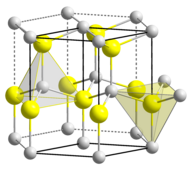 __ Al 3+ __ N 3− | |
| Are common | |
| Systematic name | aluminum nitride |
| Chem. formula | Al n |
| Physical properties | |
| condition | white to light yellow powder |
| Molar mass | 40.9882 g / mol |
| Density | 3.260 g / cm³ |
| Thermal properties | |
| T. melt. | 2200 ° C |
| T. bale. | 2517 ° C |
| Beats heat resistant. | 740 J / (kgK) |
| Thermal conductivity | 285 W / (mK) |
| Chemical properties | |
| Solubility in water | decays |
| Optical properties | |
| Refractive index | 1.9–2.2 |
| Structure | |
| Coordination geometry | tetrahedral |
| Crystal structure | type of wurtzite |
| Classification | |
| Reg. CAS number | 24304-00-5 |
| PubChem | |
| Reg. EINECS number | |
| Smiles | |
| Inchi | |
| Chebi | |
| ChemSpider | |
Content
History
Aluminum nitride was first synthesized in 1877 , but only in the mid-1980s its potential for practical use in microelectronics was realized due to its relatively high thermal conductivity for ceramics ( 70 - 210 W m −1 · K −1 for polycrystalline material, and up to 275 W m – 1 K – 1 for single crystals). This material is of interest as a non-toxic alternative to beryllium oxide . Metallization methods allow the use of this substance in electronics instead of alumina and beryllium oxide .
Physical Properties
Aluminum nitride is a (mainly) covalent bond material having a hexagonal crystalline structure known as wurtzite . The crystallographic group for this structure is .
Chemical Properties
White powder or watery white crystalline crystals. Slowly soluble in hot mineral acids . Cold HCl , H 2 SO 4 , HNO 3 and aqua regia are weak, cold HF does not. Concentrated hot solutions of alkalis decompose with the release of NH 3 . The material is resistant to very high temperatures in inert atmospheres. In air, surface oxidation occurs above 700 ° C, and surface oxidized layers 5–10 nm thick were detected at room temperature. This oxide layer protects the material up to 1370 ° C. Above this temperature, bulk oxidation of the material occurs. Aluminum nitride is stable in atmospheres of hydrogen and carbon dioxide up to 980 ° C. The material slowly decomposes in inorganic acids upon contact of the liquid with the grain boundaries, as is the case with strong alkalis. The material slowly hydrolyzes in water.
Application
- LED production ( semiconductor with a band gap of 6 eV );
- Nanofiber materials;
- The material for high-conductivity ceramics (instead of beryllium oxide) is the substrate for the production of high-frequency resistors, the body of electronic circuits.
Getting
Obtained by the reduction of Al 2 O 3 coal in a nitrogen atmosphere:
Also, aluminum nitride can be obtained by nitriding (without oxygen) aluminum powder:
When ammonia is passed through aluminum, hydrogen is obtained and, in the form of a precipitate, aluminum nitride: