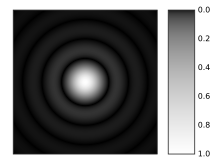
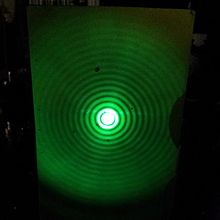
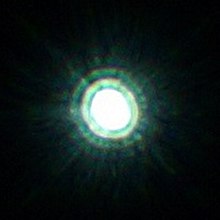
The Airy disk or Airy pattern is the designation of the light spot that can be obtained with the best focusing of an ideal optical lens with a circular aperture. The non-point character of this spot is associated with the phenomenon of light diffraction [1] .
The diffraction pattern that occurs when light passes through a uniformly illuminated round hole has a bright region in the center, known as the Airy disk [2] . In general, the diffraction pattern, including the spot and concentric bright rings around it, is known as the Airy pattern . These phenomena are named after George Biddel Airy . This optical phenomenon in itself was known even before Airy. For example, John Herschel in an article on light in the 1828 Encyclopedia Metropolitana described the appearance of a bright star through a telescope with high magnification:
... in favorable conditions, with a calm atmosphere, uniform air temperature, etc., the star is visible as a completely round, well-defined planetary disk surrounded by two, three or more alternating dark and light rings, which, if well considered, also appear to be slightly colored at their borders. They follow each other around the central disk at almost equal intervals ...
Original text... the star is then seen (in favorable circumstances of tranquil atmosphere, uniform temperature, & c.) as a perfectly round, well-defined planetary disc, surrounded by two, three, or more alternately dark and bright rings, which, if examined attentively, are seen to be slightly colored at their borders. They succeed each other nearly at equal intervals round the central disc ...- [3]
However, it was Airy who first made a complete theoretical analysis of the phenomenon and gave it an explanation in his 1835 work “On diffraction of an Object-glass with Circular Aperture” [4] .
Mathematical Description
From a mathematical point of view, the diffraction pattern is characterized by the wavelength of light illuminating the circular hole, and the diameter of the hole. The appearance of the diffraction pattern is additionally characterized by the sensitivity of the eye or other detector used to observe it.
The field strength is described by the formula where - Bessel function of the first kind , , - radius of the hole, - diffraction angle, - distance from the axis in the image plane, - the distance from the hole to the image plane, Is the wavelength of light.
For intensity the formula is correct [five]
| The cross section of the focusing beam of rays from the lens for different spherical aberration: negative at the top, absent in the center, and positive at the bottom. The lens is located to the left of the focus. | |
Longitudinal section | Cross section |
The most important is the application of the results of the study of the Airy disk to the design of cameras and telescopes. Due to diffraction, the lens or mirror cannot focus the beam into a spot that is smaller than the Airy disk. Even if it were possible to produce a perfect lens or lens, still the resolution of the image created by this lens would be limited. An optical system in which resolution is limited only by diffraction and not by inaccuracies in the manufacture of lenses is said to have reached the diffraction limit .
See also
- Amateur astronomy
- Fraunhofer diffraction
- Scattering spot
- Speckle
- Bloom
Notes
- ↑ Theory of Optical Instruments, 2001 , p. 150.
- ↑ Suiter H. R. Star Testing Astronomical Telescopes. A Manual for Optical Evaluation and Adjustment . - Richmond: Willmann-Bell, Inc., 2001 .-- xvi + 364 p. - ISBN 943396-44-1. (unavailable link) - P. 343.
- ↑ Herschel J. F. W. Light // Transactions Treatises on physical astronomy, light and sound contributed to the Encyclopaedia Metropolitana - Richard Griffin & Co., 1828 .-- P. 491.
- ↑ Airy G. B. On the Diffraction of an Object-glass with Circular Aperture // Transactions of the Cambridge Philosophical Society , Vol. 5 , 1835. - P. 283-291.
- ↑ Sivukhin D.V. §45. Fraunhofer diffraction by holes // General course of physics. - M. , 2006 .-- T. IV. Optics.
Literature
- V.N. Churilovsky . Chapter II General Theory of Optical Instruments // Theory of Optical Instruments / M.I. Poteev. - SPb. : “Willow”, 2001. - S. 129—226. - 274 p. - 150 copies, copies. - ISBN 5-7577-0077-7 .
Links
- "Concepts and Formulas in Microscopy: Resolution . " Posted by Michael W. Davidson, Nikon MicroscopyU (website).
- "Diffraction from a Circular Aperture . " Posted by Paul Padley, Connexions (website), November 8, 2005.
- "The Airy Disk: An Explanation Of What It Is, And Why You Can't Avoid It," Oldham Optical UK .