Individuals of this species caught off the coast of Taiwan were described in 1936 as Hexanchus griseus . In 1962, Teng described the new Taiwan subspecies Hexanchus griseus nakamurai based on two individuals caught off the coast of Jilong . An immature male 75 cm long was recognized as a holotype , and a 97 cm long female as a paratype . In addition, he noticed differences between the typical Hexanchus griseus and Hexanchus griseus nakamurai [2] . In 1969, Springer and Waller described a new species of Hexanchus vitulus , based on a specimen caught in the North Atlantic, not realizing that the same species was described in Tong's doctoral dissertation [3] . There has been debate for some time over whether the description of Teng can be considered an official publication. In 1990, Ebert conducted a detailed systematic review of the species Hexanchus nakamurai and described it again. Comparing the specimen stored in the National Museum of Natural History of the USA with the Taiwanese specimen, he concluded that they belong to the same species and recognized the scientific name Hexanchus nakamurai , and Hexanchus vitulus as its younger synonym [4] .
Widely, but unevenly distributed in tropical and temperate waters, the species. In the northwest Atlantic it is found off the Bahamas, Nicaragua , Costa Rica and on the northern coast of Cuba . In the eastern Atlantic in the Strait of Gibraltar and probably off the coast of Côte d'Ivoire and Nigeria . Occasionally, these large-eyed six-gill sharks are caught in the Mediterranean Sea [4] [5] . In the Indian Ocean, these sharks live off the coast of South Africa , Madagascar , a group of islands Aldabra and Kenya . In the western Pacific Ocean, they are found off the coast of Japan (Kochi, Ogasawara and Okinawa), Taiwan , the Philippines ( Luzon ), Australia ( Queensland ), New Caledonia and Tahiti [3] [4] . These sharks are kept on the continental and island shelf, as well as on the mainland slope at a depth of 90 to 600 m, usually at the bottom, but in the tropics at night they sometimes rise to the surface of the water [3] .
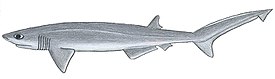
The large-eyed six-gill sharks have a slender spindle-shaped body and a narrow head with a pointed muzzle. There are 6 pairs of long gill slits. The eyes are very large, the pupils fluoresce with a blue-green light. A wide mouth is rounded in the form of an arch. In the mouth on either side of the symphysis there are 5 rows of teeth on the lower and 9 rows on the upper jaw. The lower teeth are wide, have the shape of a comb, the upper ones end with a central tip, the caudal edge is covered with serrations. The small dorsal fin is shifted to the tail. There is no spike at the base. Anal fin smaller than dorsal. The pectoral fins are medium sized, the caudal margin is slightly concave. There is a ventral recess at the edge of the upper lobe of the caudal fin. The upper lobe of the caudal fin is long, the lower lobe is quite well developed. Caudal stalk long and thin. The large-eyed six-footed shark reaches a length of 1.8 m [3] . The average length is 1.7 m and the weight is 20 kg. Coloring dark gray-brown, belly whitish. In young sharks, the tip of the dorsal fin has a black border [6] .
Little is known about the life of the big-eyed six-gill sharks. Their diet probably consists of small bony fish and bottom invertebrates . A small tuna was found in the stomach of one shark, which suggests the possibility of hunting on the surface. Potentially large-eyed six-footed sharks can become the prey of large sharks.
Big-eyed six-footed sharks breed by egg-production. In the litter from 13 to 26 newborns 40–45 cm long [4] . Males and females reach puberty with a length of 123–157 cm and 142–178 cm, respectively [3] .
The species is considered safe for humans. It has no commercial value. Sometimes by- catch falls into longlines and trawls. Data to assess the conservation status of the species is not enough [7] .