InterCity 125 or High Speed Train (HST) is a series of diesel locomotive high-speed trains built in 1975-82 by the British Crewe Works plant. Each train includes two British Rail Class 43 diesel locomotives (according to the old classification Class 253, Class 254, Class 255 ) (one at each end), connected by a system of many units . Until 2006, the InterCity 125 had the highest maximum permissible speed among regularly running diesel trains in the world, which is 200 km / h (125 mph), but now the InterCity 125 shares the palm with the German diesel train ICE TD . On November 1, 1987, the InterCity 125 broke the world speed record among diesel trains, accelerating to 238 km / h.
| InterCity 125 Hst | |
|---|---|
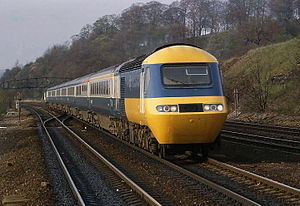 InterCity 125 on the York - Bristol line in the Chesterfield area | |
| Production | |
| Years of construction | 1975-82 |
| Country of construction |  Great Britain Great Britain |
| Factory | Crew Works |
| Compositions built | 95 |
| Technical details | |
| Kind of service | passenger |
| The number of cars in the composition | 6 - 8 |
| Axial formula | 2 0 −2 0 |
| Width | 2 730 mm |
| Height | 3 900 mm |
| Wheel diameter | 1020 mm |
| Track width | 1435 mm |
| Wagon material | steel |
| Number of diesel engines | 2 |
| Engine power | 2 × 1,678 kW |
| Construction speed | 200 km / h (record 238 km / h) |
| Exploitation | |
| Country of operation | Great Britain |
| In operation | since 1976 |
At the time of its commissioning, high-speed trains in the UK were very in demand, since then the maximum speed of trains did not exceed 160 km / h. Also, trains of this series had the best dynamic characteristics at that time, InterCity 125 accelerated faster and braked better compared to other models of trains operating then on the British railways, all this contributed to the fact that this series of trains became quite widespread.
Content
Creation History
Prerequisites for the appearance of
In the late 1950s and early 1960s, the British Transport Commission (the government organization responsible for transport) began modernizing the UK railways. It was planned to increase the average speed of trains on intercity lines so that railways become more competitive with new freeways. The government refused to finance the construction of new railway lines, and the British Transport Commission decided to focus on the development of new, faster rolling stock, as well as on the partial modernization of the existing one. In the early 1960s, a group of engineers gathered at the Derby Railway Technical Center, their task was to develop a high-speed passenger train that was supposed to reach a speed of 200 km / h (125 mph), and the engineers also applied a number of innovative technologies that never were used on British railways, for example, the inclination of the train body during turns, which allowed us not to slow down the train speed when passing a winding section [1] .
Prototype
According to the project, the new train consisted of passenger cars, which were located between two diesel locomotives . With this configuration, when two locomotives are attached to two different ends of the train, the train exerts less pressure on the rails, therefore, they wear less, while one heavy locomotive can deform the track, so the design engineers decided to use this particular train configuration. The decision to use locomotive traction rather than motor car traction was made at the very beginning of the project. Engineers calculated that in order to maintain a speed of 200 km / h, the combined power of the two locomotives should be 4,500 liters. with. (3300 kW ). The frame of the new locomotive was built at the Crew Works factory, then it was transported to the car factory in Debri, where the construction of the first experimental locomotive was completed, the new locomotive was classified as British Rail Class 41 (HST) . The new locomotive also had a number of ergonomic features. The control panel on it had a U-shape in such a way that all the controls of the train were located to the right and left of the driver , and the instruments opposite him. Soundproof doors were installed between the driver’s cab and engine room. Like other locomotives operating then on British railways, the British Rail Class 41 did not have side windows [2] . This diesel locomotive was the first diesel locomotive in the history of the UK railways, on which an alternating current generator was installed, and not a constant one, like all British diesel locomotives of that time [3] .
The construction of a prototype seven-car train with two locomotives (one at each end) was completed in August 1972. During the fall, sea trials took place, and in May 1973 a train classified as British Rail Class 252 broke his first world speed record among diesel trains, accelerating to 230.5 km / h [4] . In 1976, British Rail announced that 27 trains would be built for UK railways to operate between Paddington ( London ), Bristol and South Wales .
Series Production
The first serial diesel locomotive, number 43002, was released at the end of 1975, in appearance it was very different from the prototype. For serial locomotives, the front part was devoid of buffers , and the coupler was hidden under a removable cover, the exception was several diesel locomotives on which the buffers were installed, and the coupler was not hidden, but this design had a slightly different device than the prototype Class 41. The windshield on commercially available diesel locomotives was wider, side windows were made in the cab, it was decided to abandon the cab in the rear of the locomotive.
The appearance of InterCity 125 was worked by British designer Kenneth Grange . Initially, he was invited to develop only a livery for a new train, but when Grange saw a new locomotive, he extremely disapproved of his appearance, later he recalled
He was damn ugly, it was like a barrel with a porthole in front.
Original textIt was a bloody ugly thing, it looked like a barrel with a port-hole at the front.
Grange, together with a group of engineers, began to develop a new locomotive design. They tested their model in a wind tunnel . After work on the body was completed, Grange convinced British Rail to adopt a new diesel locomotive design [5] .
The InterCity 125 consists of two diesel locomotives with British Rail Class 43 power transmission and British Rail Mark 3 type passenger cars (usually 7 or 8 in the composition). The power of each locomotive is 1678 kW (2250 hp). The locomotives have a Paxman Valenta engine developed by Paxman diesels specifically for the British Rail Class 41.
Distinctive features of the train were the high power density of the locomotive engine - 32 liters. s / t [6] , such powerful engines were specially installed so that passenger trains could develop high speed, improved emergency shock safety compared to previous models, and the introduction of a special train configuration when locomotives are at two different ends of the train, which eliminates the need for shunting operations on locomotive rearrangement at terminal stations [7] . Prior to the commissioning of InterCity 125, the maximum train speed in the UK was limited to 160 km / h (100 mph) [8] , with the start of operation of this train, the maximum allowable train speed increased by 25%.
A small axle load on the rails allowed the train to accelerate to high speed. Better acceleration dynamics compared to other older locomotives made it possible to significantly reduce travel time. Good acceleration and braking dynamics made the InterCity 125 an ideal train for passenger traffic.
Commissioning
Deliveries of a new train began in 1976. In October of the same year, InterCity 125 began to be operated on the western railway of Great Britain [9] . The updated livery of the locomotive was supplemented by the inscription “InterCity 125”, made in a new corporate style, the InterCity 125 brand was also indicated in schedules and advertising sheets and became very recognizable. By May 1977, 27 British Rail Classes 253 locomotives were already operating on the western railway . On the lines where InterCity 125 trains were commissioned, the throughput increased, this was due to the increased average speed of trains and a decrease in the interval between them.
Diesel locomotives British Rail Classes 254 issued until 1977. Classes 254 were produced specifically for the London - Edinburgh (East Coast Main Line) line to replace the obsolete Class 55 Deltic . British Rail originally planned to install a more powerful 2500 liter Valenta engine on the Classes 254. with. (1900 kW), but it was decided to abandon this idea due to frequent engine failures, caused, as a rule, by insufficient cooling, as a result, the power of the engine installed on the locomotive was reduced to 2000 liters. with. (1500 kW). In May 1978, InterCity 125 with Class 254 diesel locomotives began operating on the London-Edinburgh line. Over the course of the year, InterCity 125 replaced the Deltic locomotives, and with their commissioning, travel time from London to Edinburgh was reduced.
InterCity 125 production ceased in 1982. InterCity 125 began to operate on the lines connecting London and the West Country , on the lines of Cross Country (York-Bristol) and Midland Main Line (London- Sheffield ), the train serves the stations of London, Bristol, Edinburgh, as well as Penzance in the south-west and Inverness in the north, so the InterCity 125 operates almost throughout the UK. Between 1976 and 1982, 95 InterCity 125 trains were built, for which 197 Class 43 diesel locomotives were built.
World Records
On June 12, 1973, the InterCity 125 prototype - British Rail Class 252 diesel locomotives with serial numbers 43000 and 43001, set the first world record among diesel trains, accelerating to 230.5 km / h (143.2 mph) [4] . InterCity 125 also holds the world speed record for diesel passenger trains. InterCity 125 broke the absolute world record among diesel trains on November 1, 1987, accelerating to 238 km / h (148 mph) [10] [11] [12] .
Regional Operation
South West England, South Wales
On the Western Railway, InterCity 125 trains were initially commissioned only on lines connecting London , Bristol and South Wales [13] , but later InterCity 125 began to operate also on lines connecting London to the counties of Devon and Cornwall . In South Wales, the InterCity 125 service network expanded to Milford Haven , Fishguard, and Pembroke Stations.
The Great Western Trains company was founded in 1996, and it managed routes from the Paddington Station in London to the counties of western England, so the Great Western trains also operated on these lines. In 1998, FirstGroup bought Great Western and founded First Great Western , which currently owns InterCity 125 operating in the region. All First Great Western lineups, including InterCity 125, were repainted in the company's corporate identity. First Great Western has a large fleet of InterCity 125, now they operate intercity transportation between London and the cities of Bristol , Bath , Chippenham , Swindon , Swansea , Cardiff , Carmarthen , Cheltenham , Oxford , Worcester , Hereford , Paignton , Plymouth , Westbury , Exeter , Taunton and Penzance . Most high-speed passenger services in the southwestern part of the UK are InterCity 125 trains.
In 2005, “First Great Western” began to modernize InterCity 125, engines were replaced in diesel locomotives of British Rail Class 43, wagons were repaired [14] , in particular, the layout of some wagons that are operated on especially busy lines was changed, the number was reduced to two tables in each car, this was done in order to increase the passenger capacity of the car and the train as a whole. During the repair, electrical sockets were installed in the cars, a bar was reconstructed in the restaurant car, and leather chairs were delivered in first-class cars [15] .
East and North England, Scotland
On the London - Edinburgh line, InterCity 125 trains with British Rail Classes 254 locomotives began to work after the decommissioning of the diesel locomotive Class 55 Deltic in 1980-82, but after the electrification of the line in 1990, the preference was given to the InterCity 225 electric train.
In this region, InterCity 125 were operated on lines connecting Kings Cross Station in London with the cities of Newcastle , Leeds , York , Bradford , Clithorps , Kingston upon Hull , Scarborough and Edinburgh ( Edinburgh Waverley Station ) [16] [17] , later, the InterCity 125 service network was expanded to Glazko , Inverness and Aberdeen .
After the privatization of British Rail in 1992, InterCity 125 operating in the region became owned by Great North Eastern Railway (GNER) [18] . Following the electrification of the London-Edinburgh line, InterCity 125 continued to operate in the region on other predominantly non-electrified lines. In particular, InterCity 125 is now operated on the lines connecting London with the cities of Kingston upon Hull , Skipton , Harrogate , Inverness and Aberdeen .
In January 2007, GNER began repairing InterCity 125 trains, during which the wagons were overhauled: new more comfortable chairs, more spacious luggage racks and new lighting were installed, toilets were repaired, and carpets were laid on the floors [19] . In the same 2007, the Great North Eastern Railway Company ceased to exist and its rolling stock, including InterCity 125, was transferred to the National Express East Coast, which continued to repair trains launched by GNER. In March 2009, National Express East Coast completed a major renovation project for its entire InterCity 125 fleet [20] .
On November 13, 2009, the National Express East Coast railway lines were nationalized after the British multinational transport company National Express Group announced the termination of financing of its subsidiary National Express East Coast. Thus, East Coast, which is a subsidiary of Directly Operated Railways, a holding company created by the UK Department of Transportation , is currently the operator of most of the railways in the region. In 2011, East Coast expanded the InterCity 125 service network to Harrogate , Lincoln and Skipton .
Another railway operator in this region is Grand Central Railway , which owns InterCity 125 trains, which have been operating on the London- Sunderland line since 2007 [21] . In 2010, Grand Central Railway replaced two engines (serial numbers: 43084 and 43123) with engines. The livery of the Grand Central Railway trains differed from the GNER livery only in the characteristic orange or yellow stripe in front of the locomotive. Grand Central Railway also changed the numbering of diesel locomotives to three-digit ones: 43465 (065) / 467 (067) / 468 (068) / 480 (080) / 484 (084) / 423 (123).
Central England
Operation InterCity 125 in central England (mainly on the Midland Main Line ( London - Sheffield )) began a little later than in other regions of the UK. In 1983, InterCity 125 was commissioned on the Midland Main Line, which links London's St. Pancras Station with the cities of Nottingham and Sheffield . Despite the fact that the maximum permissible speed on this line at that time was only 160 km / h, with the commissioning of InterCity 125, the travel time from London to Sheffield and Nottingham was significantly reduced, since the average speed of trains on this line was quite low. A little later, the maximum permissible speed in some sections was increased to 180 km / h, a decrease in the speed limit on the entire line to 200 km / h was proposed by British Rail in the first half of the 90s, but the privatization of the national railway operator prevented this project .
Transportation between London and Sheffield is now carried out mainly by modern high-speed diesel trains British Rail Class 222 but InterCity 125 still operates on the London-Nottigem route. The speed of trains on this route is now 180 km / h. InterCity 125 trains operating in this region are owned by two Midland Mainline and East Midlands Trains companies.
Cross Country Line
Following the privatization of British Rail in 1993, the Cross Country line was transferred to Virgin Trains . InterCity 125 trains were operated on this line until 2004. Since 2002, Virgin Trains began to gradually replace InterCity 125 trains with high-speed diesel trains of the Bombardier Voyager family , and in 2004 InterCity 125 was completely decommissioned on line [22] . Most InterCity 125 decommissioned trains were put in reserve for several years, and several trains are now operated by Midland Mainline. In 2007, due to increased passenger traffic, it was necessary to increase the number of rolling stock on the line; for this purpose, five InterCity 125 trains were again taken out of stock on the line. Since September 2008, the repair of several trains began. In the salons, new burgundy chairs were installed in the color of the livery of the train, and the number of tables was also reduced. A restaurant car was excluded from the composition.
West England, North Wales
Until May 2004, Virgin Trains InterCity 125 operated on routes linking London Euston Station and Birmingham International Station with Holyhead and Blackpool . InterCity 125 was also previously operated on the London- Glasgow (West Coast Main Line) line.
Accidents
The largest railway accident involving InterCity 125 occurred on October 5, 1999, almost in the center of London , 3 kilometers from Paddington Station . The train at high speed collided head-on with a British Rail Class 165 commuter train. The accident occurred due to the fault of the Class 165 driver, who drove to the red traffic light, mistaking it for yellow. Killed 31 people.
| date | Board number | A place | The victims | Incident description |
|---|---|---|---|---|
| 09/19/97 | 43173 | Art. Southall, London | 7/212 | The freight train rammed due to the carelessness of the driver, who did not notice the prohibition signal. In addition, the locomotive had a malfunctioning automatic warning system. |
| 10/10/99 | 43011 | 3 kilometers from Paddington Station , London | 7 + 24 | Faced with the British Rail Class 165 due to a mistake of the Class 165 driver who drove into the red light, the slowness of the dispatchers, who did not notify the drivers about the danger in time, also played a fatal role. |
| 6/11/04 | 43019 | 4 km from Reading | 6 + 1 | The man, committing an act of suicide , stopped his car at a railway crossing before passing the train. He died, 5 train passengers and the driver. |
In popular culture
Immediately after the commissioning of InterCity 125, it began to enjoy great popularity, partly this was a consequence of a major advertising campaign. British Rail produced a large number of commercials, where the new diesel train was positioned as fast, comfortable and cheap [23] . Miniature InterCity 125 models are produced by many manufacturers, one of the first in the UK was Hornby Railways, which manufactured the first model of this train in 1977 [24] .
There are scenes with the InterCity 125 train in many films, for example, at the end of the series Haircut from Mr. Bean of the London British series Mr. Bean , the protagonist is put in the luggage compartment of the Class 43 locomotive in the head of InterCity 125.
The InterCity 125 train is present in many railway simulators, including Rail Simulator and Train Simulator .
See also
- British Rail Class 43
- Intercity
- InterCity 225
Notes
- ↑ Marsden, pp. 7-10.
- ↑ Marsden, pp. 15-16.
- ↑ Marsden, p. sixteen.
- ↑ 1 2 Testing the prototype HST in 1973 . traintesting.com. Date of treatment April 29, 2009. Archived January 26, 2013.
- ↑ Everywhere and Nowhere (May 27, 2011). Date of treatment August 21, 2011.
- ↑ Marsden, Colin. HST: Silver Jubilee. - Ian Allan, 2001 .-- P. foreword.
- ↑ HST Power Car . National Railway Museum . Date of treatment May 18, 2009. Archived January 26, 2013.
- ↑ Collins, RJ High speed track on the Western Region of British Railways . Institute of Civil Engineers. Date of treatment May 18, 2009. Archived January 26, 2013.
- ↑ 1976: New train speeds into service , BBC News Online (October 4, 1976). Date of treatment April 28, 2009.
- ↑ Intelligence August 2002 , Railway Gazette International (1 August 2002). Archived on March 5, 2008. Date of treatment March 3, 2012.
- ↑ Rail Timeline , BBC News . Date of treatment April 7, 2008.
- ↑ Hollowood, Russell . The little train that could , BBC News (March 16, 2006). Date of treatment April 7, 2008.
- ↑ Paxman and Diesel Rail Traction . Richard Carr's Paxman history pages (March 3, 2012). Date of treatment March 4, 2012. Archived January 26, 2013.
- ↑ Trains undergo GBP63m redesign , Europe Intelligence Wire (18 January 2007). Archived July 21, 2012. Date of treatment May 18, 2009.
- ↑ Murray, Dick . Rail firm goes back to 30-years to boost reliability (10 September 2007). Archived December 22, 2007.
- ↑ DEMU inspection ensures quality , Railway Gazette International (1 March 2005). Date of treatment May 18, 2009.
- ↑ East Midland Trains (March 17, 2008). Change to our trains . Press release . Retrieved 2009-08-27 .
- ↑ GNER wins British franchise , International Railway Journal (April 1, 2005). Archived December 30, 2013. Date of treatment May 18, 2009.
- ↑ Stirling, Tom . Makeover for GNER 125 trains (March 12, 2007). Date of treatment May 18, 2009.
- ↑ National Express Group (March 13, 2009). National Express East Coast launches final refurbished and upgraded HST power cars back into service . Press release . Archived from the original on November 29, 2010. Retrieved 2009-05-18 .
- ↑ Jameson, Angela . Delay for Grand Central trains (October 5, 2006). Date of treatment May 18, 2009.
- ↑ New dawn for Virgin Trains . Virgin Group (June 13, 2001). Date of treatment May 18, 2009. Archived June 19, 2009.
- ↑ Campbell, Joe . High Speed Train marks 30 years , BBC News Online (October 4, 2006). Date of treatment April 29, 2009.
- ↑ Example of a model Intercity 125 - themodeller.com Archived on May 5, 2009.