Shevchenko Street ( Kaz. Shevchenko kөheshesі ) - a street in the central part of Almaty, stretching from east to west. Shevchenko Street starts from the Malaya Almatinka River , crosses the streets and avenues: Dostyk , Pushkina, Valikhanova, Kunaev (former Karl Marx), Tulebaev, Furmanov , K. Bayseitova, Abylai Khan Avenue, Zheltoksan , Nauryzbai Batyr, Seifulina Dalina , Masanchi Avenue. Shevchenko street ends at the intersection with Rozybakiev street.
| Shevchenko | |
|---|---|
| Shevchenko kөshesі | |
 | |
| general information | |
| A country | Kazakhstan |
| City | Alma-ata |
| Length | 5.6 km |
| Former names | Camp |
| Name in honor | |
In September 2017, on a larger section of the street, from Dostyk Avenue to Zharokov Street , one-way traffic was established in a western direction, with the arrangement of a bicycle lane on the south side of the street.
The doubler of the street will be one-way eastward from Mukanova Street to Dostyk Avenue, Kurmangazy Street.
For the most part of Shevchenko Street, tram tracks were laid from Kunaev Street to Zharokov Street (now dismantled).
Content
History
In 1879, the borders of the city of Almaty passed along Shevchenko Street, at that time called Lagernaya.
Interesting buildings and structures
- Monument to Taras Shevchenko . The monument to the Ukrainian kobzar, poet T. G. Shevchenko, who lived in western Kazakhstan during the exile (1847-1857), was erected at the intersection of Dostyk Avenue and Shevchenko Street in August 2000 in honor of the ninth anniversary of Ukrainian independence. It was made by a group of Ukrainian sculptors on hand. Vitaliy Ryzhik from granite mined in the Zhytomyr region.
- Academy of Sciences of Kazakhstan . The building complex of the National Academy of Sciences of Kazakhstan is located in Almaty, at the address: st. Shevchenko, 28 and occupies the square of Shevchenko-Kurmangazy-Kunaev-Pushkin streets with a land area of 3.0906 hectares. The complex of buildings of the Academy of Sciences of Kazakhstan is a grandiose architectural ensemble, which was started in 1948 and built in 1957 . The general designer of the complex was the architect Aleksey Viktorovich Schusev , the author of many structures, including the Mausoleum of V.I. Lenin in Moscow . The leader of the working group was engineer A.I. Prostakov. The building’s architecture uses classic motifs and stylized elements of national ornament. The Museum of Nature is located in the eastern wing of the Academy of Sciences complex. The Central Scientific Library is located in the right wing of the building.
- Fountain "Oriental Calendar" . Built in 1979 , artist V. Tverdokhlebov, architect V. Katsev , co-author of the sculptural part A. Tatarinov. At the sixth congress of the Union of Artists of the USSR, the composition "Oriental Calendar" was recognized as the best in the field of park sculpture.
- Monument to the scientist and ethnographer Chokan Valikhanov (crossing the streets of Valikhanov and Shevchenko, in front of the building of the Academy of Sciences of Kazakhstan) to a nineteenth-century Kazakh ethnographer. The monument was erected in 1969, the sculptor - H.I. Nauryzbaev , architect Sh.I. Valikhanov ; State Prize of Kazakhstan, 1970. The height of the monument is 8 m. The figure is cast from bronze. The pedestal is made of polished black gabbro. On the back of the pedestal, Kazakh national ornament and drawings by Sh. Valikhanov were used in the design. The sides are lined with ornamented tiles.
- Central Clinical Hospital of the Office of the President of the Republic of Kazakhstan ( Sovminovsky Hospital )
- “ Slanting houses ” (demolished) The microdistrict in the rectangle of Kaskelenskaya (now Tchaikovsky) in the west and Krasnoarmeyskaya (Panfilova) in the east, and Artilleriyskaya (Kurmangazy) and Lagernaya (Shevchenko) streets, which were divided into upper and lower quarters, was built during 1934 - 1937 according to the project of Peter Martynovich Wilhelmzon. Outstanding figures of art and science, prominent government officials drove into the apartments of a neighborhood of 11 two-story buildings, called the "House of Specialists". Many of them - according to modern estimates of 109 people - were repressed during the period 1937-38. A feature of the first microdistrict was the placement of houses at an angle to the gables of the streets. From this quarter was called "oblique houses."
- Dynamo stadium was built in 1931 and was part of the sports complex.
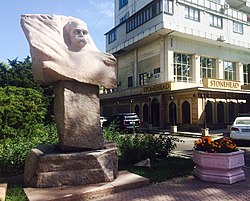
* Monument to Indian politician Mahatma Gandhi. The monument was erected in October 2003. The author of the monument was a sculptor from Mumbai - Gautam Pal. In appearance, it is a copy of the monument to Mahatma Gandhi of the same author, opened on July 8, 1988 on Indira Gandhi Square in Moscow.
Transport
Currently along the street in a westerly direction from the street. Bayzakova to st. Manas passes bus route number 80. From the street. Mukanova to the street Kunaev passes route No. 112, to Seifullin Ave. - No. 123.
Dismounted tram routes No. 4 and 6 passed along the street.
Music Festival
On September 14-16, the music festival “Parade of Orchestras” was held in the square named after S. Valikhanov in the open air. Viewers heard Kazakh kui, modern processing of folk compositions, melodies from famous films and classical works.