Plank power (or Plank luminosity ; denoted by P P or L P ) is a unit of measure of power (as well as luminosity ) in the Planck system of units . Numerically equal to the Planck energy E P divided by the Planck time t P :
- Tue

where c is the speed of light
- G is the gravitational constant .
This is an extremely large unit. It is equivalent to converting 2.03 · 10 5 solar masses per second into energy. For comparison, gamma-ray bursts , before the discovery of gravitational bursts were considered the most powerful of the known astrophysical explosive events, have a peak luminosity of the order of 10 45 W , which is less than one millionth of the Planck power. The luminosity of the Sun L ☉ = 3.86⋅10 26 W [1] , or 1.06⋅10 −26 L P.
During the last 20 microseconds of event GW150914 , which was a merger of two black holes with a mass of about 30 solar masses, the gravitational-wave luminosity was about 3.6 4910 49 watts , or 0.001 Planck luminosities. The total electromagnetic luminosity of all stars of the observed Universe is 50 times less, about 0.00002 Planck luminosities [2] [3] [4] [5] [6] .
Although the name of the unit contains the definition of “Planck”, it does not include the Planck constant and does not depend on quantum mechanics [7] . However, Planck luminosity often arises as a coefficient in the formulas of the general theory of relativity associated with the emission of gravitational waves. So, the average power radiated by the Keplerian system of two identical bodies of mass m in a circular orbit of radius R is approximately equal to [8]
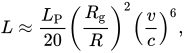
where R g = 2 Gm / c 2 is the gravitational radius of the body,
- v is the orbital velocity of the bodies.
Planck power is the upper limit of power for a closed system, and, according to the theory of 2015 [ which one? ] , the power of the Big Bang in the first segment (Planck time) of time.
Notes
- ↑ Luminosity / A. M. Cherepashchuk // Space Physics: A Small Encyclopedia / Editorial: R. A. Syunyaev (Ch. Ed.) And others - 2nd ed. - M .: Soviet Encyclopedia , 1986. - S. 607-608. - 70,000 copies.
- ↑ Knapton, Sarah . Moment scientists reveal major gravitational wave finding (February 11, 2016).
- ↑ Abbott B. P. (LIGO Scientific Collaboration and Virgo Collaboration) et al. GW151226: Observation of Gravitational Waves from a 22-Solar-Mass Binary Black Hole Coalescence (Eng.) // Physical Review Letters : journal. - 2016 .-- 15 June ( vol. 116 , no. 24 ). - P. 241103 . - DOI : 10.1103 / PhysRevLett.116.241103 .
- ↑ Castelvecchi, Davide; Witze, Alexandra. Einstein's gravitational waves found at last // English : journal. - 2016 .-- February 11. - DOI : 10.1038 / nature.2016.19361 .
- ↑ Harwood, W. Einstein was right: Scientists detect gravitational waves in breakthrough . CBS News (February 11, 2016).
- ↑ Drake, Nadia Found! Gravitational Waves, or a Wrinkle in Spacetime . National Geographic News (February 11, 2016).
- ↑ Robert G. Crittenden. Structure Formation in the Universe . - Springer Science & Business Media, 2012 .-- S. 284. - 382 p. - (Nato Science Series C: (Vol. 565)). - ISBN 9401005400 .
- ↑ Carl-Johan Haster. Globular Cluster Binaries and Gravitational Wave Parameter Estimation: Challenges and Efficient Solutions . - Springer, 2017 .-- 92 p. - (Springer Theses). - ISBN 3319634410 .
Links
- The cosmological beginning of the world. Are world constants changing?
- K. Postnov. Lectures on general astrophysics for physicists. 1.5. Planck units.