John von Neumann ( born John von Neumann / vɒn ˈnɔɪmən / ; or Johann von Neumann , German Johann von Neumann ; at birth Janos Lajos Neumann , Hungarian. Neumann János Lajos , IPA: [ nojmɒn ˈjaːnoʃ декабря December 28, ешlешɒʃ - February 8, 1957 , Washington ) - Hungarian - American mathematician and teacher of Jewish origin, who made an important contribution to quantum physics , quantum logic , functional analysis , set theory , computer science , economics and other branches of science.
| John von Neumann | |
|---|---|
| John von neumann | |
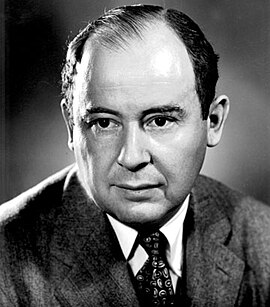 John von Neumann in the 1940s | |
| Birth name | |
| Date of Birth | |
| Place of Birth | |
| Date of death | |
| Place of death | |
| A country | |
| Scientific field | mathematician , physicist |
| Place of work | |
| Alma mater | |
| supervisor | |
| Awards and prizes | Bocher Prize (1938) Gibbs Lecture (1944) Sillimanov Lecture (1955) Enrico Fermi Prize (1956) |
Best known as the person whose name is associated with the architecture of most modern computers (the so-called von Neumann architecture ), the application of operator theory to quantum mechanics ( von Neumann algebra ), as well as a participant in the Manhattan project and as the creator of game theory and the concept of cellular automata .
Biography
Janos Lajos Neumann was born the eldest of three sons in a wealthy Jewish family in Budapest , which at that time was the second capital of the Austro-Hungarian Empire [10] . His father, Max Neumann ( Hungarian. Neumann Miksa , 1870-1929), moved to Budapest from the provincial town of Pecs in the late 1880s, received a doctorate in law and worked as a lawyer in a bank; his whole family came from Serench [11] . His mother, Margaret Kann ( Hungarian. Kann Margit , 1880-1956), was the housewife and eldest daughter (in her second marriage) of the successful merchant Jacob Kann, a partner in the Kann-Heller company specializing in the sale of millstones and other agricultural equipment. Her mother, Catalina Meisels (the scientist’s grandmother), came from Munkach .
Janos, or simply Yanchi, was an unusually gifted child. Already at the age of 6, he could separate two eight-digit numbers in his mind and talk with his father in ancient Greek. Janos was always interested in mathematics, the nature of numbers and the logic of the world. At eight years old, he was well versed in mathematical analysis . In 1911, he entered the Lutheran gymnasium. In 1913, his father received the noble title, and Janos, along with the Austrian and Hungarian noble symbols - the prefix von to the Austrian surname and the title Margittai in Hungarian naming - began to be called Janos von Neumann or Neumann Janitt Lajos. While teaching in Berlin and Hamburg, he was called Johann von Neumann. Later, after moving to the USA in the 1930s , his name changed to John in the English manner. It is curious that his brothers after moving to the USA received completely different surnames: Vonneumann and Newman . The first, as you can see, is a “fusion” of the surname and the prefix “background”, the second is the literal translation of the surname from German into English.
Von Neumann received his Ph.D. in mathematics (with elements of experimental physics and chemistry ) at the University of Budapest at 23. At the same time, he studied chemical technology in Zurich, Switzerland (Max von Neumann considered the profession of mathematics insufficient to ensure a reliable future for his son). From 1926 to 1930, John von Neumann was a private assistant professor at the University of Berlin .
In 1930, von Neumann was invited to a teaching position at American Princeton University . He was one of the first people who were invited to work at the Institute for Advanced Study , founded in 1930 , also located in Princeton , where he held a professorship from 1933 until his death.
In 1936 - 1938, Alan Turing worked at the Princeton Institute under the leadership of Alonzo Church and defended his doctoral dissertation . This happened shortly after the publication in 1936 of Turing's article “ On Computable Numbers with an Application to the Entscheidungs problem ”, which included the concepts of logical design and a universal machine. Von Neumann was certainly familiar with Turing's ideas, but it is not known whether he applied them in the design of the IAS machine ten years later.
In 1937, von Neumann became a U.S. citizen . In 1938 he was awarded the M. Boher Prize for his work in the field of analysis.
The first successful numerical weather forecast was made in 1950 using an ENIAC computer by a team of American meteorologists together with John von Neumann [12] .
In October 1954, von Neumann was appointed a member of the Atomic Energy Commission , whose main concern was the accumulation and development of nuclear weapons. It was approved by the United States Senate on March 15, 1955. In May, he and his wife moved to Washington, a suburb of Georgetown. During the last years of his life, von Neumann was the chief adviser on atomic energy, atomic weapons and intercontinental ballistic weapons. Perhaps due to his background or early experience in Hungary, von Neumann strongly adhered to the right wing of political views. In an article by Life magazine, published February 25, 1957, shortly after his death, he is presented as an adherent of a preventive war with the Soviet Union.
In the summer of 1954, von Neumann bruised his left shoulder in the fall. The pain did not go away, and surgeons diagnosed with bone cancer. It was thought that von Neumann's cancer could have been caused by radiation exposure during an atomic bomb test in the Pacific Ocean, or perhaps during subsequent work in Los Alamos , New Mexico (his colleague, nuclear research pioneer Enrico Fermi , died of stomach cancer on 54 year of life). The disease progressed, and attending meetings of the AEC ( Atomic Energy Commission ) three times a week required tremendous effort. A few months after the diagnosis, von Neumann died in severe pain. When he was lying dead at Walter Reed's hospital , he asked for a meeting with a Catholic priest . A number of friends of the scientist believe that since he was an agnostic for most of his conscious life, this desire did not reflect his real views, but was caused by suffering from illness and fear of death [13] .
Foundations of Mathematics
At the end of the nineteenth century, the axiomatization of mathematics, following the example of the Principles of Euclid, reached a new level of accuracy and breadth. This was especially noticeable in arithmetic (thanks to the axiomatics of Richard Dedekind and Charles Sanders Pearce ), as well as in geometry (thanks to David Hilbert ). By the beginning of the twentieth century, several attempts had been made to formalize the theory of sets, but in 1901 Bertrand Russell showed the inconsistency of the naive approach used earlier ( Russell's paradox ). This paradox again hung in the air the question of formalizing set theory. The problem was solved twenty years later by Ernst Zermelo and Abraham Frenkel . The Zermelo – Frenkel axiomatics made it possible to construct sets usually used in mathematics, but they could not explicitly exclude the Russell paradox from consideration.
In his doctoral dissertation in 1925, von Neumann demonstrated two ways to exclude from consideration the sets from Russell's paradox: the axiom of foundation and the concept of class . The foundation axiom demanded that each set can be constructed from bottom to top in incremental increments according to the Zermelo and Frenkel principle in such a way that if one set belongs to another, then the first must be before the second, thereby excluding the possibility of the set to belong to itself. In order to show that the new axiom does not contradict other axioms, von Neumann proposed a demonstration method (later called the internal model method), which became an important tool in set theory.
The second approach to the problem was expressed in taking the concept of a class as a basis and defining the set as a class that belongs to some other class, and at the same time introduce the concept of its own class (a class that does not belong to other classes). Under the assumptions of Zermelo-Frenkel, axioms prevent the construction of the set of all sets that do not belong to themselves. Under the assumptions of von Neumann, the class of all sets that do not belong to themselves can be constructed, but it is its own class, that is, it is not a set.
With this von Neumann construction, the Zermelo – Frenkel axiomatic system was able to eliminate Russell's paradox as impossible. The next problem was the question of whether it is possible to determine these structures, or whether this object cannot be improved. A strictly negative answer was received in September 1930 at the Mathematical Congress in Königsberg, at which Kurt Godel presented his incompleteness theorem .
Mathematical Foundations of Quantum Mechanics
Von Neumann was one of the creators of the mathematically rigorous apparatus of quantum mechanics . He outlined his approach to the axiomatization of quantum mechanics in his work “Mathematical Foundations of Quantum Mechanics” ( German: Mathematische Grundlagen der Quantenmechanik ) in 1932.
After completing the axiomatization of set theory, von Neumann began axiomatizing quantum mechanics. He immediately realized that the states of quantum systems can be considered as points in a Hilbert space , just as in classical mechanics, states are associated with points of a 6N-dimensional phase space . In this case, quantities common to physics (such as position and momenta) can be represented as linear operators over a Hilbert space. Thus, the study of quantum mechanics was reduced to the study of algebras of linear Hermitian operators over a Hilbert space.
It should be noted that in this approach the uncertainty principle , according to which the exact determination of the location and momentum of a particle is simultaneously impossible, is expressed in the non-commutativity of the operators corresponding to these quantities. This new mathematical formulation included Heisenberg and Schrödinger formulations as special cases.
Operator Theory
The main works of von Neumann on the theory of rings of operators were works related to von Neumann algebras. The von Neumann algebra is a * -algebra of bounded operators on a Hilbert space, which is closed in the weak operator topology and contains the unit operator.
The von Neumann bicommutant theorem proves that the analytic definition of the von Neumann algebra is equivalent to the algebraic definition as a * -algebra of bounded operators on a Hilbert space, which coincides with its second commutant.
In 1949, John von Neumann introduced the concept of direct integral. One of von Neumann's achievements is the reduction of the classification of von Neumann algebras on separable Hilbert spaces to the classification of factors.
Cellular Automata and Living Cells
The concept of creating cellular automata was the product of anti-vitalistic ideology (indoctrination), the possibility of creating life from dead matter. The argument of the vitalists in the 19th century did not take into account that information can be stored in dead matter - a program that can change the world (for example, the Jacard machine - see Hans Drish ). It cannot be said that the idea of cellular automata turned the world upside down, but it found application in almost all areas of modern science.
Neumann clearly saw the limit of his intellectual abilities and felt that he could not perceive some higher mathematical and philosophical ideas.
Von Neumann was a brilliant, inventive, effective mathematician, with an amazingly wide range of scientific interests that extended beyond mathematics. He knew about his technical talent. His virtuosity in understanding the most complex reasoning and intuition were developed to the highest degree; and nevertheless, he was far from absolute self-confidence. Perhaps it seemed to him that he did not have the ability to intuitively predict new truths at the highest levels or the gift for a multimodal understanding of the proofs and formulations of new theorems. I find it hard to understand. Maybe this was due to the fact that a couple of times he was ahead or even surpassed by someone else. For example, he was disappointed that he was not the first to solve Gödel's completeness theorems. This was more than he could do, and alone with himself, he admitted the possibility that Hilbert had chosen the wrong course of the decision. Another example is the proof by J. D. Birkhoff of the ergodic theorem. His proof was more convincing, more interesting, and more independent than Johnny's.
- [Ulam, 70]
This issue of personal attitude to mathematics was very close to Ulam , see, for example:
I remember how, at four, I frolic on the oriental carpet, looking at the marvelous ligature of its pattern. I remember the tall figure of my father standing next to him and his smile. I remember what I thought: “He smiles, because he thinks that I’m still a child, but I know how amazing these patterns are!” I do not claim that then exactly these words came to my mind, but I am sure that this thought came to me at that moment, and not later. I definitely felt: “I know something that my dad does not know. Perhaps I know more than he. ”
- [Ulam, 13]
Compare with the “Crops and crops” of Grothendieck .
Manhattan Project Participation and Contribution to Computer Science
As an expert in the mathematics of shockwaves and explosions during World War II, von Neumann worked as a consultant to the Army Ballistics Research Laboratory of the US Army's Ammunition Administration. At the invitation of Oppenheimer, Von Neumann was involved in the Los Alamos on the Manhattan project starting in the autumn of 1943 [14] , where he worked on calculating the compression of plutonium charge to a critical mass by implosion .
Calculations for this task required large calculations, which were first carried out in Los Alamos using handheld calculators, then on IBM 601 mechanical tabulators, where punch cards were used. Von Neumann, freely traveling around the country, collected information from various sources about current projects to create electronic-mechanical (Bell Telephone Relay-Computer, Mark I Howard Aiken computer at Harvard University was used by the Manhattan project for calculations in the spring of 1944) and fully electronic computers ( ENIAC was used in December 1945 for calculations on the problem of the thermonuclear bomb).
Von Neumann assisted in the development of ENIAC and EDVAC computers, contributed to the development of computer science in his work “ The first draft of the EDVAC report, ” where he introduced the scientific world to the idea of a computer with a program stored in memory. This architecture is still called von Neumann architecture , and for many years has been implemented in all computers and microprocessors.
After the war ended, von Neumann continued to work in this area, developing a high-speed research computer IAS machine at Princeton University, which was supposed to be used to accelerate calculations on thermonuclear weapons.
In honor of Von Neumann, the JOHNNIAC computer, created in 1953 at RAND Corporation, was named.
Personal life
Von Neumann was married twice. The first time he married Mariette Kövesi in 1930 . The marriage broke up in 1937 , and already in 1938 he married Klara Dan . From his first wife, von Neumann gave birth to a daughter, Marina , later a well-known economist.
Memory
In 1970, the International Astronomical Union named John von Neumann on a crater on the far side of the moon . The following awards were instituted in his memory:
- John von Neumann Medal
- Von Neumann Theoretical Award ,
- Lecture by John von Neumann .
Works
- Neumann J. Mathematical foundations of quantum mechanics. - M.: Science , 1964.
- Neumann J., Morgenstern O. Game theory and economic behavior . - M.: Science, 1970.
See also
- Von Neumann architecture
- Von Neumann probe
- Elephant von Neumann
- Universum von Neumann
- Von Neumann hypothesis
- The system of axioms of von Neumann - Bernays - Gödel
- Operator Algebra
- Duality (optimization)
- Entropy von Neumann
- Von Neumann programming languages
Notes
- ↑ German National Library , Berlin State Library , Bavarian State Library , etc. Record # 118770314 // General Normative Control (GND) - 2012—2016.
- ↑ BNF ID : 2011 Open Data Platform .
- ↑ 1 2 Archive for the history of mathematics MacTyutor
- ↑ 1 2 Neumann John von // Great Soviet Encyclopedia : [in 30 vol.] / Ed. A. M. Prokhorov - 3rd ed. - M .: Soviet Encyclopedia , 1969.
- ↑ Biografisch Portaal - 2009.
- ↑ Neumann John von // Neumann John von / ed. A. M. Prokhorov - 3rd ed. - M .: Soviet Encyclopedia , 1969.
- ↑ Macrae N. John von Neumann: The Scientific Genius Who Pioneered the Modern Computer, Game Theory, Nuclear Deterrence, and Much More — 1992. — С. 380. — ISBN 0-679-41308-1
- ↑ 1 2 http://www.nasonline.org/member-directory/deceased-members/20000935.html
- ↑ http://www.computerhope.com/people/john_neumann.htm
- ↑ Научная биография
- ↑ Генеалогия семьи Нейман
- ↑ American Institute of Physics. Atmospheric General Circulation Modeling. 2008-01-13.
- ↑ Abraham Pais. J. Robert Oppenheimer: A Life. — Oxford University Press , 2006. — P. 109. — «Он был полностью агностиком все то время, пока я его знал. Насколько я могу видеть, это действие не согласовывалось с мыслями и воззрениями, которые были у него почти всю его жизнь. 8 февраля 1957, Джонни умер в госпителе, в возрасте 53 года.». — ISBN 9780195166736 .
- ↑ Igniting the Light Elements: The Los Alamos Thermonuclear Weapon Project, 1942-1952 - by Anne C. Fitzpatrick, 2013,p.66
Literature
- Steve Heims. John Von Neumann and Norbert Wiener: from mathematics to the technologies of life and death. — MIT Press, 1980. — 568 p. — ISBN 0262081059 . (eng.)
- Данилов Ю. А.. Джон фон Нейман. — М. :Знание, 1981. (рус.)
- William Aspray. John von Neumann and the Origins of Modern Computing . — MIT Press, 1990. — 376 p. — ISBN 0262011212 . (eng.)
- Norman Macrae. John von Neumann. — 1992. (англ.)
- Монастырский М. И. Джон фон Нейман — математик и человек. // Историко-математические исследования . — М. : Янус-К, 2006. — № 46 (11) . — С. 240-266. .
- Улам С. М. Приключения математика. — Ижевск: R&C Dynamics, 272 с. ISBN 5-93972-084-6 .
- Вигнер Е. Этюды о симметрии, пер. с англ.. — М. , 1971. — С. 204—09.
- «Bulletin of the American Mathematical Society», 1958, v. 64, № 3, pt 2
Links
- Перельман М., Амусья М. Самый быстрый ум эпохи (к столетию Джона фон Неймана) // Сетевой журнал «Заметки по еврейской истории».
- Храмов Ю. А. Нейман Джон фон (Янош) John von Neumann // Физики: Биографический справочник / Под ред. A.I. Akhiezer . - Ed. 2nd, rev. and add. — М. : Наука , 1983. — С. 195. — 400 с. - 200,000 copies. (in per.)
- Нейман Джон фон // Большая советская энциклопедия : [в 30 т.] / гл. ed. A.M. Prokhorov . - 3rd ed. - M .: Soviet Encyclopedia, 1969-1978.
- Guenter Albrecht-Buehler. Cell Intelligence.
- D. Petz and MR Redi, John von Neumann And The Theory Of Operator Algebras, in The Neumann compendium, World Scientific, 1995, pp. 163-181 ISBN 9810222017 .