The Battle of Karkemish - a battle between the armies of Ancient Egypt and the Babylonian kingdom , which occurred in 605 BC. e. near the city of Karkemish . It ended with the victory of the Babylonians; both sides suffered heavy losses. Also mentioned in the Bible (Jeremiah 46: 2-12).
| Battle of Karkemish | |||
|---|---|---|---|
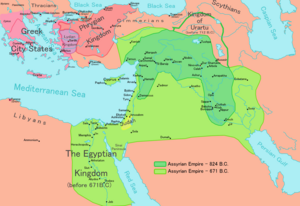 Map of Western Asia in the 7th century BC e. | |||
| date of | 605 year BC e. | ||
| A place | city of Karkemish | ||
| Total | victory of the Babylonians | ||
| Opponents | |||
| |||
| Commanders | |||
| |||
| Losses | |||
| |||
Around the end of the 7th century BC e. Assyria was under ever-increasing pressure from the kingdom of Babylon. In 614 BC e. The Babylonians took the Assyrian capital Assur in 612 BC. e. captured Nineveh , which forced the Assyrians to retreat and gain a foothold in Harran . After they were attacked there by the Babylonian forces, the Assyrians, led by King Ashshuruballitom II, left for the Euphrates . Here they were able to rely on the military assistance of the ancient Egyptian pharaoh Necho II and tried to conquer Harran the next year (although to no avail). In 608-607 years BC. e. military operations concentrated in the Kummukh region , while in the city of Karkemish Egyptian troops were located and from there carried out their operations. Based on this threat, the Babylonian heir to the throne of Nebuchadnezzar II in 605 BC. e. undertakes a campaign against Karkemish.
Nebuchadnezzar crossed the Euphrates, 20 km south of Karkemish, at Tel Tarsip, where there was a ford. After reinforcements arrived at the defenders of the city, they marched out of Karkemish for a decisive battle. The Egyptian army, learning of the approach of the Babylonian army, came out of Egypt; Pharaoh himself was at the head of it. During the clashes with the Egyptians, the Babylonians managed to break into the suburbs of Karkemish. Traces of these street battles were found during excavations in the city in 1912. In the end, the Egyptians suffered a decisive defeat under the walls of the city. Some of their remaining troops fled to the southwest, the rest retreated beyond the city walls. Nebuchadnezzar II pursued the retreating Egyptians to the city of Hama , where they finally scattered them.
After this crushing defeat, the Egyptians were forced to leave the entire region under their control in Asia Minor right up to El Arish . Although they managed to recapture in 600 BC. e. further advance of Babylon to the west and even regain the previously lost Gaza , however, the former power of Ancient Egypt in the eastern Mediterranean was undermined.
Literature
- Kurt Galling / Riekele Borger (ed.): Textbuch zur Geschichte Israels (3. Auflage), Verlag Mohr Siebeck, Tübingen 1979. ISBN 9-783-16142361-1
- JD Hawkins: Karkamiš , in: Erich Ebeling / Bruno Meissner / Dietz Otto Edzard (ed.): Reallexikon der Assyriologie , Bd. 5, Walter de Gruyter, Berlin 1980, 426–446. ISBN 3-11-007192-4
- W. Röllig: Mizir, Mizru, Musur, Musri III, Muzir , in: Erich Ebeling / Bruno Meissner / Dietz Otto Edzard (ed.): Reallexikon der Assyriologie , Bd. 8, Walter de Gruyter, Berlin 1997, S.261- 269. ISBN 3-11-014809-9
- E. Vogt: Die neubabylonische Chronik über die Schlacht bei Karkemisch und die Einnahme von Jerusalem , in: Pieter Arie Hendrik de Boer (ed.): Volume Du Congres Strasbourg , Leiden 1957, S.67-96.