Pasemahs or Middle Sumatran Malays belong to the group of peoples of Indonesia (they live on the Pasemah plateau in South Sumatra ). The number of representatives of the people of the passem is approximately 1,500 people. Pasemas speak a dialect of the Malay language of the Austronesian family . For the most part, they are Sunni Muslims. They are mainly involved in cultivating wild rice, growing corn, beans, tobacco, coffee, tea, and also raising livestock. Lead a sedentary lifestyle.
| Pasemah | |
|---|---|
| Abundance and area | |
| Total: 450,000 | |
 Indonesia Indonesia Province: South Sumatra | |
| Language | Malay dialect |
| Religion | Islam |
| Included in | Austronesian peoples |


Content
- 1 Board Features
- 2 Resettlement
- 3 Language
- 4 Family and marriage
- 5 Culture
- 6 Religion
- 7 Literature
- 8 References
Board Features
At the head of the people was the leader. In the eighteenth century, the leaders of the Pasemes took the oath of allegiance. There was a legend that one who breaks the oath will be damned. They had armed units that could perform various functions (Miksik 1966: 52) .
Settlement
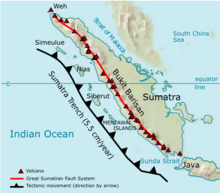
They live in Indonesia , in a province called South Sumatra and on the slopes of the Bukit Barisan mountains.
Language
Pasemahs speak a dialect of the Malay language belonging to the Austronesian family . Use syllabic writing (kaganga) to write ritual texts in the Malay language.
Family and marriage
There was tremendous influence from neighboring communities. Only in the middle of the 20th century communal houses (bale) disappeared. The main thing in the family can be both a man (patriotic marriage) with a ransom for the bride and a patrilineal account of kinship, and a woman (matrilocal marriage) without a ransom and with a matrilineal account of kinship.
Culture
Representatives of the passages created various stone statues. In addition to statues, various figures and gravestones were found in South Sumatra (Edwin 1937: 295) . In addition, women were able to sew beautifully. Rich and revered men wore long clothes. The pattern mainly consisted of 2 multi-colored stripes, the colors of which depended on traditions and customs (Majlis 1966: 45) .
Religion
Representatives of the Passeme people are mostly Muslims - Sunnis . Only in the 20th century Islam began to prevail. Prior to this, there was a syncretic belief system that was heavily influenced by Indonesian Hinduism .
Literature
- Brigitte Khan Majlis. Catalog // Art Institute of Chicago Museum Studies. - 1966. - Vol. 33 - No. 2. pp. 28-112.
- Edwin M. Sumatra. Its History and People / Edwin M. // Artibus Asiae. - 1937. - Vol.7— No. 2. - pp. 290-296.
- Miksic J. Classical Archeology in Sumatra / Miksic J. // Indonesia. - 1966.— Vol. 30.— pp. 42-66.
Links
- Ethnologue
- Brigitte Khan Majlis. Catalog // Art Institute of Chicago Museum Studies. - 1966. - Vol. 33 - No. 2. pp. 28-112.
- Edwin M. Sumatra. Its History and People / Edwin M. // Artibus Asiae. - 1937. - Vol.7— No. 2. - pp. 290-296.
- Miksic J. Classical Archeology in Sumatra / Miksic J. // Indonesia. - 1966. - No. 30.— pp. 42-66.