Arago Crater ( lat. Arago ), not to be confused with the Arago Crater on Mars , is an impact crater in the western part of the Sea of Tranquility on the visible side of the Moon . The name is given in honor of the French physicist and astronomer Dominic Francois Jean Arago (1786-1853) and approved by the International Astronomical Union in 1935. The formation of the crater belongs to the Eratosthenes period [1] .
| Arago | |
|---|---|
| lat Arago | |
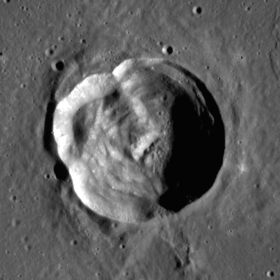 Shot of the Lunar Reconnaissance Orbiter probe. | |
| Characteristics | |
| Diameter | 26 km |
| Deepest | 2680 m |
| Title | |
| Eponym | Dominic Francois Jean Arago (1786-1853) - French physicist and astronomer. |
| Location | |
| Heavenly body | Moon |


Content
- 1 Crater Description
- 2 Satellite Craters
- 3 See also
- 4 notes
- 5 Links
Crater Description
The immediate neighbors of the crater are the Sozigen crater in the northwest; Craters Macleer and Ross in the north; Lamont Crater in the southwest and Manners Crater in the southwest [2] . The selenographic coordinates of the center of the crater are , diameter - 26 km [3] , depth - 2.68 km [4] .
The crater shaft has a circular shape with a protrusion in the western part. Several spurs leave from the southern part of the crater. The inner slope of the crater has a terrace-like structure. The shaft height above the surrounding area is 870 m [5] , the volume of the crater is approximately 440 km³ [5] . In the crater bowl is a central ridge stretching to the northern part of the crater. To the east and southeast of the crater in the Sea of Tranquility are the folds of the area. To the north of the crater is a large thyroid volcano , designated as Arago α. Another similar volcano, designated as Arago β, is located at the same distance to the west of the crater. The crater shaft has a brightness of 5 ° according to the Schröter brightness table .
Thermal anomalies during lunar eclipses were recorded in the crater . This phenomenon is explained by the small age of the crater and the lack of a sufficient layer of regolith , which has a thermally insulating effect. The phenomenon is characteristic of most young craters.
Satellite Craters
| Arago [3] | Coordinates | Diameter, km |
|---|---|---|
| B | 6.9 | |
| C | 3.0 | |
| D | 4.0 | |
| E | 6.3 |
See also
- List of Craters on the Moon
- Lunar crater
- Morphological catalog of Moon Craters
- Planetary nomenclature
- Selenography
- Mineralogy of the Moon
- Geology of the moon
- Late heavy bombardment
Notes
- ↑ Crater description on The Moon-Wiki
- ↑ Arago Crater on the LAC-60 map.
- ↑ 1 2 Handbook of the International Astronomical Union
- ↑ John E. Westfall's Atlas of the Lunar Terminator, Cambridge Univ. Press (2000)
- ↑ 1 2 Lunar Impact Crater Database . Losiak A., Kohout T., O'Sulllivan K., Thaisen K., Weider S. (Lunar and Planetary Institute, Lunar Exploration Intern Program, 2009); updated by Öhman T. in 2011. Archived page .
Links
- Digital photographic atlas of the moon.
- Pictures from the side of Apollo 10, Apollo 15.
- Arago Crater on the LAC-60 map.
- Selenological map of the vicinity of the crater.
- Arago Crater on AIC60 map.
- Andersson, LE, and EA Whitaker, NASA Catalog of Lunar Nomenclature, NASA Reference Publication 1097, October 1982.