Arson stadium in Zagreb ( Serbohorv. Stadium stadium near Zagreb / Paljenje stadiona u Zagrebu ) - sabotage action of the Yugoslav communist partisans, committed July 22, 1941 in Zagreb [1] . In the course of the events, nine people burned down an old wooden stadium in the Maksimir Zagreb district. [2]
| Arson Stadium in Zagreb | |||
|---|---|---|---|
| Main conflict: Yugoslav people's war of liberation | |||
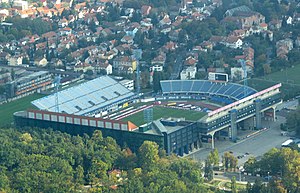 Stadium " Maksimir ", built on the site of the burned stadium | |||
| date | July 22, 1941 | ||
| A place | Maksimir , Zagreb district | ||
| Total | stadium burned to the ground | ||
| Opponents | |||
| |||
| Commanders | |||
| |||
| Forces of the parties | |||
| |||
| Losses | |||
| |||


Content
Background
From the very beginning of the reign of the Croatian fascists in Zagreb, who were subordinate to the leadership of the Third Reich, the capital of Croatia was restless, despite the apparent silence and the unchanging pace of life. Most of the population of Zagreb did not welcome the new government, considering it not as a liberation movement, but as collaborators and traitors. Among the dissatisfied were especially many members of the Union of Communist Youth of Yugoslavia and other anti-fascists. The very first act of sabotage against the authorities of the Ustasha was the burning of the stadium in the Maksimir district. Former pupils of Zagreb secondary schools were outraged by the fact that at the stadium, where training of the HASHK club had previously been held, it was now impossible to simply train or warm up: the Zagreb authorities decided to disassemble the stadium and put the wood in for military production. In response, the youth decided to burn the stadium and leave the Ustashi without a valuable resource. The first two attempts were unsuccessful, and the firemen successfully coped with the flame twice.
Arson
For the third time, Croatian youth decided to prepare much more thoroughly. The initiator of the arson was Martin Mojmir [2] , a member of the Zagreb city committee of UCMU. He was assisted by Kresho Rakic , Stanko Bronzin , Bratso Belic and Gvozde Budak (alumni-members of the JCC), Ljubo Šarić , Stepan Mlinarich , Boris Triglavchan and Raika Bakovich (schoolchildren). Raika took the post of courier in this team [3] .
Taking into account the unsuccessful experience, the conspirators decided to prepare a larger combustible mixture: they constantly conducted experiments with nitroglycerin in the apartment of Martin Moymir, trying to get the explosive substance they needed. After one of these experiments, an explosion thundered in the apartment: fortunately, there were no injuries, but one of the rooms of Moymir was burned. In the end, young people produced a rather explosive substance, after which at 9 o'clock in the evening, after being divided into two groups, they headed for the Sokol stadium in Maksimir. They managed to secretly sneak past the guards and arrange tanks with a combustible mixture on all sides of the stadium. After completing the work, the group set fire to the stadium and quietly ran away. By morning it turned out that the stadium had burned to the ground [2] .
Implications
The Croatian authorities were furious to learn of such arson, but until November 1941 they could not even reach the trail of suspects. After long interrogations and tortures, the Ustash police found out the names of several conspirators. On November 22, 1941, agents of the Ustash Inspection Service on the corner of Heinzlowa and Zvonimirova streets arrested Kresho Rakic , Stepan Mlinarich , Velko Dragovic and another unknown person who was found to have leaflets from the Communist Party of Yugoslavia. Milan Ivekovich, an ONS agent, was supposed to deliver them to House 2 on Zvonimirova Street on the third floor, but Mlinarich grabbed a pistol and shot the agent [2] . Kresho Rakic was arrested, and soon he was shot with 17 more anti-fascists in Rakov Stream [2] . In memory of him in the Zagreb suburb of Trnsko, a primary school and a cultural center were renamed [4] .
In popular culture
In 1977, Dusan Vukotic made a film about the events entitled “ Operation„ Stadium “ " ( Serb. Aktsi stadia ).
Notes
- ↑ forum.net.hr: Zagreb antifasisticki grad! Bio i ostao !, sa portala forum.net, pristupljeno 6. rujna 2010. Archival copy dated March 4, 2016 on Wayback Machine (Croatian)
- ↑ 1 2 3 4 5 sites.google.com: Oružane akcije i diverzije, sa portala Zagreb se bori, pristupljeno 6. septembra 2010. (Croatian)
- ↑ znaci.net: Biografija Rajke Baković na portalu Narodni heroji Jugoslavije
- ↑ Novi Zagreb - Informativni web portal, pristupljeno 7. septembra 2010. Archival copy of July 23, 2011 on the Wayback Machine (Croatian)
Links
- Kultura zaborava - upoznavanje nepoznatog Zagreba (serbohorv.)