Pigeon Mu (μ Columbae, μ Col) is a fifth magnitude star (5 m , 17) of spectral class O9.5, located on the main sequence , one of the few in its class that can be seen with the naked eye . Having a declination of 32 ° south of the celestial equator , Mu Dove is the star of the southern hemisphere . In the northern hemisphere, the star is observed up to 58 ° north of latitude , that is, in almost all countries, with the exception of Greenland , the northern regions of Canada and Russia , as well as Iceland and most of Sweden and Norway . The best months for observing a star on the territory of Russia : December , January .
| Mu Dove | |||
|---|---|---|---|
| Star | |||
| Observational data ( Epoch J2000.0 ) | |||
| Right ascension | |||
| Declination | |||
| Distance | 1300 sv. years (398 pc ) [1] | ||
| Visible magnitude ( V ) | 5.17 [1] | ||
| Constellation | Dove | ||
| Astrometry | |||
| Radial velocity ( R v ) | 109.2 [2] km / s | ||
| Proper motion (μ) | RA: 3.01 [2] mas per year Dec: -22.62 [2] mas per year | ||
| Parallax (π) | 2.45 ± 0.20 [2] mas | ||
| Absolute magnitude (V) | -2.84 [3] | ||
| Specifications | |||
| Spectral class | O9,5V [2] | ||
| Color Indicator ( B - V ) | -0.28 [2] | ||
| Color Index ( U - B ) | -1.12 [2] | ||
| Variability | possible [4] | ||
| physical characteristics | |||
| Weight | 11.2 [5] M ☉ | ||
| Radius | 4.5 [1] R ☉ | ||
| Age | 2.5 [1] million years | ||
| Temperature | 33,700 [1] K | ||
| Luminosity | 23 300 [1] L ☉ | ||
| Rotation | ~ 140 km / s (1.5 days) [1] | ||
| Properties | Star runner | ||
| |||
| Information in databases | |||
| SIMBAD | data | ||
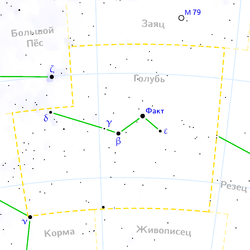


The star is located at a distance of 1300 light years from Earth in the constellation Dove . If we take into account that its temperature is 33,700 K and, accordingly, it emits a lot in the ultraviolet range , and also take into account that the interstellar absorption of dust is small - 0.1 m of magnitude , we can calculate that the Pigeon Mu has a luminosity of 23,300 solar . From this figure it can be calculated that its radius is 4.5 times the solar one , and the orbital period is less than 1.5 days (although the exact rotational speed for this star is unknown, but for stars of this class the typical minimum rotational speed starts from 140 km / s ). The mass of a star can be estimated as about ten solar [1] , Tetslaf et al. (2011) give a maximum mass estimate of 11.2 M ☉ [5] .
It is also typical that the star emits a fairly strong stellar wind with a mass loss rate of about 0.1 ppm of the mass of the Sun per year. Mu Dove and her partner AE Vozneg are classic " runner stars ." The star moves at a speed of 117 km / s relative to the Sun , and in relation to AE, the Chauffeur moves directly from it at a speed of more than 200 km / s . Once they must have been together, and now they are 70 ° apart. Modern calculations allow us to trace their history in time, and show that the couple was born near the area where the Trapezium of Orion is now (the area itself, since the Trapezium itself is about a million years old) about 2.5 million years ago [1] .
Astronomers Blaau and Morgan in 1954 suggested [6] that both stars gained so much speed as a result of a single event. Neither AE Auriga nor Pigeon do not show signs of mass exchange in the past (this is judged by the amount of helium ), which means, most likely, the reason that these two stars are thrown out of the cluster is precisely the dynamic scenario [7] . Shortly after the pair was born, they experienced a close span of the Orion's iota (Nair Al Saif), a multiple star system whose main component is a very close binary star with an unusually large orbital eccentricity . Dzhies and Bolton in 1986 concluded [8] that the AE of the Aurigaeus , μ Dove, as well as a pair of massive stars with large eccentricities of the orbits called Orion ι (O and B giants) is the result of a two-by-two interaction, which caused the appearance of running stars. As a result of this flight, star pairs, apparently, exchanged stars, and two other stars were thrown at high speed in different directions, one of which is currently in the constellation Dove , and the other in the constellation Auriga [1] .
Notes
- ↑ 1 2 3 4 5 6 7 8 9 10 Jim Kaler. Mu Columbae (Eng.) . STARS . Archived January 24, 2013.
- ↑ 1 2 3 4 5 6 7 HR 1996 - Variable Star . SIMBAD . Center de Données astronomiques de Strasbourg . The date of circulation is December 11, 2012. Archived January 25, 2013. (eng.)
- ↑ Of apparent magnitude and parallax
- ↑ Mu Columbae (English) . BSC . Archived January 25, 2013.
- ↑ 1 2 Tetzlaff, N .; Neuhäuser, R .; Hohle, MM Runway of Hipparcos stars within 3 kpc from the Sun (Eng.) // Monthly Notices of the Royal Astronomical Society : journal. - Oxford University Press , 2011. - January ( vol. 410 , no. 1 ). - P. 190-200 . - DOI : 10.1111 / j.1365-2966.2010.17434.x . - . - arXiv : 1007.4883 .
- ↑ Blaauw, A .; Morgan, WW The Aurigae and the Columbae of the Space Motions of the Columbae ; - IOP Publishing , 1954. - May ( vol. 119 ). - P. 625 . - DOI : 10.1086 / 145866 . - . (eng.)
- ↑ Hoogerwerf, R .; de Bruijne, JHJ; Ote and B-type stars with high velocities. Ii. Runaway stars and pulsars from the nearby young stellar groups (English) // Astronomy and Astrophysics : journal. - EDP Sciences , 2001. - January ( vol. 365, ). - P. 49-77 . - DOI : 10.1051 / 0004-6361: 20000014 . - . (eng.)
- ↑ Gies, DR; Bolton, CT The runaway stars (The English) // The Astrophysical Journal : journal. - IOP Publishing , 1986. - June ( vol. 61 ). - P. 419-454 . - DOI : 10.1086 / 191118 . - . (eng.)