Scarlet finch [1] ( lat. Haematospiza sipahi ) is a bird of the finch family. For a long time, the bird was in the monotypic genus Haematospiza , until it was combined with Uragus and Bonian oak-trees Chaunoproctus into a tribe of lentils Carpodacini. [2] The scientific name of the species sipahi is associated with sipahs - cavalrymen of the Ottoman Empire who wore a red coat.
| Scarlet Reel |
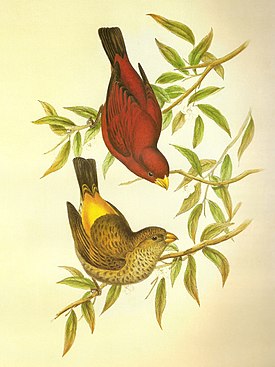
A pair of birds. Illustration by John Gould , 1850-1854 |
| Scientific classification |
|---|
| No rank : | Bilateral symmetrical |
| Infrastructure : | Passerida |
| Gender: | Scarlet reels ( Haematospiza Blyth , 1845 ) |
|
| International scientific name |
|---|
Haematospiza sipahi Hodgson , 1836 |
| Synonyms |
|---|
Carpodacus sipahi , Erythrina sipahi |
| Security status |
|---|
Least ConcernedIUCN 3.1 Least Concern : 22720635 |
|
The body length is 18–19 cm, for example, a large and strong beak 16–20 mm long is brownish pink above and yellowish below. The legs are brownish pink. The male has a wing length of 98–108 mm, a tail length of 59–70 mm, and a weight of 38–42.5 g. The female has a wing length of 95 to 103 mm, a tail length of 55 to 66 mm, and a weight of 39 to 40 g Expressed sexual dimorphism . Males have bright red plumage with black wings, females have brown plumage.
It lives in the Himalayas from central Nepal to Vietnam and in some regions south to Thailand . It inhabits mainly pine forests at an altitude of 1600 to 3355 m above sea level.
Scarlet finch is found both individually and in packs. Leads a secretive daytime lifestyle. Nutrition consists of seeds, buds, berries and sometimes insects.
Little is known about the biology of reproduction.