A toroidal coordinate system is an orthogonal coordinate system in space whose coordinate surfaces are tori, spheres, and half-planes. This coordinate system can be obtained by rotating a two-dimensional bipolar coordinate system around an axis equidistant from the foci of the bipolar system.
Toroidal coordinate system {\ displaystyle (\ alpha, \ beta, \ varphi)}  determined by the transition formulas from these coordinates to Cartesian coordinates :
- {\ displaystyle x = {\ frac {c \, \ mathrm {sh} \, \ alpha \ cos \ varphi} {\ mathrm {ch} \, \ alpha - \ cos \ beta}} \ quad \ quad y = { \ frac {c \, \ mathrm {sh} \, \ alpha \ sin \ varphi} {\ mathrm {ch} \, \ alpha - \ cos \ beta}} \ quad \ quad z = {\ frac {c \ sin \ beta} {\ mathrm {ch} \, \ alpha - \ cos \ beta}}}
 ,
,
Where {\ displaystyle c> 0}  - a scale factor that must be fixed to select a specific toroidal coordinate system, {\ displaystyle 0 \ leqslant \ alpha <\ infty, - \ pi <\ beta \ leqslant \ pi, - \ pi <\ varphi \ leqslant \ pi}
  .
.
Coordinate surfaces
{\ displaystyle \ alpha = \ mathrm {const}}  - tori
- {\ displaystyle ({\ sqrt {x ^ {2} + y ^ {2}}} - c \, \ mathrm {cth} \, \ alpha) ^ {2} + z ^ {2} = \ left ({ \ frac {c} {\ mathrm {sh} \, \ alpha}} \ right) ^ {2}}
 ,
,
{\ displaystyle \ beta = \ mathrm {const}}  - spheres
- {\ displaystyle (zc \, \ mathrm {ctg} \, \ beta) ^ {2} + x ^ {2} + y ^ {2} = \ left ({\ frac {c} {\ sin \ beta}} \ right) ^ {2}}
 ,
,
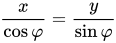
{\ displaystyle \ varphi = \ mathrm {const}}  - half planes
- {\ displaystyle {\ frac {x} {\ cos \ varphi}} = {\ frac {y} {\ sin \ varphi}}}
 .
.
Differential characteristics
- The metric tensor in toroidal coordinates has the form:
- {\ displaystyle g_ {ij} = {\ begin {pmatrix} {\ frac {c ^ {2}} {(\ mathrm {ch} \, \ alpha - \ cos \ beta) ^ {2}}} & 0 & 0 \\ 0 & {\ frac {c ^ {2}} {(\ mathrm {ch} \, \ alpha - \ cos \ beta) ^ {2}}} & 0 \\ 0 & 0 & {\ frac {c ^ {2} \ mathrm { sh} ^ {2} \ alpha} {(\ mathrm {ch} \, \ alpha - \ cos \ beta) ^ {2}}} \ end {pmatrix}}, \ quad g ^ {ij} = {\ begin {pmatrix} {\ frac {(\ mathrm {ch} \, \ alpha - \ cos \ beta) ^ {2}} {c ^ {2}}} & 0 & 0 \\ 0 & {\ frac {(\ mathrm {ch} \, \ alpha - \ cos \ beta) ^ {2}} {c ^ {2}}} & 0 \\ 0 & 0 & {\ frac {(\ mathrm {ch} \, \ alpha - \ cos \ beta) ^ {2 }} {c ^ {2} \, \ mathrm {sh} ^ {2} \, \ alpha}} \ end {pmatrix}}.}

It is diagonal, since the toroidal coordinate system is orthogonal .
- {\ displaystyle ds ^ {2} = {\ frac {c ^ {2}} {(\ mathrm {ch} \, \ alpha - \ cos \ beta) ^ {2}}} (d \ alpha ^ {2} + d \ beta ^ {2} + \ mathrm {sh} ^ {2} \ alpha \, d \ varphi ^ {2})} .
- {\ displaystyle dS ^ {2} = {\ frac {c ^ {4}} {(\ mathrm {ch} \, \ alpha - \ cos \ beta) ^ {4}}} ((d \ alpha \, d \ beta) ^ {2} + \ mathrm {sh} ^ {2} \ alpha (d \ alpha \, d \ varphi) ^ {2} + \ mathrm {sh} ^ {2} \ alpha (d \ beta \ , d \ varphi) ^ {2})} .
- {\ displaystyle dV = {\ frac {c ^ {3} \ mathrm {sh} \, \ alpha} {(\ mathrm {ch} \, \ alpha - \ cos \ beta) ^ {3}}} d \ alpha \, d \ beta \, d \ varphi} .
- {\ displaystyle h _ {\ alpha} = h _ {\ beta} = {\ frac {c} {\ mathrm {ch} \, \ alpha - \ cos \ beta}}, \ quad h _ {\ varphi} = {\ frac {c \, \ mathrm {sh} \, \ alpha} {\ mathrm {ch} \, \ alpha - \ cos \ beta}}} .
- {\ displaystyle {\ frac {\ partial (x, y, z)} {\ partial (\ alpha, \ beta, \ varphi)}} = {\ frac {c ^ {3} \ mathrm {sh} \, \ alpha} {(\ mathrm {ch} \, \ alpha - \ cos \ beta) ^ {3}}}} .
- Kristoffel's symbols of the second kind:
- {\ displaystyle \ Gamma _ {ij} ^ {1} = {\ begin {pmatrix} 0 & - {\ frac {\ sin \ beta} {\ mathrm {ch} \, \ alpha - \ cos \ beta}} & 0 \ \ - {\ frac {\ sin \ beta} {\ mathrm {ch} \, \ alpha - \ cos \ beta}} & {\ frac {\ mathrm {sh} \, \ alpha} {\ mathrm {ch} \ , \ alpha - \ cos \ beta}} & 0 \\ 0 & 0 & {\ frac {\ mathrm {sh} \, \ alpha (\ mathrm {ch} \, \ alpha \ cos \ beta -1)} {\ mathrm {ch } \, \ alpha - \ cos \ beta}} \ end {pmatrix}},}
- {\ displaystyle \ Gamma _ {ij} ^ {2} = {\ begin {pmatrix} {\ frac {\ sin \ beta} {\ mathrm {ch} \, \ alpha - \ cos \ beta}} & - {\ frac {\ mathrm {sh} \, \ alpha} {\ mathrm {ch} \, \ alpha - \ cos \ beta}} & 0 \\ - {\ frac {\ mathrm {sh} \, \ alpha} {\ mathrm {ch} \, \ alpha - \ cos \ beta}} & 0 & 0 \\ 0 & 0 & {\ frac {\ mathrm {sh} ^ {2} \ alpha \ sin \ beta} {\ mathrm {ch} \, \ alpha - \ cos \ beta}} \ end {pmatrix}},}
- {\ displaystyle \ Gamma _ {ij} ^ {3} = {\ begin {pmatrix} 0 & 0 & - {\ frac {1} {(\ mathrm {ch} \, \ alpha - \ cos \ beta) \ mathrm {sh} ^ {2} \ alpha}} \\ 0 & 0 & - {\ frac {\ sin \ beta} {\ mathrm {ch} \, \ alpha - \ cos \ beta}} \\ - {\ frac {1} {(\ mathrm {ch} \, \ alpha - \ cos \ beta) \ mathrm {sh} ^ {2} \ alpha}} & - {\ frac {\ sin \ beta} {\ mathrm {ch} \, \ alpha - \ cos \ beta}} & 0 \ end {pmatrix}}.}
The Laplace equation in toroidal coordinates has the form:
- {\ displaystyle \ left ({\ frac {\ partial} {\ partial \ alpha}} \ left ({\ frac {\, \ mathrm {sh} \, \ alpha} {\ mathrm {ch} \, \ alpha - \ cos \ beta}} {\ frac {\ partial u} {\ partial \ alpha}} \ right) + {\ frac {\ partial} {\ partial \ beta}} \ left ({\ frac {\, \ mathrm {sh} \, \ alpha} {\ mathrm {ch} \, \ alpha - \ cos \ beta}} {\ frac {\ partial u} {\ partial \ beta}} \ right) + {\ frac {1} {(\ mathrm {ch} \, \ alpha - \ cos \ beta) \, \ mathrm {sh} \, \ alpha}} {\ frac {\ partial ^ {2} u} {\ partial \ varphi ^ {2 }}} \ right) = 0}
It is convenient to search for a solution in the form:
- {\ displaystyle u = v {\ sqrt {2 \ mathrm {ch} \ alpha -2 \ cos \ beta}}} ,
then the equation for the function {\ displaystyle v} :
- {\ displaystyle v _ {\ alpha \ alpha} + v _ {\ beta \ beta} + v _ {\ alpha} \ mathrm {cth} \, \ alpha + {\ frac {1} {4}} v + {\ frac {1 } {\ mathrm {sh} ^ {2} \ alpha}} v _ {\ varphi \ varphi} = 0} .
Then you can separate the variables:
- {\ displaystyle v = A (\ alpha) B (\ beta) \ Phi (\ varphi)} .
The result is a system:
- {\ displaystyle {\ begin {cases} A '' + \, \ mathrm {cth} \, \ alpha \, A '+ \ left ({\ frac {1} {4}} - {\ frac {k _ {\ varphi} ^ {2}} {\ mathrm {sh} ^ {2} \ alpha}} - k _ {\ beta} ^ {2} \ right) A = 0 \\ B '' + k _ {\ beta} ^ { 2} B = 0 \\\ Phi '' + k _ {\ varphi} ^ {2} \ Phi = 0 \ end {cases}}}
In the case of the Helmholtz equation in toroidal coordinates, the variables are not divided.