- This article is about a noble family; about carriers of a surname see: Bogomolets ; on the Serbian Social Movement - Prayer Movement
The pilgrims , or Oliferovich-Bogomoltsy , are Polish, Belarusian, Ukrainian and Russian gentry and noble families . They come from Vitebsk region (the territory of modern Belarus ). They were printed with the emblems of “ Bogoria ” and “ Pomian ” (some with the emblem of “ Koscesh ”).
| Pilgrims | |
|---|---|
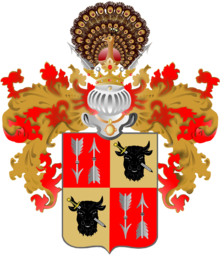 Coat of arms of the “Bogoria-Pomian” Pious pilgrims and Sobolev-pilgrims | |
| Coat of arms description: Four-part shield. In the first and fourth scarlet parts, two silver arrows in a row, of which the right one is overturned. In the second and third golden parts, the black head of the bison is pierced obliquely to the right with a silver hilt with a golden hilt. The shield is crowned with a noble crowned helmet. Crest: Exiting peacock with open tail between two diverging silver arrows. Bait: scarlet with gold. | |
| Ancestor | Olifer |
| Branches of the genus | Vitebsk branch and Chernihiv branch |
| Place of origin |  Grand Duchy of Lithuania , Vitebsk Grand Duchy of Lithuania , Vitebsk |
| Nationality | |
 Grand Duchy of Lithuania Grand Duchy of Lithuania | |
 Polish-Lithuanian Commonwealth Polish-Lithuanian Commonwealth | |
 Russian empire Russian empire | |

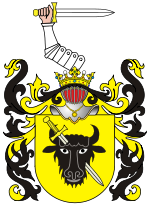
Genesis
According to the surviving documents, the beginning of the Bogomolets family can be traced from the middle of the 15th century . Under the year 1450, the “Book of Award” of the Lithuanian Metric mentions Ivan and Semyon Oliferovichi, servicemen of the Grand Duchy of Lithuania, and the owners of the family estate Pogostishche. The protoplast of the genus Olifer, which is known only from the full names of his children, could be born at the end of the XIV - beginning of the XV centuries.
Allegedly, either Olifer himself or his father unknown to us participated in the Battle of Grunwald in July 1410 as part of the Vitebsk gonfalon of the Grand Duchy of Lithuania .
The knightly title and clan coat of arms of “Bogoria” Olifer or his children received the Vilnius privilege of 1447 , issued by the Polish King and Grand Duke of Lithuania Casimir Jagielonchik . Priviley accelerated the formation of a knightly estate on the lands of modern Belarus and Ukraine. Thus, we can conclude that Olifer came under the "first wave" of the action of this document .
The hypothesis about the origin of the family name of Bogomoltsev is associated with the church of St. Nicholas the Miracle Worker , mentioned in the documents on the division of the family estate of Pogostishche between representatives of two branches of Olefirovich under 1527 . However, it is clear that the church was built earlier . The oldest mention of the first of the Oliferovichs, which began to be called the Bogomolets - Senko Yushkovich (Semyon Yuryevich) Oliferovich (60-70 years of the 15th century - after 1543 ) in documents takes place under the year 1500 . Obviously, he built this church, after which both himself and his descendants who cared for her began to be called Prayers . Other Oliferovichs began to be called Pogoskih - from the name of the estate Pogostishche .
Prominent representatives of the clan
Military service was the main occupation of the service boyars of the Olefirovichs, and later the nobility of the Bogomolets. In the military register of the Grand Duchy of Lithuania from 1528 , three brothers Olefirovich, as well as Senko Yushkovich (Semyon Yuryevich) Bogomolets, who served in equestrian banners, are mentioned.
Senka’s grandson, Grigory Ivanovich Bogomolets (late 16th century - 1640 ), served in the elite cavalry of the Commonwealth — winged hussars .
Three sons of Gregory Bogomolets - Dmitry, Alexander and Jan - participated in the defense of Vitebsk from Moscow troops in 1654 . After the fall of the city, the brothers were captured, where they spent about 14 years. The youngest, Jan, was not even 15 years old at that time.
Among the grandchildren of Jan Bogomolets, three chose a spiritual career, joining the Jesuit order. The most famous of them was Franciszek Bogomolets ( 1720 - 1784 ) - a well-known theologian, activist of the Polish and Belarusian Enlightenment , the founder of Polish dramaturgy and professional theater. His plays, especially comedies, still go on with success on the theatrical stages of Poland. He was also a talented poet, linguist, historian, publisher, editor-in-chief of the first Polish periodicals, including literary and pedagogical. Franciszek Bogomolets streamlined and published Polish-Lithuanian historical chronicles, laid the foundations of historical biography.
His younger brother, Jan Chrysostom-Anthony Bogomolets ( 1724 - 1795 ) is a theologian, moralist, religious philosopher, astronomer and mathematician. He fought against the prejudices prevalent among the people. This topic is dedicated to his most famous work - "The Devil As He Is."
Their brother, Ignatius the Bogomolets ( 1726 - after 1780 ), served as head of the Roman Catholic Church in Moscow. .
Their brother, Petr-Tadeusz Bogomolets ( 1729 - after 1789 ) is a deputy of the Sejm and the Main Lithuanian Tribunal. For a long time, he resisted Russian intervention in the internal affairs of the Commonwealth , so even Russian diplomats considered him hopeless for negotiations. However, after dividing the country, he was forced to take an oath of allegiance to Empress Catherine II .
The sons of Peter-Tadeusz began their careers in the tsarist army. One of them, Romuald Bogomolets (1763-1840) served in the Life Guards Horse Regiment . He was mayor of Vitebsk in 1812, for three years ( 1816 - 1819 ) he was elected the Vitebsk provincial leader of the nobility . Among his merits - the construction of postal stations in the Vitebsk province , for which he attracted funds from the local gentry; participation in the construction of the Vitebsk Holy Intercession Cathedral, guardianship of the Vitebsk male gymnasium.
One of the best graduates of this institution was Mechislav-Troyan Bogomolets ( 1843 - after 1901 ). He served in the Kostroma Zemstvo hospital, had an impeccable professional reputation, led the Kostroma Society for Helping Children, was the headman of the local Roman Catholic parish. And in 1901 he became a member of the Board of Trustees of the first female gymnasium in Kostroma.
The direct descendant of Romuald Bogomolets - sailor-yachtsman Andrzej Bogomolets ( 1900 - 1988 ) served in the Lancers of the Polish army, fought against the Red Army near Warsaw (the battle known in history as the “ miracle over the Vistula ”). In 1933-34, Andrzej Bogomolets, together with his comrades, became the first Poles to cross the Atlantic Ocean on the Dahl sailing yacht. He wrote a book about this journey. During the Second World War, he fought against the Nazis as a volunteer in France , North Africa , the Middle East in the army of Vladislav Anders . Knight of the Legion of Honor . After the war, Andrzej Bogomolets emigrated to Canada . He owned the ranch, which is now part of Canada’s National Park Heritage.
A direct descendant of Jan Bogomolets is also an outstanding Russian artist, art critic and restorer Lev Konstantinovich Bogomolets ( 1910 - 2009 ), the last of the representatives of the classical school of Russian painting. The artist’s favorite topics were the sea and flowers. At the age of 29, Leo Bogomolets discovered the secret of paint, which was used by the great Italian artist of the 16th century Paolo Veronese to get a purple-pink color. His paintings adorn private and national galleries in the USA , France, Israel , Russia, Latvia , Ukraine , Germany .
Elzbieta-Malgožata Bogomolets - Doctor of Psychiatry , a professional psychoanalyst. She began to study psychoanalysis back in the 1970s, for which she was persecuted by the communist government. Licensed member of the Polish Psychoanalytic Society (Polskie Towarzystwo Psychoanalityczne), full member of the International Psychoanalytic Association (IPA) since 1989 . One of the first regiments elected to this Association at a congress in Rome, when the taboo was removed from psychoanalysis due to political changes in Poland.
Chernigov Branch
The splitting of the genus into the "Vitebsk" and "Chernigov" branches occurred, most likely, in the middle - second half of the XVI century. However, representatives of the “Chernihiv” branch of the Bogomolets are traced on the territory of modern Chernihiv region (Ukraine), namely, in the Kozeletsky district not earlier than the end of the XVII - beginning of the XVIII century. Former Lithuanian gentry, moving to the territory of the Hetman , which was part of the Moscow kingdom , went to serve in the Cossack regiments as iconic comrades, received land from the tsarist administration with serfs, orders and ranks.
The grandson of probably the first immigrants from Lithuania to Ukraine - Vasily Bogomolets, Eustathius (Ostap) Petrovich Bogomolets (bl.1750-1755 - 1805 \ 1806), served as a military comrade - resigned and became burgomaster of Kozelets. Unlike his predecessors, the coat of arms of Bogoria, he already used the coat of arms of Pomyan.
His grandson, Mikhail Fedorovich Bogomolets (1811–1898), rose to the title of Advisor in the Nizhinsky District Court. Two daughters and the son of Mikhail Fedorovich - Anna, Elizabeth and Alexander ( 1850 - 1935 ) - were carried away by revolutionary activities. The sisters were expelled from St. Petersburg for participating in student gatherings, and Elizabeth was even arrested for unreliability.
More dramatic was the fate of Alexander Mikhailovich Bogomolets . In 1875, he graduated with honors from the medical faculty of the University of St. Vladimir , and the next year he married Sofia Nikolaevna Prisetskaya (1856-1892), the coat of arms of Novina . Together with her, he participated in revolutionary activities, was arrested and deported to Kazakhstan , several years unsuccessfully seeking a meeting with his wife, who was serving her sentence in hard labor in Siberia . From the marriage of Alexander and Sofia Bogomoltsev was born an outstanding scientist, 7th president of the Academy of Sciences of the Ukrainian SSR, vice president of the USSR Academy of Sciences, academician Alexander Alexandrovich Bogomolets ( 1881 - 1946 ).
The cousin of academician Alexander Bogomolets is Vadim Mikhailovich Bogomolets ( 1878 - 1936 ), a coronet general of the Ukrainian State , the author of the first Ukrainian law on the fleet - “The Provisional Law on the Fleet of the Ukrainian People’s Republic ”. Chief naval prosecutor of the Ukrainian State. In the days of the Directory of Simon Petliura, he was a naval attache of Ukraine in Romania . After the defeat, the UPR emigrated to Constantinople , where for two years he headed the organization “Committee for the Salvation of Ukraine”. Died in Paris.
Another representative of the "Chernihiv" branch of the clan is Nikolai Fedorovich Bogomolets ( 1871 - 1951 ), an officer of the Russian Imperial Army , and later a participant in the White Guard movement. The son of a military officer, a participant in the Russian-Turkish war of 1877-1878. He participated in the first world war . The only St. George cavalier among all the pilgrims who served in the Russian Imperial Army. He served in the rank of Major General in the army of Admiral Kolchak , and commanded an armored division with Ataman Semenov . After the civil war he emigrated to the United States. His son, Boris Nikolaevich, was shot in 1937 as an “ enemy of the people ."
Medical Dynasty of Pilgrims
One of the oldest medical dynasties in Ukraine.
The founder of the dynasty is Alexander Mikhailovich Bogomolets (1850-1935), a zemstvo doctor, and his wife Sofia Nikolaevna. Their son, Alexander Alexandrovich Bogomolets (1881–1946), was the president of the Academy of Sciences of the Ukrainian SSR , the vice president of the USSR Academy of Sciences and the USSR Academy of Medical Sciences . Founder of the first medical research institutions in Russia and Ukraine.
The youngest doctor of medicine in the Russian Empire (at the time of defense of his doctoral dissertation, he was 28 years old). He developed a technique for preserving donated blood, which is still used today. Invented immune cytotoxic antireticular serum, which was widely used in Soviet hospitals during the Soviet-German war of 1941-1945. Defended fellow scientists from Stalinist repression. After the death of Academician Bogomolets, the doctrine of connective tissue was declared “unscientific”, contrary to the teachings of Ivan Petrovich Pavlov . The research institutes founded by him in Ukraine were on the verge of closure. Repression stopped only after the death of Stalin .
The only son of Academician Bogomolets from his marriage with Olga Georgievna Tikhotskaya coat of arms “ Nalench ” ( 1891 - 1956 ) - Oleg Alexandrovich Bogomolets ( 1911 - 1991 ), continued the work of his father. After being in the scientific direction in which Alexander Alexandrovich worked, Oleg Bogomolets headed the pathophysiology laboratory of the Ukrainian Research Institute of Pharmacology and Toxicology ( 1953 - 1980 ). At the same time he was the head of the department of pathophysiology of the Kiev Institute for Advanced Medical Studies. Corresponding Member of the Academy of Sciences of the Ukrainian SSR ( 1964 ), Honored Worker of Science and Technology of the Ukrainian SSR.
The daughter of Oleg Alexandrovich, Ekaterina Olegovna ( 1939 - 2013 ) - professor of the Department of Pathological Anatomy of the National Medical University named after Pilgrims. She worked as an anesthetist at the Institute of Tuberculosis and Breast Surgery under the guidance of Academician Nikolai Amosov .
Her sister, Alexandra Olegovna (born 1958 ) is a pediatric resuscitator.
Olga Vadimovna Bogomolets (born 1966 ), doctor, public figure, daughter of Ekaterina Olegovna Bogomolets and Vadim Akimovich Berezovsky (born 1932 ), head of the department of the Institute of Physiology named after Bogomolets , Honored Worker of Science and Technology of Ukraine, holder of the Order of Yaroslav the Wise, V degree.
Honored Doctor of Ukraine, Doctor of Medicine, Professor of Kiev National Medical University Pilgrims. In 1994 she founded the clinic of laser medicine (now the Institute of Dermatology and Cosmetology, Dr. Bogomolets).
Olga Bogomolets is the author of more than 70 scientific papers and 9 patents for inventions in the field of treatment of skin diseases.
Olga Bogomolets created the historical and cultural complex “Radomysl Castle” in the city of Radomyshl (Zhytomyr region), which includes the world's only Museum of Ukrainian home icon .
Author and performer of Ukrainian romances to poems by Ukrainian poets and their own. An active participant in the Euromaidan (November 2013 - February 2014), the organizer of the Euromaidan medical service in Kiev. Since March 29, 2014 she was a candidate for the post of President of Ukraine through self-nomination. Since September 1, 2014 - Advisor to the President of Ukraine on humanitarian issues. On October 26, 2014, at an extraordinary parliamentary election, she was elected People's Deputy of Ukraine from the Bloc Petro Poroshenko (No. 3 on the list).
Sources
- National History Archive of the Republic of Belarus (NIAB). F.2512, op. 2, ref. 2, l 7-14.
- State Archive of the Chernigiv Oblast (DACHO). Nizhny branch. F. 101, op. 21, l 1-29
- Acts issued by the Vilnius Archaeographic Commission (AWAC). T. XIII. - Vilna, 1886 .-- S. 93-98; T. XXXIV. - Vilna, 1909. - S. 64, 390.
- Historical and legal materials extracted from the assembly books of the provinces of Vitebsk and Mogilev (IUM). Vol. 17. - Vitebsk, 1888. - S. 213-216; Vol. 22. - Vitebsk, 1891. - S. 455-457; Vol. 23. - Vitebsk, 1892. - S. 320—326, 492, 493; Vol. 24. - Vitebsk, 1893. - S. 244-248, 248-251, 493; Vol. 25. - Vitebsk, 1894. - S. 335—336; Vol. 26. - Vitebsk, 1895. - S. 120-131.
- Lithuanian metric. Book No. 3. - Vilnius, 1998. - C. 31.
- "Perapis troops of the Vyalikag prince of the Litokskag." - Minsk, "Belarusian Navuka", 2003. - S. 156.
- “The address calendar and reference book of the Poltava province for 1904”. - Poltava. 1904.
- Blinova T. “Jesuits in Belarus (their role in the organization of education and enlightenment)”. - Grodno, 2002 .-- S. 113-115.
- Vilensky Yu. “Unknown Praying Mantis”. - “Mirror of the week”, No. 14 \ 1999
- Cat S. Kucheruk O. "National Pantheon". “Call for help”, No. 9, 2007 p. - S. 50-52.
- Litvin M.R., Naumenko K.Є. “Ukraine’s first half of the XX century Generals and Admirals ”/ Institute of Ukrainian Studies im. І. Krip'yakevich National Academy of Sciences of Ukraine. - Lviv, Kharkiv. “Vidavnitstvo Saga”, 2007. - 244 p. Stor. 44-45.
- Mamchak M. “Ukraine. Way to the sea. History of the Ukrainian Fleet
- Boniecki A. Herbarz polski. - TI - Warszawa, 1899. - S. 360.
- Boniecki A. - Herbarz Polski. Uzupelnienia i sprostowania do części I. - Warszawa, 1901. - S. 231.
- Niesiecki K. Herbarz Polski. - Lipsk, 1839. - T. II. - S. 206).
- Rocznik oficerski. - Warszawa, 1923 - S. 601, 688.
- Wojcicki K. Cmientarz Powązkowski pod Warszawą. - Warszawa, 1856. - T.II. - S. 158-160.
- Wywiad z Wojciechiem Jacobsonem. - “Zeszyty Żeglarskie”, 23 sierpnia 2005 r.
- "Immigration: Mme Perkins' Problems." - “TIME”, 1938, Sep. 26.
- "Semenoff, Cossack Chief, Is Arrested On Arrival Here" - The New York Times, 1922, Apr. 7.
Links
- Yuri Rudnitsky. Dangerous relatives of academician Alexander Bogomolets (inaccessible link)
- MARTIROLOG of officers and units of the Ukrainian Sovereign Fleet (b. 1917-1921). Miroslav Mamchak
- Profile Alexander Bogomolets on the RAS official website
- Ukrainian Internet Encyclopedia (inaccessible link)
- Gajl T. Polish Armorial Middle Ages to 20th Century . - Gdańsk: L&L, 2007 .-- ISBN 978-83-60597-10-1 . (polish)