Mikhail Pavlovich (Israel Mendelevich) Schreider ( June 2, 1902 , Vilna , Vilna Province , Russian Empire - December 8, 1978 , Moscow , RSFSR , Soviet Union ) - officer of the Cheka-OGPU-NKVD , deputy People's Commissar for Internal Affairs of the Kazakh Soviet Socialist Republic for police , Deputy of the Supreme Council of the Kazakh SSR , captain of the police .
| Mikhail Pavlovich Shreider | |||||||||||||||||||
|---|---|---|---|---|---|---|---|---|---|---|---|---|---|---|---|---|---|---|---|
| Israel Mendelevich Schreider | |||||||||||||||||||
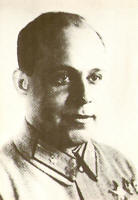 police captain M.P. Schreider | |||||||||||||||||||
| Date of Birth | June 2, 1902 | ||||||||||||||||||
| Place of Birth | Vilno ( Russian Empire ) | ||||||||||||||||||
| Date of death | December 8, 1978 (aged 76) | ||||||||||||||||||
| Place of death | Moscow ( Soviet Union ) | ||||||||||||||||||
| Affiliation |  the USSR the USSR | ||||||||||||||||||
| Type of army | Cheka - OGPU - NKVD , Red Army | ||||||||||||||||||
| Years of service | 1919 - 1938 , 1942 - 1945 | ||||||||||||||||||
| Rank | Before repression:  After the repression:  | ||||||||||||||||||
| Part | 1st Guards Motorized Rifle Division | ||||||||||||||||||
| Commanded | State Political Administration of Khibinogorsk Police Department of the Ivanovo Region Police Department of the Novosibirsk Region Police Department of the Kazakh SSR | ||||||||||||||||||
| Battles / wars | Soviet-Polish war Soviet-Georgian war Civil war in Russia The Great Patriotic War | ||||||||||||||||||
| Awards and prizes |
| ||||||||||||||||||
| Communications | A.P. Radzivilovsky , V.V. Chernyshev , S.F. Redens | ||||||||||||||||||
| Retired | since October 1954 | ||||||||||||||||||


Biography
Born on May 20 (old style) in 1902 in Vilna in a Jewish family [1] . Father, Mendel Berko-Movshevich (Moiseevich) Schreider (1871, Antokol - 1935, Vilnius), was a worker in a tobacco factory. Mother - Rohl-Leia Mordukhovna (Rohlya Markelevna) Schreider (nee Kirzner, 1879-1908), grandfather worked as a saddler . He received his primary education in Vilna . At 12, he ran away from home, lived in Saratov and Yekaterinoslav . Since 1917, actively involved in revolutionary activities, joining the Union of Revolutionary Youth (Union of Working Youth) and becoming a member of its Vilnius City Committee , and then an instructor of the Central Committee of Lithuania and Belarus , from 1918 engaged in underground work. In 1919, he was in Vilna in the Komsomol detachment named after Karl Liebknecht , in the guard of the chairman of the Council of People's Commissars of the Lithuanian-Belorussian SSR V. Mitskevichyus-Kapsukas .
VChK-OGPU-NKVD
Member of the CPSU (b) since 1919, since September of the same year - at work in the Cheka’s bodies in various cities of Lithuania, Ukraine, Belarus, Russia, as a scout of a special division of the Western Front division. From the end of 1919 to 1920 he was in Polish captivity, from which he fled . In 1920 - Commissioner for special assignments under the plenipotentiary representative of the Cheka on the Western Front, F. D. Medvedev in the cities of Vilna and Rzhev , as well as in the border troops on the border with Poland.
In 1921 he participated in a group of Chekists in the liberation of Georgia . In 1922 he worked in Smolensk , then in the Moscow Provincial Secret Political Department of the GPU , for some time consisted of P.P. Bulanova's assistant, at the same time deputy secretary of the Komsomol cell of the central apparatus and the Moscow Provincial Department of the GPU. From 1925 to 1927 he worked in the secret-encryption department of the USSR People's Commissariat of Foreign Affairs and Sovkino . Since 1927, he was authorized by the Special Department of the Moscow Proletarian Division , worked in the special department of the Moscow Military District , and M.I. Gai was the head. He was the secretary of the Komsomol cell. From 1928 to 1929 he was ill for almost a year and lived in Moscow. At the same time, the party’s Moscow committee opened the case of the so-called “Unprincipled Bloc” in the Sokolniki district , in which G. G. Yagoda , T. D. Deribas and M. A. Trilisser , as well as the secretary of the Sokolniki RK VKP (b) B were involved V. Giber , the letter of the MK of the party was discussed at a party meeting in the OGPU. The speakers sharply criticized the behavior of the members of the district committee and literally rained, besides those mentioned, on M.S. Pogrebinsky and M.P. Frinovsky , but no one said a word about G.G. Yagoda, except for M.P. Schreider. Respecting such uncompromising attitude, the head of the administrative-organizational and economic management of the NKVD of the USSR I.M. Ostrovsky becomes friendly with him, thanks to this acquaintance he becomes aware of the numerous abuses of the administrative-economic and award parts in the state security organs. Subsequently, he became the head of the special currency group of the Economic Department of the OGPU in Leningrad .
From 1930 to 1931 he worked in the authorized representative of the OGPU in Central Asia and the Leningrad Military District . Having received the personal parting words of S. M. Kirov , in 1931 he was appointed head of the GPU of Khibinogorsk . Then he is transferred to the post of head of IVF and the Inspectorate of Reserves of the PP OGPU of the Tatar Autonomous Soviet Socialist Republic. In 1932 he met his future wife Irina. In 1933 he worked in the Kazan Criminal Investigation Department . After the conflict with the Kazan security officers, whom he exposed in the thefts, as a result, the case was considered at a meeting of the Politburo of the Central Committee of the party with the participation of M.P. Schreider, ended with the dismissal of the OGPU envoy for the Tatar Autonomous Soviet Socialist Republic D. Y. Kandybin and court sentences, was transferred to the post of head of the 6th branch of the ECO PP OGPU in the Moscow region , where he also began disagreements with the head of the ECU of the OGPU A.I. Uspensky , and his minions S.I. Lebedev and R.A. Listengurt , on which Igrozil complained to L. G. Mironov and G. E. Prokofiev for giving them political coloring and fanning ordinary thefts. During one of the quarrels with R. A. Listengurt, in response to foul language, he grabbed a service weapon and shot at it, but missed a few centimeters, then dropped the revolver. Listengurt did not report on what had happened, in view of the commission's clarification of the cause of the conflict and the disclosure of falsification of the case by V. R. Menzhinsky and I. A. Akulov . As a result of the incident, M.P. Schreider was sent to a sanatorium . On the recommendation of Y. A. Deich , his assistant, the future head of Smersh, V. S. Abakumov , received a report after two months of work to dismiss him as decomposed and unsuitable for operational work, and indeed for work in the organs, as a result of which Abakumov was dismissed, but subsequently returned to the post of inspector in the General Directorate of Camps .
Police Work
After all that happened, he transferred from the OGPU to the police, took part in the fight against currency crimes , worked in Moscow (assistant to the head of the Moscow Criminal Investigation Department of the police director L.D. Vul , who had previously repeatedly offered to go to work in the workers 'and peasants' police).
From 1935 to January 1938 he worked as the head of the criminal investigation department , the assistant to the chief and the head of the Office of the RCM, the assistant to the chief of the UNKVD V. A. Styrne for militia in the city of Ivanovo . He participated in the creation of the Special Meeting (“ troika ” [2] ) under the regional administration of the NKVD. At the operational meeting, the First Secretary of the Ivanovo Regional Committee of the CPSU (B.) I.P. Nosov convened an operational meeting of senior officials of the UNKVD and raised the question that the Chekists working under the leadership of Yagoda would repent and admit their guilt. When asked by Schrader what kind of guilt and what should be admitted, Nosov shouted:
- But didn’t you yourself follow the orders of the Berry?
Schreider replied that, of course, he carried out the orders of the People's Commissar of Internal Affairs in the same way as now he carries out the orders of Comrade Yezhov . Then Nosov fervently began to rebuke Schreider, how dare he compare the spy - the Trotskyist Yagoda, with the Stalinist Commissar and Secretary of the Central Committee Yezhov, and said that such comparisons would not lead to good. When V. A. Styrne was repressed , he worked under the direction of A. P. Radzivilovsky . Early in the morning of August 7, 1937, a special train arrived from Yaroslavl to Ivanovo with a group of Central Committee workers led by L. M. Kaganovich [3] and M. F. Shkiryatov [4] .
At the beginning of November 1937 in Lomakh , one of the three drunk “executioners” Salamatin told Schreider:
“Let’s see how you will behave when I shoot you.”
To which the answer was received:
“Before they shoot me, I’ll shoot you like a dog!”
Two other "executioners", Viktorov and Ryadnov, grabbed Salamatin by the arms and dragged into the next room. After a call to V.V. Chernyshev, all three came to Schrader's apartment with an apology, but he still decided to ask for a transfer.
In January 1938, Schreider left Ivanovo in connection with the appointment of the head of the regional police department of the Novosibirsk region , instead of the already repressed A.K. Altberg . It turned out that for the last two or three months the fight against banditry has not been conducted at all, because, by order of the head of the NKVD G.F. Gorbach, all of the menacing men in the police, as well as other police departments, were engaged in operations through the NKVD, including participation in the execution of death sentences imposed by a special “troika”. Having returned the vehicles and people for law enforcement, he listened to threats from the latter and his deputy I. A. Maltsev and replied:
“As for me, your hands are short!”
However, neither a call to the Deputy People’s Commissar of Internal Affairs V. V. Chernyshev, nor an appeal to another deputy L. N. Belsky , who was traveling with A. S. Nevernov , helped to completely rectify the situation. Therefore, a month later, in February, Mikhail Pavlovich’s unauthorized departure from Novosibirsk and a meeting with the head of the Main Directorate of the Worker and Peasant Police of the NKVD V.V. Chernyshev, which he reported that he could no longer continue to work in Novosibirsk and was ready to bear any punishment. A day later, by order of N. I. Ezhov, the only one of the chiefs of police departments was appointed Deputy People's Commissar of Internal Affairs of the Kazakh Soviet Socialist Republic S. F. Redens - brother-in-law of Stalin, and the head of the main police department of the Kazakh SSR in Alma-Ata . However, after the arrests of two deputies of Redens - Major of State Security Volodzko and brigade commander Rottermel - Schrader was also entrusted with the leadership of the border guard. In April 1938, the family (wife and two children) moved from Moscow to Alma-Ata, families began to make friends with families with Stanislav Frantsevich Redens and his wife Anna Sergeyevna Alliluyeva . In May, the first secretary of the Central Committee of the Communist Party of Kazakhstan, L. I. Mirzoyan , was arrested , then in June news was received of the arrest of Shreider's cousin Oleg Mikhailovich Reichel, a student at the Moscow Aviation Institute , who had been sentenced to 5 years in the Shards case, probably , served as a friendship with the children of the People's Commissar of Agriculture M. A. Chernov . The closest friend Feodosiy Ivanovich Changuly, an assistant to the head of the department of places of detention, was also arrested. M.P. Schreider wrote a report to Moscow about their innocence; in response, after a while, N. I. Ezhov received an order to arrest Schrader himself. Meanwhile, there was a nomination as a candidate for deputies to the Supreme Soviet of the Kazakh SSR from a number of Peter and Paul enterprises and organizations. A trip to Petropavlovsk took place to meet with voters (where he was accompanied by Deputy N. D. Undasynova - Lazarev, who spoke at meetings and recommended his candidacy to voters, meeting reports were published in the press) and a visit to the Karaganda camp in Akmolinsk and Balkhash . After which, Schreider returned to Alma-Ata, where Redens acquainted him with Yezhov’s telegram by order on his arrest. He was elected a deputy, which he found out about already in a prison car , having seen his portrait from a barred window on a poster, which by that time had not yet been removed.
Repression
Arrested on June 16, 1938 [5] , and for several minutes he was left alone in the office of the People’s Commissar with access to telephone communications, up to the Kremlin, and with arms with the ability to shoot himself, but did not use it, despite the fact that he knew that he awaiting. The secretary of the People's Commissar confiscated all weapons ( Mauser and Steyr ), and also tore off the gymnast and threw awards and insignia into the trash, after which Schrader was transferred to the solitary confinement of the NKVD internal prison.
Then it was sent to Moscow, where he was placed in the preliminary detention cell of the Butyrka prison . The investigation was charged with cooperation with German , Polish and Japanese intelligence . During interrogations, beatings were used. He became ill with dysentery and was without medical assistance for several days, falling into unconsciousness, but after a while he was transferred to Butyrka prison hospital. Still not recovered, he was transferred to a common cell in which he met fellow-dealer F.I. Changuly. After one of the walks in the prison yard, they are locked up in a punishment cell . He lodges a complaint addressed to Deputy Yezhov, Frinovsky, and the investigator at the next interrogation presents him with the answer:
“I authorize the direction to Lefortovo. Permission to beat. Frinovsky ".
A shooting is staged , then Mikhail Pavlovich is sent to the basement of the NKVD, but his last name is not on the lists of those shot.
Further, on the night of November 11, 1938 , they were transferred to Lefortovo prison and questioned by L.P. Beria and B.Z. Kobulov , who are little interested in the case and fate of Schreider, but are stubbornly trying to get incriminating evidence against V.P. Zhuravlev [ 6] . Put in an internal prison, met with L.I. Mirzoyan. It should be charged on all points of article 58 of the Criminal Code of the RSFSR , refuses to give false testimonies. It is again transferred to the inner cell of the Butyrka prison, after which it is sent under escort to Yaroslavl , and locked up in a special cell of the Yaroslavl city prison.
February 5, 1939 sent to Ivanovo and placed in an internal prison of the Office of the NKVD of the Ivanovo region. Regular interrogations and beatings are followed by the head of the department, his deputies, the head of the investigative unit and their many assistants. The second time they are staging the death penalty. They are interrogating in the presence of a member of the Central Committee, the first secretary of the Ivanovo regional party committee, I. K. Sedin . Once, during interrogation by an investigator-trainee Chernov and getting beatings from the latter, he gives back, as a result of which the investigator is unconscious for several minutes, but he does not touch his weapons and keys. In the future, he was regularly beaten by several interrogators at once. In the prison cell, Schrader managed to expose an informant pretending to be a repressed engineer, and he was recalled. The self-confident head of the investigative unit introduces him to the secret directive of I.V. Stalin on allowing physical measures to be used against “enemies of the people”.
I heard another series of incredible accusations: of killing Kirov ; in what is not only a German spy, but also an ethnic German, whose circumcision was done for disguise, there are also others, no less ridiculous:
- Oh you, fascist reptile! Shouted the former subordinate of Schrader. “You can't see the position of police chief that Hitler promised you!”
- You better tell about your relations with the resident of the Italian intelligence Quasimodo ...
Despite the beatings and torture, M. P. Schreider did not testify for more than 9 months, decided to inflate his case for transfer to Moscow and began to give “testimonies”, simultaneously “exposing” as his “accomplice” the deputy chief who severely beat him of the NKVD Directorate of the Ivanovo Region (the head of the department A. S. Blinov , who was not satisfied with the deputy Nareiko, a former deputy, and the head of the Ryazantsev’s investigative unit who was aiming for the deputy’s position, supported the prosecution), saying, among other things:
- While on a business trip in Ethiopia , entered into an intimate relationship with the daughter of Menelik II , who recruited him into British intelligence ( Churchill 's personal representative for espionage in the Soviet Union);
- He is the illegitimate son of the emperor of Manzhou-go - Pu Yi ;
- В дополнении к шпионажу в пользу Польши, Англии, Германии, Японии, «сознался» в шпионаже в пользу Франции и Турции , а также участии в право троцкистском подполье , контрреволюционной деятельности и прочих преступлениях.
Часть этих «признаний» отобразилась в следственном деле. Вызвавшись на очную ставку с Ф. И. Чангули, и пользуясь тем, что в нарушение инструкций их посадили за столом рядом, незаметно для следственной комиссии и представителей прокуратуры Шрейдер дал ему понять, что, поддержав дезинформацию , они развернут масштабы дела для передачи в Москву, где есть надежда, что разберутся по существу и оправдают по несправедливым обвинениям.
В апреле — мае 1939 года последовал ожидаемый перевод в Москву, где, однако, невзирая на заверения в невиновности, продолжились избиения, также Шрейдера среди прочего дополнительно обвиняли в сговоре с санкционировавшим его избиение М. П. Фриновским. Состоялся новый допрос у Берии , к которому он был препровождён под личным конвоем начальника внутренней тюрьмы НКВД А. Н. Миронова. Следствие обманом и провокациями пыталось вырвать показания на В. В. Чернышёва, что было неоднократно категорически отвергнуто. На один из допросов заявился будущий председатель КГБ СССР И. А. Серов , предложив «разоблачить врагов народа» из Главного управления рабоче-крестьянской милиции, однако Шрейдер заявил следователю, чтобы, как его сообщника по «изменнической и вражеской» деятельности записали самого Серова и данную встречу считали очной ставкой… последний вынужден был ретироваться.
25 июля 1939 года вышло постановление о прекращении дела и дана возможность ознакомиться с материалами следствия, а также разрешение позвонить домой и передать записку жене, которой был разрешён визит к следователю, позволены передачи. Однако уже в августе 1939 года следствие возобновлено, Михаил Павлович был водворён в одиночную камеру Бутырской тюрьмы, снова начались избиения. Состоялся суд, приговор Особого Совещания при НКВД: лишение свободы на 10 лет с помещением в ИТЛ с последующим поражением в правах сроком на 3 года (статья УК РСФСР 193/17-А) и лишением звания и правительственных наград. Дана возможность обжалования приговора апелляцией в течение 72 часов, однако воспользовался этой возможность только в декабре 1940 года, передав жене таковую на 25 страницах (женой апелляция была размножена и разослана в ЦК И. В. Сталину, в Верховный Совет М. И. Калинину , в комиссию партийного контроля М. Ф. Шкирятову и в НКВД — Л. П. Берии). Также её дядя, бывший председатель Гражданской коллегии Верховного Суда СССР , снятый с работы после ареста сына, М. О. Рейхель , ходил на приём к заместителю председателя ВС СССР, который, просмотрев заявление, сказал, что приговор формальный, просто «надо временно изолировать , поскольку был связан со многими врагами народа», что в лагере по статье 193/17-А будет на административной работе, в неплохих условиях и жене надо прекратить бесполезные хлопоты…
За время следствий известными сокамерниками М. П. Шрейдера были:
- Бела Кун , венгерский и советский коммунистический политический деятель и журналист.
- Иван Семёнович Кутяков , военачальник времён Гражданской войны, командир 25-й ( Чапаевской ) стрелковой дивизии.
- Павел Иванович Кушнер , советский этнограф, профессор, доктор исторических наук.
- Левон Исаевич Мирзоян , советский государственный и партийный деятель.
- Яков Христофорович Петерс , профессиональный революционер, один из создателей и первых руководителей ВЧК.
- Гуго Эберлейн , немецкий политик, коммунист, деятель Коминтерна .
Из них на свободу был выпущен только П. И. Кушнер.
За последующие три месяца пребывания в тюрьме получил два свидания с женой и передачу с тёплыми вещами. С октября по декабрь 1940 года этапировался в Севжелдорлаг .
Rehabilitation
C 1941 года после нападения Германии на СССР многократно посылал письменные просьбы отправить на фронт . В 1942 году освобождён и направлен на фронт рядовым в район Синявино, воевал в 115-й стрелковой дивизии до Победы , за время Великой Отечественной войны дослужился до старшины . Однако частично реабилитирован и восстановлен в коммунистической партии был только в конце 1950-х годов . По данным историка Н. В. Петрова , полностью до сих пор не реабилитирован, ввиду того, что превышал служебные полномочия, пропуская через милицейскую тройку по формальным признакам принадлежности к уголовному миру, игнорируя народный суд .
В июне 1945 году вернулся в Москву, работал в московском городском тресте по снабжению топливом и других топливных организациях Москвы. В октябре 1954 года последовал вызов в комиссию по назначению персональных пенсий . После этого становится персональным пенсионером СССР . В 1970-е работал над воспоминаниями под общим названием «Жизнь чекиста-оперативника» (ценнейшего источника по истории органов государственной безопасности СССР 1920 годы — 1930-х годах , хранятся в отделе рукописей Российской государственной библиотеки ), часть из которых опубликована. Скончался в Москве в конце 1978 году.
Family
- Отец — Мендель Мовшевич Шрейдер, рабочий , сын ошмянского шорника Мойше Лейбовича Шрейдера. Умер 13 марта 1935 года от сердечной недостаточности.
- Мать — Рохл-Лея Мордхелевна Кирзнер, умерла 13 февраля 1908 года от тифа. В том же 1908 году отец женился во второй раз на Этл Ицковне Мордухович из Михалишек .
- Братья — Вульф-Мойше (1899—1908) и Беньямин (1907—1908), умерли в детском возрасте.
- Сестра — Эсфирь Менделевна Шрейдер, родилась в 1904 году, вышла замуж за человека по фамилии Хирург (имя и отчество неизвестны) и эмигрировала в 1920 году .
- Жена (второй брак, в 1934 году) — Ирина Элланская, тёща — Маргарита Михайловна Элланская (пианистка, библиотекарь), происходят из дворянской семьи.
- Дети — Михаил и Виктор (Элланские).
Rewards
- Орден Красной Звезды (1937, лишён после ареста);
- Два ордена «Знак Почёта» (лишён после ареста);
- Знак «Почетный работник ВЧК-ОГПУ (XV)» (1932, лишён после ареста);
- трижды награждён боевым оружием (лишён после ареста);
- Медаль «За оборону Ленинграда» [7] (1943);
- Медаль «За боевые заслуги» (старшина Шрейдер, заведующий делопроизводством оперативного отдела штаба 115-й стрелковой дивизии, приказом по 115-й стрелковой дивизии №: 43/н от: 28 ноября 1943 года награждён за действия в период наступательных боёв, стойкость, мужество и дисциплинированность) [8] (1943);
- Орден Красной Звезды (старшина Шрейдер, помощник начальника заготовок 115-й стрелковой дивизии, приказом по 44-му стрелковом корпусу №: 167/н от: 31.08.1944 награждён за организацию заготовительных работ и обеспечение продовольствем личного состава дивизии) [9] (1944).
Notes
- ↑ Запись о рождении доступна на сайте еврейской генеалогии JewishGen.org.
- ↑ Внесудебные «милицейские тройки» были образованы приказом НКВД СССР № 00192 27 мая 1935 года для нарушителей паспортного режима, уголовных и деклассированных элементов. Мероприятие диктовалось тем, что число задержанных лиц по указанным делам было очень значительным, и рассмотрение этих дел в Особом Совещании приводило к чрезмерной затяжке рассмотрения этих дел и к перегрузке мест предварительного заключения. При вынесении решений «тройкам» НКВД предлагалось руководствоваться правами, предусмотренными Положением об Особом совещании при НКВД СССР. Участие прокурора в заседании «тройки» было обязательно. Протоколы «троек» направлялись начальнику Главного управления рабоче-крестьянской милиции для представления их на Особое совещание НКВД СССР . Однако даже в случае самых тяжёлых преступлений милицейская «тройка» в отличие от политической «тройки» (имевшей право приговаривать к высшей мере наказания ), могла выносить приговоры до предела в 5 лет заключения .
- ↑ Во время пребывания в Иваново неоднократно звонил из кабинета Шрейдера в Кремль и докладывал Сталину об очередных « врагах народа », заменив привезёнными с собой сотрудниками почти весь партийно-советский актив области.
- ↑ Возглавлял комиссию ЦК, выезжавшую в 1932 года в Казань для проверки вскрытого Шрейдером дела о хищении спирта на пороховом заводе, в котором было замешано свыше 100 человек, в том числе 39 работников ГПУ.
- ↑ Санкция прокурора на арест была дана в Москве в июле 1939 , на 1 год и 1 месяц позже фактически произведённого ареста.
- ↑ Звезда и смерть Виктора Павловича Журавлёва Архивировано 13 января 2013 года.
- ↑ Память народа :: Документ о награде :: Шрейдер Михаил Павлович, Медаль «За оборону Ленинграда» . pamyat-naroda.ru. Date of treatment October 11, 2017.
- ↑ Память народа :: Документ о награде :: Шрейдер Михаил Павлович, Медаль «За боевые заслуги» . pamyat-naroda.ru. Date of treatment October 11, 2017.
- ↑ Память народа :: Документ о награде :: Шреидер Михаил Павлович, Орден Красной Звезды . pamyat-naroda.ru. Date of treatment October 11, 2017.
Publications
- Шрейдер М. П. НКВД изнутри. Записки чекиста. — Москва: Возвращение, 1995. — 506 с. — ISBN 5-7157-0062-0 .
Literature
- Петров Н. В., Скоркин К. В. Кто руководил НКВД, 1934-1941. Directory. — Москва: Звенья, 1999. — 502 с. — ISBN 5-787-00032-3 .
- Абрамов В. Евреи в КГБ. Палачи и жертвы. — Москва: Яуза: Эксмо, 2005. — ISBN 5-699-13762-9 .