Peter Dmitrievich Kokorin ( 1887 - November 22, 1919 ) - a participant in the First World War with the rank of senior non-commissioned officer , a Bolshevik, a participant in the Civil War in Altai, the commander of an equestrian partisan detachment, and then a regiment acting on the side of the Red Movement.
| Peter Dmitrievich Kokorin | |
|---|---|
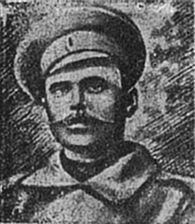 Commander of the 2nd Regiment, 1st Mountain Horse Altai Partisan Division , 1919. | |
| Date of Birth | |
| Place of Birth | Bezrukovo village, Bezrukovskaya volost , Tobolsk province , Russian empire |
| Date of death | |
| Place of death | Kuyagan (village) , Kuyagan volost, Altai province RSFSR |
| Citizenship |  Russian Empire → Russian Empire →  RSFSR RSFSR |
| Occupation | |
| Father | Dmitry Ermolaevich Kokorin |
| Spouse | Sofya Savvateevna Kokorina (Romanova) |
| Children | German Petrovich and Agnia Petrovna |
Content
Kokorin's Biography
The Early Years and Participation in World War I
Peter Kokorin was born in 1887 in the village. Bezrukovo, Tobolsk province , in the family of an artisan. In 1905, 18-year-old Peter and his two sisters moved to Altai in the village. Demino , Biysk district , Tomsk province [1] . The reason for the move was the arrest of his father and older brother. In Demino, Kokorin got married, got a house and a plot of land. Engaged in hunting, he studied Altai mountain trails well, worked as a confidant in the Dyominsky dairy cooperative, taking oil to the city of Biysk on a supply line.
With the outbreak of World War I he was mobilized into the army. In August 1914, he went to the front in the artillery (grenadier regiment). In battles with the German troops, he went from an ordinary soldier and rose to the rank of senior non-commissioned officer. In the grenadier regiment, Kokorin commanded a platoon of horse reconnaissance, skillfully using his hunting savvy. In 1916 he joined the party of the RCP (b) . After the February Revolution of 1917, he was elected a member of the Soldier-Regimental Council. In 1918 he returned home. [2] .
Kokorin's participation in the Altai Civil War
After the bloody reprisals of the white punishers with the peasants of Altai, to fight them in June 1919, the Dyominsky horse detachment (80 people) was created, whose commander was elected Bolshevik and a supporter of Soviet power - P. D. Kokorin. Due to a lack of weapons (Kokorin managed to get 13 three-line rifles, several checkers and guns), the partisans armed themselves with hunting rifles and homemade peaks. People from neighboring villages joined the Dyominsky detachment; it became the number of 200 Red Army men.
In early August 1919, an uprising broke out around Altai against the authorities of A.V. Kolchak, whose army was in dire need of provisions and therefore taxes were increased in territories under their control, and whoever did not pay them, punitive detachments of Cossacks were brutally cracked down.
From August 5-6, 1919, Kokorin’s detachment, without waiting for the punitive to arrive in Demino, conducted successful horse raids, freeing the volost center from the well-armed enemy - s. Kuyagan [3] . During the battle near Kokorin, a horse was killed, but he began to develop an offensive and knocked out whites from the villages next to Kuyagan - Kuyacha, Tourak, Nikolskoye and Kazanda. In these villages, the White Guards burned many houses, carved the peasants, and shot those involved in Bolshevism, so many willingly joined the Kokorin detachment. After these raids, Kokorin headed the leaders of the partisan headquarters of the entire Kuyagan volost, and the center of leadership of the partisan movement (partisan volost headquarters) was moved to s. Demino [4] . Having received a lot of reinforcements, the White Guards returned. All liberated villages of the volost were again captured by punishers and reprisals against the peasants continued. Only the partisans of the villages of Demino and Aleksandrovka fought a stubborn struggle, but there were few forces.
September 17, 1919 Kokorin occupied with. White Anui, where he teamed up with a partisan detachment led by I. Konstantinov. As a result of the union, a detachment of more than 800 fighters was formed, but the larger White Guard forces of the punitive, Colonel Khmelevsky (1000 sabers), were drawn to the village. Kokorin led the partisans to the mountains, the Tokush tract, where on September 18, 1919, a partisan regiment was created from the combined units. The next day, the Kokorinsky regiment teamed up with the Baschelaksky regiment of Nikiforov and a partisan partisan brigade was formed.
"On September 18, in the Tokush tract, the rebels of the Black Anuisk, Keleyskaya, Baragash, Kuyagansk, Soloneshenskaya volosts organized the 2nd regiment, whose commander was elected Pyotr Dmitrievich Kokorin, the head of the Deminsko-Alexander partisan detachment." - Potapov L. P. "Essays on the history of the Gorno-Altai Autonomous Region", Art. 100-104.
On September 19, the Nikiforov and Kokorin brigade defeated Colonel Khmelevsky in Black Anui, but with a fresh onslaught of Cossacks retreated to the Abai steppes. October 8, 1919 in the village. The 3rd regiment (commander S. G. Latkin) and the 1st Mountain-Horse Altai partisan division were created . I. Ya. Tretiak became the head of the division, and P. D. Kokorin was elected partisans as his deputy, but despite another wound, he refused, saying that he would not leave his battle regiment called the second.
On October 13, 1919, from Abai the division launched a counterattack in two directions - to Inuy (Chuysky tract) and Ust-Kan, Black Anuy. In the midst of the battle near Ust-Kan, when 7 Cossacks tried to seize Kokorin cut off from his own, he was wounded by a bullet and a horse was killed under him. Kokorin, in hand-to-hand combat, threw one Cossack from his horse and managed to hide it from pursuit while continuing to command the battle. As a result, the partisans, inspired by the fearlessness of their commander, defeated the Cossack part of the corral Gorbunov, in Ust-Mut - Kiryanov’s Altai squad and Klepikov’s Shebalin squad. Over two days of continuous fighting, more than 1,500 Kolchakites were defeated and scattered. From October 13 to 21, 1919 there were continuous battles to clear the White Guards of the Chuysky tract.
“For two days, partisan regiments fought back the fierce attacks of the White Guards near Touktou. It was one of the major battles of partisans with the enemy. At the initiative of the commander of the 2nd Regiment P. D. Kokorin, the partisans again adopted the tactics of circumvention. The appearance of partisans in the rear of the enemy for the Kolchakites was a complete surprise. Confused, the enemy began to retreat, and subsequently the retreat turned into flight. Partisans chased the enemy over 100 km to the village of Mute. In these battles, they captured about 100 prisoners, several 25-charge machine guns, up to 600 rifles, a large number of rounds, drafts, guns, and grenades. ”
- Potapov L. P. "Essays on the history of the Gorno-Altai Autonomous Region", Art. 100-104.
After clearing the Chuysky tract on November 2, 1919, the offensive of partisan regiments began on Altai. After 5 hours of battle, on the night of November 5-6, 1919, thanks to the rear approach of Kokorin, Altai was occupied by partisans. The intelligence service of the 2nd regiment was caught on the spot by Khmelevsky, who had an order found:
“To the commandant s. Altai Barichu. In the villages of Demino and Alexandrovka put an end. There are reasons. The execution shall be entrusted to Warrant Officer Kiryanov. ”
The punishers wanted to destroy these villages, since it was from them that the main composition of the Red Army soldiers of the most efficient Kokorinsky regiment of the partisan division was. Kokorin with intelligence intercepted the detachment of Kiryanov and defeated him.
Fights on the outskirts of Biysk and the death of Kokorin
With the occupation of Altai, the partisan division advanced on Biysk, and Colonel Khmelevsky, receiving replenishment, went to meet. The forces of both sides met near the village of Smolensk . After a daily stubborn battle, the punitive retreated. The 7th partisan regiment was formed in Smolensk, in the village. Shulgin Log - 6th partisan regiment, in the village. N-Kamenka - 13th regiment.
After lengthy bloody battles on the outskirts of Biysk, the division began to retreat, due to heavy losses, due to the betrayal of the commander of the 3rd regiment. To cover the retreat, P.D. Kokorin volunteered, who, with his 2nd regiment, restrained the onslaught of punishers under s. Ust-Anuisk. Having given time to go to the mountains to the headquarters of the division and the rest of the regiments, on November 21, 1919, the Kokorin residents single-handedly fought a battle with the 2 thousandth force of Cossacks and infantry, placing their positions on a high hill and in Lisyu Logu west of the village of Tochilnoye. The adjutant and fellow villager of Kokorin, V. S. Vyunov, were killed in the battle. Kokorin himself was mortally wounded by a bullet in his stomach, immediately after he ordered the retreat, another bullet hit him in the back. Standing on a horse, he galloped in a fever to the bottom of the hill, and then partisans on a sleigh took him to Kuyagan. Until the last minute, P. D. Kokorin was conscious and gave instructions and advice to the partisans. November 22, 1919 he died from his wounds. His body was brought to Demino, where they buried under a company-wide volley of weapons below the church [5] .
“... in the middle of November 1919, during heavy offensive-defensive battles, the partisan division suffered its first defeat and retreated, having lost and been wounded. In a fierce battle near the village. On November 21, 1919, the exact one was mortally wounded by the universal favorite of the partisans, the commander of the 2nd Regiment, P. D. Kokorin. ” - Potapov L. P. "Essays on the history of the Gorno-Altai Autonomous Region", Art. 100-104.
Golyshev became the commander of the Kokorin regiment. The family of Peter Dmitrievich soon left his native village and moved to Alma-Ata. The son of the legendary commander, German Petrovich Kokorin, fought on the front of the Great Patriotic War.
Memory of P. D. Kokorin
Memoirs of the Head of the 1st Mountain Horse Division, Ivan Yakovlevich Tretyak [6] .:
“... Kakorin was very fond of the partisans. He was a brave Bolshevik and a comrade very necessary to our cause. Under the company volley salute, we buried our dear comrade Kakorin. "
From the memoirs of Dyominsky partisans Gordeeva F., Skirdov A., Parshchukova I., Astanina M. [7] .:
“... Petr Dmitrievich was capable, talented and energetic as the organizer of the partisan movement and enjoyed great confidence not only of the partisans, but also of the volost population ... In battles, he carried away by example. Three times under him they killed a horse. In many battles, he received various injuries, and in the battles near Kuyagan and Ust-Kan they even got shots at him ... Kokorin was the pride not only of partisans and villagers, but of the entire population in the area of his regiment. ”
In 1930, in the city of Ulale ( Gorno-Altaisk ), the name of Kokorin was named Peasant's House (hotel). [8] . One of the Deminsky collective farms was named in honor of P. Kokorin. In 1933, in Demino, in honor of P.D. Kokorin, the 4th farm of the collective farm was named after him and is currently one of the streets with. Demino is called P. D. Kokorin.
In 1919, a “pyramid-shaped” wooden monument was erected at the burial place of Kokorin. Then another wooden monument was erected at the same place, and the old one was demolished. At the burial site of Peter Kokorin, subsequently, as they passed away, the rest of the partisan detachment and regiment living in the village were buried. Demino. In 1967, in honor of the 50th anniversary of Soviet power, the battalion “Young Kokorinets” was held along the path of military-revolutionary glory of Peter Kokorin. Students who have earned this right in excellent studies, and teachers of Demino and the entire Soloneshensky district actively participated in the campaign following the traces of the heroes of the Civil War, Peter Kokorin and Peter Sukhov . The path of the detachment "Young Kokorinets" of 150 pioneers, began in with. Soloneshnoe, then in with. Demino opening of a new concrete monument to Kokorin and his comrades. The pioneers then passed the villages of Black Anui, White Anui, Baragash, Tourak, Kuyagan and the last point of the village. Sharpening, Smolensk region , where Kokorin was mortally wounded.
The detachment "Young Kokorinets" gathered invaluable material about Kokorin and his military glory from the recollections and stories of partisans and eyewitnesses of the events of the Civil War. It so happened that Kokorin is known in every village along the route of the pioneers and his name appeared in local museums and lists of events of those years. After the campaign, on July 18-20, in the city of Barnaul, the second regional meeting took place at the battle sites in Altai, where the team from the Soloneshensky district defeated the organization of the campaign and the collection of information about the battles of P. Kokorin. In the 1980s, they installed zinc memorials to Kokorin and his comrades, with the image of a five-pointed star.
Photos related to Kokorin
Monument to Kokorin and the partisans in Demino.
Notes
- ↑. Now with. Demino in the Altai Territory.
- ↑ A.A. Shipunov. There was a day yesterday, there is a day today. Biysk. 2010.S. 10.
- ↑ . Before the revolution, Demino was part of the Kuyagan volost, Biysk district, now part of the Soloneshensky district, Altai Territory.
- ↑ Z. I. Vorontsova. The establishment of Soviet power in the Altai region. // In the foothills of Altai. Essays on History and Culture.-Barnaul, 1998. S. 246.
- ↑ A.A. Shipunov. There was a day yesterday, there is a day today. Biysk. 2010.S. 21.
- ↑ I. Ya. Tretiak. Partisan movement in the Altai Mountains in 1919
- ↑ Students of Demino recorded. 1971.
- ↑ Ulala, Oirot - Tour, Gorno - Altaysk. Pages of history. Chronicle of the city from 1830-1945 prepared based on the materials of V.I. Edokov. Gorno-Altaysk. 1997.S. 75.
Sources
- Shipunov A. A. There was a day yesterday, there is a day today. Biysk. 2010.
- Vorontsova Z. I. Establishment of Soviet power in the Altai region. // In the foothills of Altai. Essays on History and Culture.-Barnaul, 1998.
- Belikova T. G. Establishment of Soviet power in the territory of Soloneshensky district. 1918-1921 Essays. The path of the detachment P. Sukhov. // Soloneshensky district: Essays on history and culture: Sat. scientific and practical. Materials / Scientific. ed. T.K.Shcheglova. - Barnaul: Publishing House of BSPU, 2004.
- Medvedev I.F. Medvedeva T.F. Roots, past and present of the Medvedev family. Gorno-Altaysk. 2011.
- Tretyak I. Ya. Partisan movement in the Altai Mountains. 1919 West-Sib. regional publishing house. Novosibirsk, 1933
Links
- Vorontsova Z. I. Establishment of Soviet power in the Altai region .// In the foothills of Altai. Essays on History and Culture. - Barnaul, 1998.
- Panin N.P. The Great October Socialist Revolution.// Smolensky District: Essays on History.- Barnaul, 2002.
- Tretyak I. Ya. Partisan movement in the Altai Mountains. 1919 West-Sib. regional publishing house. Novosibirsk, 1933
- Events in the White movement.