Manuel Máximo Alberti ( Spanish: Manuel Máximo Alberti , May 28, 1763 , Buenos Aires - January 31, 1811 , Buenos Aires ) - Argentine priest and politician, editor of , member of the First Junta of Argentina - the first independent government.
| Manuel Alberti | |||||||
|---|---|---|---|---|---|---|---|
| Manuel alberti | |||||||
 | |||||||
| The president | |||||||
| President of the First Junta | |||||||
| Birth | May 18, 1763 Buenos Aires Vice Kingdom of Rio de la Plata | ||||||
| Death | January 31, 1811 (47 years old) Buenos Aires , Argentina | ||||||
| Father | Antonio Alberti | ||||||
| Mother | Juan Augustine Marin | ||||||
| The consignment | |||||||
| Education | National University of Cordoba | ||||||
| Profession | Priest | ||||||
| Religion | Catholicism | ||||||
| Autograph | 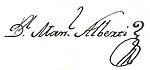 | ||||||
Content
- 1 Biography
- 1.1 Young years and education
- 1.2 Work as a priest
- 1.3 British invasion
- 1.4 Member of the First Junta
- 1.5 Death and funeral
- 2 memory
- 3 notes
- 4 Literature
Biography
Young years and education
Born in the capital of the Spanish vice-kingdom of Rio de la Plata, Buenos Aires in the family of Antonio Alberti and Juan Augustine Marin. Manuel had three brothers, Isidoro, Manuel Sylvester and Felix, as well as three sisters, Casimir, Juan Maria and Maria Clotilde. The Alberti family patronized the House of Religious Works of Buenos Aires, transferring to it the land plot where the headquarters of this institution was located [1] .
In February 1777 he entered the , studying there philosophy , logic , physics and metaphysics . At this educational institution, he studied with Hipolito Villietes , a future active fighter for the independence of Argentina.
He graduated from college on February 17, 1779 and the next year went to Cordoba to enter the university and graduate in theology. Despite the health problems that began, he even had to return to Buenos Aires for a short time. He successfully graduated from the university and on July 16, 1785 received a doctorate in theology and physics [2] .
Priest Work
In early 1786, Alberti was appointed a priest in the church in which he was baptized. He also worked in the aforementioned Buenos Aires House of Religious Works. In September 1790 he moved to the small town of and became a clergyman there, however, he left this post the following year due to health problems. But already in 1793 he returned again, and in February 1794 he finally left this town and settled in Maldonado on the territory of modern Uruguay , where he served as a priest in several parishes [3] .
British invasion
In June 1806, British troops launched an invasion of the Viceroyalty of Rio de La Plata , briefly part of its territory, including Maldonado , came under British control. Due to the increasing looting of Alberti had to hide all the values from the unfinished church of his parish. Ignoring the British authorities, the priest provided medical assistance to the Spanish soldiers and buried them in case of death. He also informed the Spanish military leaders of the British troops stationed in the city. [4] For all these actions, he was arrested, but then was released, but during the occupation he was under the supervision of the British [5] . Ultimately, British troops were defeated by the army of and left the Viceroyalty.
Member of the First Junta
In 1808 he returned to Buenos Aires . During the May Revolution , as a prominent spiritual figure, he was invited to a hearing about the fate of Viceroy Balthasar Cisneros , where, like most, he voted to remove the former Spanish governor [5] .
May 25, 1810 he was included in the First Junta [6] . The reasons why he was accepted into the new authority are unknown. There is a version that in the future they planned to make him the confessor of government [7] . In the junta, became a supporter of most reformist ideas, in addition to supporting Juan Larrea and [8] . He signed all the decisions that included reforms of the political system, such as representativeness and publicity of power, principles of separation of powers , freedom of speech and federalism . However, he fundamentally did not support initiatives contrary to his religious beliefs [9] . Refused to sign the death sentence to who tried to arrange a .
In addition to actually working in the government, he was the editor of the periodical , created by the junta. At the same time, the priest became the head of the news section of the newspaper, as he had the exclusive right to choose news for publication. Some historians also consider him the author of all other articles [10] .
The first conflict between Moreno and Alberti happened because of the arrival of Gregorio Funes , the vicar of Cordoba, who had views close to the president of the junta . There was an internal conflict between him and the president of the junta, and Mariano hoped that Alberti would oppose Funes. However, the priest did not agree to this, and Moreno spoke about it in very harsh colors [11] . Alberti moved even further away from Moreno during the discussion on the inclusion of deputies from other cities in the junta. At first, both politicians were against this proposal, but then Alberti, like most other members of the government, voted for [6] . The first junta was transformed into the Big Junta. Moreno, left in the minority, resigned [11] .
Death and funeral
The inclusion of new members only intensified the disputes and disagreements within the junta. Alberti opposed and Funes , albeit with less force than . The ongoing struggle and heated discussions negatively affected the health of the priest, which led to a heart attack on January 28, 1811 [12] . Fearing an imminent death, he wrote a will and he was chained . Three days later, an argument broke out again between Alberti and Funes, and upon returning home with Manuel again a heart attack occurred that he could not survive.
Manuel Alberti was buried in the cemetery of the Church of St. Nicholas, as was written in the will [12] . All members of the Great Junta came to the funeral, even his main political opponent, Gregorio Funes [12] . The death priest had the greatest influence on , who even burst into tears during the funeral procession [12] . Of all the members of the First Junta, Alberti died before all [13] . His place was taken by - a determined moraine worker. Saavedra and Funes did not like him, but because of the universal regret created by the death of Alberti, they decided not to resist the appointment of a political opponent [12] .
Memory
In 1822, the Buenos Aires government decided to name the street in his honor. During the May Revolution in 1910, a statue of Manuel Alberti was erected in in northern Buenos Aires. In the province of Buenos Aires, there is also the , named after a member of the First Junta .
Despite the careless storage, most of his personal diaries, which are actively used by historians, have been preserved. His works include works on theology , biblical studies, scholasticism and jurisprudence [12] .
Alberti’s grave was lost when the church of St. Nicholas was dismantled for the expansion of the Prospect on July 9 [12] .
Notes
- ↑ National ... p. 30-31
- ↑ National ... p. 31
- ↑ National ... p. 32
- ↑ Balmaceda, p. 38
- ↑ 1 2 National ... p. 33
- ↑ 1 2 Balmaceda, p. 39
- ↑ National ... p. 34-35
- ↑ National ... p. 35
- ↑ National ... p. 36
- ↑ National ... p. 36-37
- ↑ 1 2 National ... p. 37
- ↑ 1 2 3 4 5 6 7 Balmaceda, p. 40
- ↑ National ... p. 38
Literature
- Balmaceda, Daniel. Historias de Corceles y de Acero. - Buenos Aires: Editorial Sudamericana, 2010 .-- ISBN 978-950-07-3180-5 . (Spanish)
- Luna, Félix. La Independencia argentina y americana. - Buenos Aires: Planeta, 2003 .-- ISBN 950-49-1110-2 . (Spanish)
- National Academy of History of Argentina. Revolución en el Plata. - Buenos Aires: Emece, 2010 .-- ISBN 978-950-04-3258-0 . (Spanish)