Ugolsko-Shirokoluzhansky reserve massiv ( Ukrainian: Ugolsko-Shirokoluzhansky reserve massiv ) is a reserve massif of the Carpathian biosphere reserve , located on the territory of the Tyachevsky district of the Transcarpathian region (Ukraine).
| Ugol-Shirokoluzhansky reserve massif | |
|---|---|
| Ukrainian Ugolsko-Shirokoluzhansky zapovidny masiv | |
 View from the Red Mountain | |
| IUCN Category - Ia (Strict Nature Reserve) | |
| basic information | |
| Square | 15 580 ha |
| Established | 1968 year |
| Management organization | Carpathian Biosphere Reserve |
| Location | |
| A country |
|
| Nearest town | Hust Tyachev |

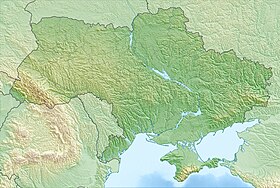


Area - 15 580 ha. The massif is located on the eastern slopes of Mount Menchul (1501 m), the southern and southwestern slopes of the Krasnaya Ridge (1568 m), within the altitude of 400-1280 m above sea level .
Content
History
The Carpathian Forest Reserve was created by a decree of the Council of Ministers of the Ukrainian SSR in 1964 to protect unique beech forests and yew trees . Ugolsko site on the southern slopes of the Munchel and Krasnaya Polonina with an area of 4724 hectares is located in the basins of the Malaya and Bolshaya Ugolka rivers . In the Carpathian reserve since 1968. Shirokoluzhansky site (attached to the reserve in 1979) is located in the Luzhanka river basin.
Geological structure and terrain features
The geological foundation of the massif is formed by powerful layers of flysch . Ugolsko sections of the massif are characterized by the presence of large blocks of limestone with well-developed karst formations. The height of individual limestone cliffs reaches seventy meters. There are more than thirty caves , including the largest cave of the Carpathians - “Friendship” with a total length of about 1 km. Late Paleolithic site of an ancient man was found in Milky Stone Cave. The main streams of the reserve massif is r. Small and Big Coals and r. Luzhanka. The highest peaks of the protected massif are Ugolskaya Plesha (1108 m), Pagan Kichera (1092 m), Vidnozhanskaya Kichera (1072 m), Tower (937 m).
Climate
The climate is warm, temperate, humid in the foothills, cool and very humid in the highlands. A powerful ridge protects the massif from northern winds - winds of western and southwestern directions prevail. The average monthly temperature in January is −4.5 degrees, July + 17.2 degrees, the average annual temperature is +7.1 degrees. The average annual rainfall is 1390 mm.
Soil
Light brown medium- loamy thick soils formed in the lower part of the Ugol-Shirokoluzhansky massif, and dark brown forest soils are higher. On the limestones, gravelly deposits have formed, and in the river valleys - soddy, sometimes gley soils.
Vegetation cover
The massif is located in the zone of beech forests, where zonal buccins predominate, which also form the upper border of the forest at altitudes of 1200–1300 m. Above, mainly in the basins, fragments of wrywood from green alder are found. The limestone outcrops preserved unique for the Carpathians of Tisovoy - beech groups and groups with the participation of Cossack juniper . Relict plants, in particular rock oak , are also represented here. The largest beech forests in Europe are protected within the massif, in which all economic activities are completely prohibited. Here many beech trees reach a height of 40 m, thickness up to 1 m, age 250-300 years.
Flora and Fauna
The flora of the massif totals more than 700 species. Large floral baggage is characteristic of limestone outcrops, where Cossack juniper grows (the only place of growth in the Carpathians), rocky oak , laxative buckthorn , large-leaved linden , yew berry (about 1.5 thousand specimens), and of rare herbaceous species - alpine aronnik , pollen-headed red , knitted slender , Carpathian bells , European kandyk , three-notched rook , cortuza Mattioli , Iris , Preys Borodnik , paniculata paniculata , stonecrop Spanish .
The fauna of the beech forests of the massif is very peculiar. Here you can find both purely “taiga” species - lynx , long-tailed owl , black woodpecker , bullfinch , as well as species characteristic of broad-leaved forests. They are represented by blackbird , middle woodpecker , white-backed and gray -headed woodpeckers, fly-fly flycatcher, oak-birder , clintukh , forest cat , wild boar , spotted salamander . Common on the territory of the massif are red deer , pine marten , red vole , common buzzard , nuthatch , grass frog - the species of which are common throughout the forest belt of the Carpathians. In the Red Book of Ukraine are noted: a small cutter , an ermine , an otter , an eagle owl , a black stork , a forest snake, a Carpathian triton , etc. The fauna of bats , most of which are associated with karst caves, is very diverse. In total there are 20 species, of which 8 are rare. These are the horseshoes, large and small , the European wide-legged , the long-winged common , the three-colored nightlight , the long-eared , the Nutterra and the small evening party . In winter, the concentrations of bats in the underground vaults are about one and a half thousand individuals, the bulk of which are large and sharp-eyed. More than 1000 bats belonging to 14 species winters in the Druzhba cave alone. Insects are represented by typical Mesophilic Central European species. Among them are such rare species as the hermit beetle , stag beetle , alpine barbel , large oak barbel , mnemosin butterflies , saturnia and others. In the karst caves of Ugolki, a unique fauna of invertebrate troglobionts is noted, among which there are a number of endemic species. Only on the territory of this massif in Transcarpathia were found rare species of mollusks listed in the Red Book of Ukraine: grain granaria , serotina serratina , serratina chondrina . Trout , grayling , minnow , and Hungarian lamprey are found in the rivers, which does not apply to fish, but to the class of cyclostomes .
Interesting Facts
- Luzhanka is the only river in the reserve where the “Red Book” Danube salmon ( Hucho hucho ) enters spawning .
- Near the office of Ugolsky lesnichestvo (on the northern outskirts of the village of Malaya Ugolka ), coniferous stands are striking, which does not look like a grouping of local species - spruce or fir . An alien from North America , the famous Pseudotsuga menziesii , grows here, which occupies vast areas and reaches incredible sizes - up to 100 meters in height and several meters in diameter. This tree has extremely valuable wood, which prompted local foresters to create Douglas fir plantations here more than a hundred years ago (this is what the people call pseudotsugu).
Sources
- https://web.archive.org/web/20050827234819/http://karpattour.narod.ru/rezer123592.htm
- "Carpathians through the eyes of the inquisitive." - Lviv, 1976
- Encyclopedia of Ukrainian Studies. In 10 volumes. / Editor-in-chief Vladimir Kubiyovich. - Paris; New York: Young Life, 1954-1989.