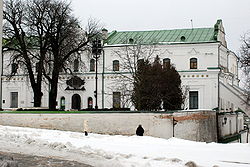
The printing yard of the Kiev Pechersk Lavra is one of the oldest and historically most influential printing houses of Little Russia . It was founded at the peak of the confrontation between the Uniates and the Orthodox in 1615 by the archimandrite of the Kiev Pechersk Lavra, Yelisey Pletenetskiy , who also established the Radomyshl Paper Mill . When creating the Printing House, the equipment of the Stratinsky printing house , purchased from Bishop Gideon (Balaban), was used .
| Sight | |
| Printing yard of the Kiev Pechersk Lavra | |
|---|---|
| A country | |
| Location | |
In December 1616 , the first book was published - The Hourglass . Until 1624 , Pletenetsky published 11 significant works of religious, historical and polemical literature , in particular, Antologion ( 1619 ), Nomokanon ( 1620 , 1624), and Servant (1620). For a short time, a circle of scientists, educators, and writers formed around the printing house. An active role in it was played by Zakharia Kopystensky , Pamvo Berynda , Lavrentiy Zizaniy , Tarasiy Zemka , Peter Mogila and many others.
Most editions of the Lavra Printing House were published in the Old Slavonic language , but books were also found in other languages. A characteristic feature was the attempt of publishers to bring books closer to the reader by translating certain sections into a language close to spoken. Figures of the mentioned Kiev circle translated and edited “Conversations of John Chrysostom about 14 Epistles of St. Apostle Paul "( 1623 ) and" Conversations of John Chrysostom about the actions of the Holy Apostles "(1624).
In 1625 , the printing house printed another significant theological work, "Interpretations of St. Andrew the Caesarean Apocalypse of St. John the Evangelist." The Teaching Gospel ( 1637 ), a collection of Sunday teachings selected from the works of John Chrysostom, was very popular.
Editions of the Kiev-Pechersk printing house were distinguished by complex printing technology. Many of them, especially theological works, were published in large format, had a ceremonial look, and, therefore, were expensive. Books designed for more mass consumption (“Hourly Book”, “Psalter”, “Lexicon”), poetic literature was printed in small format. Laurel editions began with a title page, decorated with engravings on the plot of the book. In addition to the title of the book, it marked the year and place of publication. On the reverse side was the emblem of the patrons of the printing house.
Primary printing was wooden and one-story. Her appearance is captured on the engraving of 1638 . In 1701 , the wooden structure was replaced by a stone, which was damaged by a fire in 1718 . The printing house was repaired, and over time they built up the second floor.
See also
- Ostrog printing house
- Moscow Printing House
Links
- Information on the website of the Kiev Pechersk Lavra (inaccessible link)