F-1 (GRAU index 57-G-721) ; colloquially - “fenyusha” [2] ) - a manual anti - personnel defensive grenade .
| Manual anti-personnel grenade F-1 | |
|---|---|
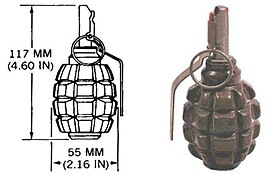 Manual anti-personnel grenade F-1 (training sample) | |
| A country | |
| Service History | |
| Adopted | |
| Wars and conflicts | |
| Instance cost | $ 5 (Lebanon black market, 1992) [1] |

The grenade is designed to defeat manpower in a defensive battle . Due to the significant radius of fragmentation (up to 200 meters), it can be thrown only because of shelter, from an armored personnel carrier or from a tank [3] .
As for the name " lemon ", it appeared during the First World War . Many believe that the pomegranate received this name for its characteristic shape, but this is not true. The fact is that the F-1, which we habitually call today “lemon”, is nothing more than a copy of the French hand grenade of the 1915 model of the same brand, only in French - F.1. However, such a grenade had a very imperfect fuse, which undermined it upon impact and therefore required great care in handling. The British acquired a fragmentation grenade — with a sleek body and a more reliable fuse with a check — designed by Captain Lemon. The name turned out to be “speaking,” and since the Russian army used grenades of various systems, but most of them were French, the name “lemon” passed to them, although initially the English grenades were called - however, there is no consensus today.
Initially, the F-1 grenades were equipped with a fuse of F.V. Koveshnikov . Subsequently, instead of fusing the Koveshnikov system, in 1941 the UZRG fuse (“unified fuse for hand grenades”) of Soviet designers E. M. Vitseni and A. A. Bednyakov was adopted for supplying the F-1 grenade. After the war, it was finalized and It still serves under the name UZRGM (universal ignition of modern hand grenades).
History
In 1922, the artillery department of the Red Army began to restore order in their warehouses. According to the reports of the artillery committee, the Red Army was armed with grenades of seventeen different types at that time. There was no fragmentation defensive grenade of its own production in the USSR during that period. Therefore, the Mills system grenade was temporarily adopted for service, the stocks of which were in large quantities at the warehouses (200,000 units as of September 1925). In extreme cases, the delivery of French F-1 grenades to the troops was allowed. The fact was that the fuses of the French model were unreliable. Their cardboard cases did not provide tightness, and the detonation composition was damp, which led to massive failure of grenades, and even worse to lumbago, which was fraught with an explosion in the hands [4] .
In 1925, the Artillery Committee noted that the need for hand grenades of the Red Army was satisfied by only 0.5%. To correct the situation, Artkom on June 25, 1925 decided:
- The Red Army Artillery Directorate to conduct a comprehensive test of existing samples of hand grenades, now in service.
- It is necessary to make improvements to the 1914 grenade, in order to increase its striking ability.
- Design a fragmentation grenade like Mills, but more advanced.
- In F-1 hand grenades, replace Swiss fuses with Koveshnikov fuses.
In September 1925, comparative tests of grenades of the main types available in warehouses were carried out. The main test criteria was fragmentation of grenades. The conclusions reached by the commission were as follows:
... thus, the situation on the types of hand grenades for supplying the Red Army now seems to be as follows: a hand grenade of the 1914 model, equipped with melinite, significantly surpasses all other types of grenades in its action and is a typical example of an offensive grenade by the nature of its action; it is only necessary to reduce the number of individual far (over 20 steps) flying fragments as much as the state of the art of this matter allows. This improvement is provided for by the attached “Requirements for New Hand Grenade Samples”. Grenades Mills and F-1, provided they are equipped with more advanced fuses, are considered satisfactory as defensive grenades, while Mills grenades are slightly stronger in action than F-1. Due to the limited reserves of these two types of grenades, a new type of defensive grenade must be developed to meet the new requirements ... [4]
In 1926, tests were carried out of F-1 grenades from those stored (in warehouses at that time there were 1 million grenades of this system) with a 1920 Kveshnikov fuse. According to the test results, the fuse design was finalized, and after military tests in 1927, the F-1 grenade with the Koveshnikov fuse under the name F-1 brand grenade with the fuse of the F.V. Koveshnikov system was adopted by the Red Army in 1928 [4] [ 5] [6] [7] .
All the grenades available in the warehouses were supplied with Koveshnikov fuses already by the beginning of the 1930s, and soon the USSR launched its own production of grenade cases [4] .
In 1939, engineer F.I. Khrameev finalized the grenade - the body of the lemon became somewhat simpler, lost the bottom window [7] .
There is another version of the appearance of the F-1 grenade. In 1999, retired colonel Fedor Iosifovich Khrameev informed in an interview with Kommersant Vlast magazine that in 1939 he designed the F-1 grenade [8] .
In February 1939, I received a task to develop a defensive grenade ... in Moscow I saw an album released by the Russian General Staff in 1916 , which presented images of all grenades used in the First World War. German and French were corrugated, egg-shaped. I especially liked the French F-1. It exactly corresponded to the received task: convenient in throwing, safe fuse, a sufficient number of fragments. There was only a drawing in the album. I developed all the working drawings. I had to suffer. Replaced the simple cast iron from which F-1 was made, with steel - to increase the destructive power of the fragments.
As F.I. Khrameev said in an interview, preliminary tests of the grenade were minimal, only 10 prototypes were made, which were soon tested, and then the design was put into serial production:
- Was there any kind of selection committee?
- Well no! Again I am alone. The head of the plant, Major Budkin, gave me a steamer cart and sent to our training ground. Throwing grenades one after another into a ravine. And on you - nine exploded, but one - no. Come back, report. Budkin shouted at me: they say, he left a secret sample unattended! I'm going back, alone again.
- Was it scary?
- Not without that. I lay on the edge of the ravine, I saw where the pomegranate lies in clay. He took a long wire, made a loop at the end and gently hooked a grenade with it. Twitched. Didn't explode. It turned out that the fuse failed. So he pulled it out, defused it, brought it, went to Budkin and laid it on the table. He yelled and jumped out of the office with a bullet. And then we transferred the drawings to the Main Artillery Directorate (GAU), and the grenade was put into mass production. Without any experimental series [8] .
In 1942–43, the Koveshnikov fuse was replaced by the standard unified fuse of the UZRG; after the end of World War II, the fuse was improved, the reliability of the operation was increased, and it received the designation UZRGM [4] .
Design
Grenade F-1 has the following tactical and technical characteristics:
- Total weight: 600 grams
- Weight BB: 60 grams
- Cast Range: 35-45 m
- Estimated radius of damage: fragments - up to 200 m; shock wave (70-80 kPa) - less than 0.5 m.
- The safe distance is 200 m [9] .
- Fuse deceleration time: 3.2-4.2 seconds [10] [11] .
- The number of fragments up to 300 pieces [12] .
The F-1 grenade is a remote-controlled hand-held anti-personnel fragmentation defensive grenade. Its design turned out to be so successful that it has survived to the present day without fundamental changes. The design of the fuse was slightly changed and finalized in order to increase the reliability of operation.
- Manual - delivered to the target due to a throw by the hand of a soldier.
- Anti - personnel - designed to defeat enemy manpower.
- Fragmented - damage is carried out mainly with the help of fragments of the metal body of a grenade.
- Defensive - the fragmentation radius exceeds the average grenade throw range with the help of the fighter’s muscle strength, which necessitates the throwing of a grenade from the shelter in order to avoid damage from the fragments of its own grenade.
- Remote action - grenade detonation occurs some time after the throw (3.2 ... 4.2 sec.) [10] .
Like most anti-personnel grenades, F-1 consists of 3 main parts [13] .
- Fuse . The grenade has a universal fuse UZRGM (or UZRG), also suitable for grenades RG-42 , RGD-5 . The fuse of the UZRGM differs from the UZRG in changes in the shape of the trigger guard and the design of the striker, which made it possible to reduce the failure rate of weapons.
- Explosive . Explosive charge - 60 g of TNT . Equipment trinitrophenol is possible. Such grenades have an increased infectious ability, but the shelf life in warehouses is tightly limited, after the expiration of the grenade it is a significant danger. Checker BB is isolated from the body metal with varnish, paraffin or paper. There are known cases of equipping grenades with pyroxylin mixtures.
- Metal shell . Externally, the grenade has an oval ribbed case made of steel cast iron, the profile resembles the letter "Zh". The case is a complex casting, it pours into the ground, and chill casting is also possible (hence the form). Initially, the fins were created for the formation of fragments of a certain size and mass during the explosion, and the fins also perform an ergonomic function, contributing to a better grenade holding in the hand. Subsequently, some researchers expressed doubts about the effectiveness of such a system for the formation of fragments (cast iron is crushed into small fragments, regardless of the shape of the shell). Slicing the case makes it easier to attach the grenade to the peg. The total weight of a grenade with a fuse is 600 grams.
The structure of the fuse UZRG includes, in addition to the body itself, the following elements:
- A safety check , which is a ring with two pieces of wire, which, passing through the holes in the fuse case, are fixed by extension in the hole on the opposite side of the fuse and protect the check from accidental loss. At the same time, the hammer blocks the check, preventing it from striking the igniter capsule.
- The drummer is a metal rod, pointed from the side directed to the capsule, and having a protrusion on the opposite side, with which he holds the trigger. Also, a shock spring is attached to the striker, ensuring its impact on the capsule.
- The trigger lever is a curved metal plate that, after removing the safety pin, blocks the striker in its original position. After the grenade is thrown, the trigger guard is pushed out by the pressure of the striker spring, and he hits the capsule, activating it. That is, a grenade with a safety pin pulled out can be held indefinitely before a throw. This feature made it possible to reduce the deceleration distance to a minimum and practically eliminate the reverse transfer of grenades by the enemy, in contrast, for example, from German specimens with a precision fuse.
- The igniter capsule ignites the moderator.
- The moderator transmits the force of the flame from the igniter capsule to the detonator capsule for a certain time and creates a time interval between the start of the throw (the moment the projectile is released) and the detonation of the grenade. At the same time, unlike grenades with a shock fuse, the grenade is very safe in production and storage, it is supplied by the factories ready for battle, which compares favorably with the latter, usually equipped in military workshops.
- The detonating mixture of the detonator capsule detonates a grenade explosive [10] .
Usage
To use the grenade, it is necessary to straighten the antennae of the safety pin , take the grenade in your right hand so that your fingers press the lever to the body. Before throwing a grenade, passing the index finger of his left hand into the ring checks, pull it out. Experienced instructors say that a left-hander can easily hold and throw a grenade with his left, and pull out a check with his right. The grenade can continue to remain in the hand for as long as you like until the lever is released, the fuse striker cannot break the capsule (in principle, if the need to throw a grenade has disappeared and the check has not been ejected, it can be inserted (without releasing the lever!); After bending antennae pomegranate checks are suitable for normal storage). After choosing the moment of the throw and the goal - throw a grenade at the target. At this moment, the lever under the influence of the spring of the hammer will turn, releasing the hammer, and fly off to the side. The drummer drops capsules and in 3.2 - 4.2 seconds there will be an explosion.
The grenade is designed to destroy manpower and unarmored vehicles. The striking factors are the direct high -explosive action of explosives and fragments that form when the metal shell of a grenade is destroyed [10] [14] .
Marking and storage
The combat grenade turns green (from khaki to dark green). Training and simulation grenade is painted black with two white (vertical and horizontal) stripes. In addition, it has a hole in the bottom. The fighting fuse has no color. At the training simulator fuse ring checks and the lower part of the pressure lever are painted in scarlet color.
F-1 grenades are packed in wooden boxes of 20 pieces. UZRGM fuses are stored in the same box separately in two metal hermetically sealed cans (10 pieces each in a can). Box weight - 20 kg. The box is equipped with a can opener designed to open a can with fuses. Grenades are equipped with fuses immediately before the battle; when transferred from a combat position, the fuse is removed from the grenade and stored separately.
The purpose of packing fuses in sealed containers is to ensure maximum safety throughout the entire storage time, to prevent corrosion and oxidation of the components of the detonating mixture.
Combat use
Combat Tactical Features
In an open area, the effective range of the enemy’s destruction during a grenade explosion directly by the high-explosive action of ammunition is 3-5 meters. The radius of continuous destruction of manpower by fragments is 7 meters. The chances of defeating the grenade fragments remain at a distance of up to 200 meters, but this statement is true only for large fragments of the grenade. As a rule, these are elements of a fuse, less often - fragments of the bottom of a grenade; the main part of the cast-iron casing (more than 60%) during the explosion is sprayed onto small non-hazardous fragments [15] . The larger the fragment, the higher its potential range. The initial velocity of the grenade fragments is 700-720 meters per second; the mass of fragments is on average 1-2 grams, although there are both larger and smaller ones [14] .
Features of the damaging factors of pomegranates naturally determine the scope in modern conflicts. Grenades have the greatest effect in rooms and confined spaces. This is due to the following factors. Firstly, in a relatively small room, up to 30 meters in size, the entire space is in the area of destruction of the fragments, also fragments can ricochet from the walls, ceiling and floor, which also increases the chances of defeating the enemy, even if he is in cover. Secondly, the high-explosive action of a grenade in an enclosed space is amplified many times, causing concussion , barotrauma , disorienting the enemy, which makes it possible to seize the moment and use other weapons to destroy it [10] [14] .
The F-1 grenade is more effective than offensive grenades during the assault on enclosed spaces and premises, since due to its higher mass it gives more fragments and has a more pronounced high-explosive effect. All this makes it more likely to incapacitate the enemy [10] [14] .
Tactical sabotage features
Also, F-1 grenades are often used when setting up stretch marks , which is due to the number of fragments that increase the chances of defeating the enemy, and a reliable fuse that will not hurt a long stay in adverse conditions before the trap works. The combination of 2 F-1 grenades creates a stretch, which also has some anti-sapper properties - it explodes when the cable (wire) is cut. In special units fuse grenades F-1 "modify", before installing as a stretch, cut off the detonating charge and remove the moderator wick. You can also equip a grenade with an instant-firing mine fuse, suitable in size. Thus, they achieve an almost instantaneous explosion and deprive the enemy of 3-4 seconds to save.
Use in military conflicts
At the beginning of World War II , grenade bodies were equipped with explosives at hand instead of TNT ; search engines find grenades in the St. Petersburg area equipped with smoky gunpowder . A grenade with such a filling is quite effective, although less reliable.
During World War II, the F-1 was widely used on all fronts [16] .
In the late 1930s and early 1940s, tactical manuals for infantry units recommended the F-1, including as an anti-tank weapon. Several grenades were tightly tied into a bag so that the detonator of one of them remained outside, the bag was thrown under the tracks or wheels of enemy armored vehicles in order to disable the chassis. Subsequently, this method was not widely used due to its relatively low efficiency [17] .
Armed
The F-1 grenade is in service in all the armies of the CIS countries , and it has also become widespread in Africa and Latin America . There are also Bulgarian, Chinese and Iranian copies.
F-1 in the movie and apparent discrepancies
In action movies, you can often see grenades suspended by a ring of a safety pin on a belt or vest. In reality, a sane person will not do this: during a battle you have to move over rough terrain, where there is a high risk of catching something with a grenade and pulling a safety pin out of it. After this, the grenade will quite naturally explode, most likely destroying the fighter or at least unmasking it. During the battle, grenades are in the grenade pouch or unloading vest , and in their absence - in the pockets of clothes [13] .
In feature films, you can often see the main character, effectively pulling out a grenade pin with his teeth. In reality, in most cases, this action will lead to tooth loss. This is due to the fact that significant physical effort is required to remove the safety check: this was done intentionally to prevent accidental detonation of grenades [13] .
Also, in many films you can see how a grenade falling into a group of people scatters them in different directions, killing most of them. In practice, this is far from the case. When a grenade is detonated, a powerful blast wave does not form: indeed, people within a radius of 2-3 meters from the place of detonation receive barotrauma , concussions , often they fall to the ground, but they do not throw anyone away from the site of the explosion by tens of meters. The fragments hit only those immediately close to the place of detonation. With a small mass and low penetrating ability, the vast majority of fragments are not able to penetrate the human body through. This is the basis for the principle of saving comrades by covering the grenade with their body [10] [13] .
In some films and many illustrations, the F-1 grenade is black, which creates an opinion about the standard black garnet color. In fact, black coloring means that the grenade is training or is a fake, combat grenades are painted green.
Training Fighters
When a grenade is struck by fragments of a grenade, there is a great deal of chance: for example, in some cases, detonating a grenade in the immediate vicinity of a fighter can only stun him; however, there are cases when a single fragment of a grenade hit a soldier who was in a shelter at a distance of 70-80 meters from the place of detonation of a grenade [10] .
For recruits, throwing a grenade often poses a psychological problem: based on ideas received from militants, they consider the grenade to be a weapon of monstrous destructive power and experience panic fear, which leads to stupid and absurd actions that can really pose a threat to their life. So, for example, they can throw a check instead of a grenade, and leave a grenade in a trench; drop the activated grenade under your feet and, being paralyzed by fear, stand waiting for the explosion, instead of running back and lying down. It is also important to observe safety precautions when throwing grenades in winter: when throwing, a grenade can catch on sticking parts of clothes and fly in a direction dangerous for a soldier, or even roll into a sleeve [10] .
Project Evaluation
In general, this model of anti-personnel grenade should be considered successful. F-1 has passed the test of time, has a simple, reliable device, is technologically advanced and easy to manufacture, effectively copes with the tasks assigned to this type of weapon. It is logical that the flaws of the project stem from its merits.
Advantages
Due to its simple and reliable design, the F-1 grenade has been in service for about 70 years without significant changes and, probably, will not be removed from service for a long time. Advantages providing such a long service life are as follows [18] :
- A natural crushing case from which damaging elements are successfully formed even when a metal shirt is damaged.
- The remote fuse has a relatively simple design and is highly reliable.
- The all-metal monolithic case is easy to manufacture and can be manufactured in almost any industrial enterprise, not even a specialized one. The body material - steel cast iron - is very cheap.
- The simplicity of the internal structure allows, in war conditions, to use any available explosives instead of regular TNT.
- The power of the explosion of this grenade is such that, when thrown into the well, it literally “throws out” all the objects in it, including water. This property is useful for storming various mines and tunnels of medium diameter. If shrapnel hiding behind a bend, angle, or other obstacle closer than 30 meters from the enemy’s explosion, they will almost certainly be killed by a sharp pneumatic blow caused by the blast wave [19] . At the same time, the attacker is not allowed to be in the tunnel, since he himself can be injured.
- The remote action of the detonation allows you to throw a grenade at the enemy, using the rebound from the walls, ceiling and various obstacles.
Weaknesses
The disadvantages of this grenade are mainly due to the obsolescence of its design, and not to defects in the design. These include: [18]
- Low efficiency of fragmentation during crushing of the body. Most of the mass of the body (up to 60%) forms too small indestructible fragments. At the same time, several too large fragments are often formed, increasing the dangerous distance and reducing the number of fragments of optimal size. Corrugation of the shell, which is generally random in nature, cannot ensure the formation of satisfactory fragments and their optimal mass distribution (the very idea of forming fragments of a predictable size due to corrugation of the shell turned out to be not entirely true).
- Remote fuse does not lead to an explosion when it hits the target, but fires after a while (this is a property of any remote fuse, and not just UZRG ).
- The grenade is relatively heavy, which somewhat reduces the limiting range of the throw.
See also
- Hand Grenade List
Notes
- ↑ The Global Intelligence Files - Re: SITREP - INSIGHT - LEBANON - update on black market prices
- ↑ Vernidub I.I. Hand grenades - “pocket” infantry artillery // Ammunition of victory. Essays. - Moscow: TSNIINTIKPK, 1998 .-- S. 95. - 200 p.
- ↑ Manual on a small business. Hand grenades. - M .: Military Publishing House of the Ministry of Defense of the USSR . 1965 - 65, p. 15
- ↑ 1 2 3 4 5 B.V. Pribylov, E.N. Kravchenko. Hand and gun grenades. - M .: "Arctic 4D", 2008. - 776
- ↑ Brief description of the device and application of hand grenades of the F-1 brand with the fuse of the system of F.V. Koveshnikov. Artillery Directorate of the Red Army. M. 1937
- ↑ A.A. Blagonravov and M.V. Gurevich. Ammunition of small arms. Cartridges, hand and gun grenades. Their device. L .: Edition of the Military Technical Academy of the Red Army named after Comrade Dzerzhinsky, 1932, p. 159
- ↑ 1 2 Fedoseev S. L. Throwing shells of the Soviet infantry. Military-industrial courier. Issue No. 39 (355), October 6, 2010
- ↑ 1 2 Kommersant Power magazine. No. 47 (348) of November 30, 1999
- ↑ Very often, when describing this type of ammunition, a distance of 200 m is indicated. Theoretically, grenade fragments can fly away at such a distance, but the probability of these fragments getting into the target tends to zero. Most likely, a distance of 200 m means the distance at which the observer must be in order to avoid injury under any circumstances. In reality, one can speak of a more or less guaranteed defeat of a person standing in height at a distance of no more than 5-10 meters. At distances of more than 50 m, human damage is extremely unlikely
- ↑ 1 2 3 4 5 6 7 8 9 Anatomy of the army. Veremeev Yu. Soviet defensive grenade F-1
- ↑ Hand anti-personnel grenade F-1
- ↑ Fragments weighing at least 2 grams are considered dangerous. Shards of smaller mass, even having a high speed, are not able to inflict any significant damage. Thus, theoretically, one grenade weighing 540 g (explosive charge mass 60 g) under ideal conditions can produce up to 270 fragments with a lethal effect. In reality, the number and mass of fragments fluctuate within very large limits, and the number of slaughter fragments does not exceed 150-200. In the event that a grenade explodes on the ground, the number of destructive fragments is reduced by about half, since the fragments leaving in the lower hemisphere are not dangerous
- ↑ 1 2 3 4 LCI. Hand grenades.
- ↑ 1 2 3 4 Anatomy of the army. Veremeev Yu. Garnet Arithmetic
- ↑ Weapon magazine No. 8, 1999, article “Prepare grenades”
- ↑ Magazine "Brother". Grenade for military intelligence
- ↑ BOB-60. RPG-40 - manual anti-tank grenade syst. Bubbles (inaccessible link)
- ↑ 1 2 Grenade F-1 Archived on February 24, 2007.
- ↑ What are the specifics of the metro explosion?
Literature
- Shunkov V.N. Weapons of infantry 1939-1945. - Minsk: Harvest, 1999 .-- 624 p. - ISBN 985-433-803-7 .
- Description of a hand grenade F.1 with a Koveshnikov fuse .. - M .: Edition of the Artillery Directorate of the Red Army., 1931. - 16 p.
- A.A. Blagonravov, M.V. Gurevich. Ammunition of small arms. Cartridges, hand and gun grenades. Their device .. - L .: Edition of the Military Technical Academy of the Red Army named after Comrade. Dzerzhinsky., 1932. - 210 p. - 1000 copies.
- Краткое описание устройства и применения ручных гранат марки Ф-1 с запалом системы Ф. В. Ковешникова.. — М. : Артиллерийское Управление РККА., 1937. — 6 с.
- Б. В. Прибылов, Е. Н. Кравченко. Ручные и ружейные гранаты.. — М. : «Арктика 4Д», 2008. — 776 с. - 3000 copies. — ISBN 978-5-902835-04-2 .
- Наставление по стрелковому делу (НСД-38). Ручные гранаты.. — М. : Государственное военное издательство Наркомата обороны Союза ССР., 1939. — 47 с.
- Наставление по стрелковому делу. Ручные гранаты. / Под наблюдением Козлова Д. И.. — М. : Военное издательство Министерства обороны СССР., 1965. — 65 с.