Kalinga is a Filipino people living in the northern part of the island of Luzon . The number of people reaches up to 120,000 people. The people include several groups that are close to other nations of the Philippines.
| Kalinga | |
|---|---|
| Total: 120 thousand people | |
| Tongue | Kalingan |
| Religion | animism |

Origin of title
Kalinga got its name from the neighboring nations, with whom they had a lot of hostility. Translated from their language, the word "kalinga" means "enemies."
Religion
Most of the Kalinga people adhere to traditional beliefs. According to their religion, the world is divided into five regions, from underground to heaven. These areas are inhabited by spirits and gods, the main of which dwells in the sky. However, there are a small number of people who adhere to Christianity, Catholic and Protestant interpretations.
Language
The language of the Kalinga people belongs to the Austronesian family of the Western Austronesian language group. In the people the dialects peculiar to separate groups are widespread. Kalinga is also fluent in English and several Filipino dialects.
Habitat
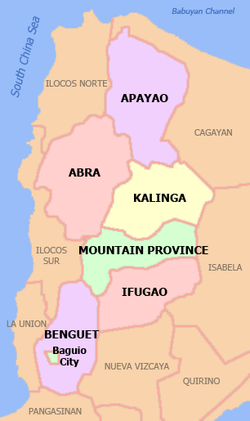
Kalinga is inhabited by compact villages located in the mountain valleys in the northern part of Luzon Island (Tani Masakazu 1999: 300). Kalinga houses are built on stilts, making them rectangular or octagonal in shape. In the past, houses could be placed in the crowns of trees. The capital of Kalinga is the Lubuagan settlement (Barton RF 1958: 212).
Life and lifestyle
Until the beginning of the 20th century, until the administration of the American colonial administration was established, the kalinga were bounty hunters (Bacdayan Albert S. 1969: 62). They mined the skulls of their enemies with axes and used them to decorate their dwellings. Traditional clothing: a loincloth for men, a skirt made of unstitched linen fabrics, decorated with colored stripes for women. Since the 20th century, modern Philipian style clothing has been worn. Kinship in families is determined by both male and female lines. Relatives live separately, in small families. The society has preserved the division into classes according to property. The traditional occupation of the people of Kalinga is farming. The favorable climate of the islands allows you to get two harvests per year. Livestock is not used; they prefer to use hunting and fishing to harvest meat. Among artisans, the main occupation is wood processing.
Literature
- Bacdayan Albert S. // Peace Pact Celebrations: The Revitalization of the Kalinga Intervillage Law, Law & Society Rewiew, Vol. 4, no. 1 (Aug., 1969). pp. 61-78.
- Barton RF // Primetive Kalinga peace-treaty system, Folklore Studies, Vol.17 (1958), pp. 212-214.
- Tani Masakazu, Longacre, William A. // On the Methods for Measuring Ceramic Uselife: A Revision of the Uselife Estimates of Cooking Vessels among the Kalinga, Philippines, American Antiquity, Vol. 64, No. 2 (Apr., 1999), pp. 299-308.
- Peoples of the Philippines // Peoples of Southeast Asia / Ed. A. A. Guber, Yu. V. Maretina, D. D. Tumarkina, N. N. Cheboksarov. - M .: Science, 1966. - P. 641-692. - (Peoples of the world, ethnographic essays).