On Wednesday , January 31, 2001, in the sky above the coast of Suruga Bay ( Japan ) in Shizuoka Prefecture, an aircraft incident occurred with the participation of two Japan Airlines ships, which nearly collided at intersecting courses.
| JAL907 and JAL958 flights | |
|---|---|
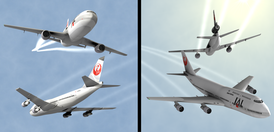 Computer reconstruction of an incident | |
| General information | |
| date of | January 31, 2001 |
| Time | 15:55 |
| Character | Dangerous rapprochement in the air |
| Cause | Dispatcher error |
| A place |  near Yaizu over Suruga Bay , ( Japan ) near Yaizu over Suruga Bay , ( Japan ) |
| Dead | 0 |
| The wounded | one hundred |
| Aircraft | |
 Boeing 747-446D similar to the colliding airline Japan Airlines | |
| Model | Boeing 747-446D |
| Airline | Japan airlines |
| Departure point | Haneda , Tokyo |
| Destination | Naha |
| Flight | Jal907 |
| Board number | Ja8904 |
| Passengers | 411 |
| Crew | 16 |
| The wounded | one hundred |
| Survivors | 427 (all) |
| Second aircraft | |
 McDonnell Douglas DC-10-40 similar to the colliding airline Japan Airlines | |
| Model | McDonnell Douglas DC-10-40 |
| Airline | Japan airlines |
| Departure point |  Gimhae , Busan Gimhae , Busan |
| Destination | Narita , Tokyo |
| Flight | Jal958 |
| Board number | JA8546 |
| Passengers | 237 |
| Crew | 13 |
| Survivors | 250 (all) |
Content
- 1 Timeline
- 2 Consequences
- 3 Court
- 4 See also
- 5 notes
- 6 References
Timeline
At 15:36 local time, a B747-446D with registration number JA8904 departed from Tokyo International Airport , which operated domestic flight JAL 907 and flew to Naha [1] . On board were 16 crew members, led by 40-year-old captain Makoto Watanabe ( Japanese 渡 辺 誠 ) and 411 passengers . Soon the plane took level 390 ( 39,000 feet or 11,700 meters ). Meanwhile, across the plane at 370 ( 37,000 feet or 11,100 meters ), the DC-10-40D flew with registration number JA8546, which operated the JAL 958 international flight from Gimhae 's South Korean airport ( Busan ) to Japanese Narita . On board were 13 crew members led by Captain Tatsuyuki Akzazawa ( Japanese. 沢 達 幸 ) and 237 passengers [1] .
The aircraft were supposed to disperse at a safe interval of 2,000 feet (600 meters). At 15:54, a 26-year-old intern Hideki Hatitani ( Japanese 蜂 谷 秀 樹 ), who also worked with a dozen other flights and saw intersecting flight paths 907 and 958 on the screen, located at the Tokyo Mission Control Center in Tokorodzawa , gave the command to flight 958 (DC-10) to decrease to echelon 350 ( 35,000 feet or 10,500 meters ). However, confused, he called the wrong number - 907 (B747). A little later, noting that 958 continues to fly at the same height, the intern gave the command for this flight to the right turn. But on board the 958th this command was not heard. The trainee leader, Yasuko Momiya ( 籾 井 康 子 ), realizing the danger of the situation, gave the command “957, start the climb”, although there was no 957 flight at that moment on the radar. Meanwhile, the TCAS system on board the B747 (flight 907) began to give a command to climb, while giving a command to the DC-10 pilots (flight 958) to decrease. However, the pilot Watanabe ignored the TCAS commands and continued to execute the dispatch command. The Akzawa pilot, acting according to the commands of the system, also began the descent. Thus, both aircraft now flew across at the same altitude.
At 15:55:02, the team finally heard the flight 907, which at that moment was at an altitude of 36,200 feet (10,860 meters), to climb and climb to level 390. But Watanabe did not have time to complete it, because after a few seconds, he saw flight 958 flying across him and completely yielded the helm away from him, sending the 747th sharply down and forcing him to dive under the DC-10. The aircraft parted at a distance of less than 100 meters. Watanabe himself stated that the height difference was only 35 feet (11 meters). An unknown passenger later said in a program on NHK : I never saw planes fly so close. I thought we were going to crash ( I have never seen a plane fly so close. I thought we were going to crash ). Student Alex Turner ( Eng. Alex Turner ), studying at the Academy on the territory of the military base of Kaden, calculated that the duration of the maneuver was a couple of seconds.
Since flight attendants were servicing passengers by the time the planes crossed, a sharp Boeing maneuver caused the carts with hot drinks topple over, many flight attendants and unfastened passengers were thrown up and they hit the ceiling. One boy was thrown over 4 rows of seats, a 54-year-old woman broke her leg. In total, on board flight 907, 9 people were seriously injured: 2 flight attendants and 7 passengers [1] . Another 81 passengers and 10 cabin crew received minor injuries [1] - mainly burns from overturned hot drinks and bruises . At 16:45, flight 907, with minor damage, returned and made an emergency landing at Tokyo Airport. No one was injured on board flight 958.
None of those on both planes died.
Consequences
At 6 o’clock in the evening of the next day, 8 passengers remained from hospitals on flight 907, 22 of the initially hospitalized were discharged. Subsequently, all the others were also discharged. Japan Airlines sent an official apology to all passengers on flight 907, with the apology delivered to the wounded in person, and the rest sent by mail. The Japanese authorities also called on the International Civil Aviation Organization (ICAO) to take measures to prevent similar incidents in the future. . ICAO did not conduct further investigation . But on July 1, 2002, 18 months after the incident with flights 907 and 958, Tu-154M ( Bashkir Airlines ) and Boeing 757 ( DHL ) collided in the sky over Germany near Lake Constance under similar circumstances, killing 71 people. This prompted ICAO to continue investigating the incident. in the Japanese sky, which she conducted together with the Tokyo Police Department and the Ministry of Land, Infrastructure, Transport and Tourism . The investigation report was published on July 12 of the same year. .
Court
On May 7, 2003, the Tokyo Police Department launched an investigation into dispatchers Hideki Hatitani and Yasuko Momiya, and pilot Makoto Watanabe on suspicion of negligence in the performance of professional duties. Soon, the charges were dropped from the pilot Watanabe, since the then-current airline instructions did not give priority to TCAS teams over dispatcher teams. In addition, TCAS began to issue commands 50 seconds before a possible collision, when the dispatchers still had time to rectify the situation. On March 30, 2004, dispatchers from Khatitani and Momiya were charged with negligence in the performance of professional duties, as a result of which several people were injured.
Representing the Tokyo District Court, Khatitani and Momiya, who at that time were 30 and 35 years old respectively, refused to plead guilty. The dispatcher’s lawyer insisted that the pilots themselves were to blame. A preliminary hearing was held on September 9, 2004, after which, until November 16, 2005, 12 tests were conducted to simulate the incident. According to their results, the prosecution stated that the defendants neglected the requirement for the correct separation of the two aircraft, gave incorrect instructions, and the supervisor could not correct the trainee's mistake. In response, the defense claimed that incorrect commands did not immediately lead to the danger of a collision, the existing instructions for TCAS were not appropriate, and in the on-board navigation computer, some reference points for building the route (CNF, they were entered not by pilots, but by the manufacturer) were entered with errors.
In 2006, the prosecutor demanded 1 year in prison for Khatitani, and 1.5 years for Momiya. On March 20 of the same year, a court chaired by Judge Hisaharu Yasui ( Jap. 安井 久 治 ) found them not guilty, believing that the trainee could not have foreseen the danger and that the confusion in the flight numbers was not a causal relationship. At the same time, Judge Hisaharu Yasui noted that the prosecution of pilots and controllers in this case is "inappropriate." On March 31, the Tokyo District Attorney appealed to the Tokyo Central Court. In the same year, the Japanese government decided to allocate a total of 82.4 million yen to Japan Airlines and Tokio Marine & Nichido Fire Insurance to enable compensation for the victims.
On April 11, 2008, the Tokyo Main Court, after considering the appeal, quashed the 2006 decision, finding the dispatchers of Khatitani and Momiya guilty. Presiding Judge Ken Suda ( Jap. 須 賢 賢 ) sentenced 33-year-old Hatitani to imprisonment for 1 year, and 39-year-old Momiya to imprisonment for 1 year and 6 months, both sentences were adjourned for three years. The Judge of the Court explained that the confusion of flight numbers was an “elementary mistake”. The attorneys representing the dispatchers filed an appeal, but on October 26, 2010, the Supreme Court dismissed it.
See also
- Clash over Lake Constance
Notes
- ↑ 1 2 3 4 ICAO .
Links
- Accident Investigation Report Outline Concerning Boeing 747-400D JA8904 . International Civil Aviation Organization . Date of treatment November 27, 2012. Archived September 29, 2007.
- Accident Investigation to a Near Mid-Air Collision . Date of treatment November 27, 2012. Archived January 24, 2013.
- Aircraft Accident Investigation Report . Date of treatment November 27, 2012. Archived June 25, 2011.
- Aircraft Accident Investigation Report (Japanese) (link not available) . Date of treatment November 27, 2012. Archived June 25, 2011.
- The German Midair - Lessons to be Learned ( link unavailable) . Date of treatment November 27, 2012. Archived January 24, 2013.
- Close Call For JAL Jets . CBS News . Date of treatment November 27, 2012. Archived January 24, 2013.
- Japan Jet in Mid-Air Near-Miss . ABC News . Date of treatment November 27, 2012. Archived January 24, 2013.