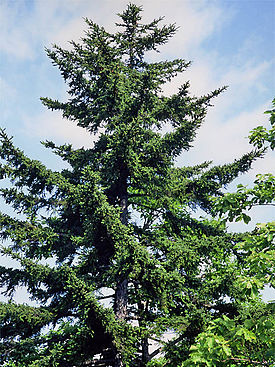
Spruce Glen ( lat. Picea glehnii ) - one of the species of spruce . The species is named after its discoverer for science, Petr Petrovich Glen (1835-1876), a Russian florist, plant taxonomy, traveler, geographer and hydrograph, researcher of Amur and Sakhalin . In Japanese it is called yap. ア カ エ ゾ マ ツ - red spruce.
| Spruce glen | |||||||||||||||||||
 | |||||||||||||||||||
| Scientific classification | |||||||||||||||||||
|---|---|---|---|---|---|---|---|---|---|---|---|---|---|---|---|---|---|---|---|
| |||||||||||||||||||
| International scientific name | |||||||||||||||||||
Picea glehnii ( F. Schmidt ) Mast. , 1880 | |||||||||||||||||||
| Security status | |||||||||||||||||||

Content
Range
The main range is located on the Japanese island of Hokkaido . It is also found on Mount Khayatin in the Kitakami Mountains in northern Honshu ( Iwate Prefecture ) and in Russia - in southern Sakhalin (along Aniva Bay in the Mereya River Valley, on the outskirts of Lake Big Vavaiskoye and Busse Lagoon ) and in the southern Kuril Islands ( Kunashir , Shikotan , south of Iturup ) [1] [2] .
Glen spruce grows in low places and cold, excessively moist soils with rocky subsoil at an altitude of 0 to 1600 meters above sea level.
View Description
A tree with a dense crown of cone-shaped appearance, with a trunk about 62-73 cm in diameter, on Sakhalin some spruce trees reach 17 m in height. In the Japanese mountains there are specimens up to 30 m. The bark of old trees is scaly, lamellar, chocolate-brown (this property is different for other species of spruce). Young shoots are orange or burgundy, pubescent along grooves and on petioles 1 mm long. Kidneys 3-7 mm long, about 5 mm wide, ovate-conical, reddish-brown, slightly resinous; their scales are triangular or trigonal with a long awl-shaped end.
The needles are about 10 mm long, 2.5 mm wide, tetrahedral, slightly curved, mature blunt, but sharp in young plants, bluish-green, when rubbed with a tart smell.
Cones are oblong-ovate or ellipsoidal with an almost flat bottom, 3.6-8.7 cm long and 2-4 cm thick; purple or green, mature brown, in the mature state dark red, with obovate, in the base part burgundy brown, seed scales. Seeds are 2–2.4 mm long, light brown, with a yellowish-orange wing, 2-3 times their length.
It is hardy to shade, resistant to winter frosts. In culture, it goes well with larch Gmelin .
Hybrids
Forms a hybrid of Picea × notha with Alyanskaya Spruce ( Picea jezoensis ).
Security
It is included in the Red Book of the Sakhalin Region and is also protected in national parks of Japan, especially in the area of the Honshu area.
Notes
- ↑ Picea glehnii . conifers.org. Date of treatment April 25, 2013. Archived April 30, 2013.
- ↑ Spruce Glen . Red Book of Sakhalin Oblast . Date of treatment April 25, 2013. Archived April 30, 2013.
Literature
- Koropachinsky I. Yu. Picea glehnii (Fr.Schmidt) Mast. - Spruce Glen // Vascular plants of the Soviet Far East: Plain-shaped, Horsetail, Fern-shaped, Gymnosperms, Angiosperms (Flowering): in 8 tons / hole. ed. S. S. Kharkevich . - L .: Nauka, 1989 .-- T. 4 / ed. volumes A.E. Kozhevnikov. - S. 13. - 380 p. - 1,500 copies - ISBN 5-02-026590-X . - ISBN 5-02-026577-2 (t. 4).