The Republic of Karakalpakstan , or Karakalpakstan , also has a variant of Karakalpakiya ( Karakalp. Qaraqalpaqstan Respublikası / Karagalpakstan Republics ; Uzbek. Qoraqalpogʻiston Respublikasi / Қoraқalpoiston Republic of Uzbekistan ) -.
| Sovereign Republic of Uzbekistan | |||||
| Republic of Karakalpakstan | |||||
|---|---|---|---|---|---|
| Karakalp. Qaraqalpaqstan Respublikasi Қaraқalpaқstan Republicy uzb Qoraqalpogʻiston Respublikasi Қoraқalpoғiston Respubliki | |||||
 | |||||
| Anthem of Karakalpakstan | |||||
| A country |  Uzbekistan Uzbekistan | ||||
| Included in | The Republic of Uzbekistan | ||||
| Administrative division | 14 fogs (districts) | ||||
| Adm. Centre | Nukus | ||||
| Chairman of the Jokargi Kenes | Musa Yerniyazov | ||||
| Chairman of the Council of Ministers | Sariev, Kahraman Ramatullaevich | ||||
| History and Geography | |||||
| Date of education | March 20, 1932 January 9, 1992 (as it stands) | ||||
| Square | 166 600 km² (40%, 1st place ) | ||||
Height
|
| ||||
| Timezone | UTC + 5 | ||||
| The largest city | Nukus | ||||
| Dr. big cities | Khojeyli , Beruni , Kungrad , Turtkul , Chimbay | ||||
| Population | |||||
| Population | 1 million 842 thousand people. ( 2018 ) (5.6%, 10th place ) | ||||
| Density | 10.77 people / km² (13th place) | ||||
| Nationalities | Uzbeks , Karakalpaks , Kazakhs , Turkmens and others | ||||
| Denominations | Sunni Muslims , also Christians and others | ||||
| official languages | Karakalpak Uzbek | ||||
| Digital identifiers | |||||
| Abbreviation | UZ-QR | ||||
| ISO 3166-2 Code | UZ-QR | ||||
| FIPS Index | UZ-KRK | ||||
| Telephone code | +998 61 | ||||
| Internet domain | .uz | ||||
| Automat code numbers | 95 - 99 | ||||
| |||||
| Official site | |||||
 | |||||


The Republic of Karakalpakstan is located in the north-west of Uzbekistan , occupies 166,600 km² of territory (28% of the territory) of Uzbekistan, and is the largest region in the territory of Uzbekistan. The population of the republic as of 2018 is 1 million 842 thousand people, and this is 5.6% of the total 33 million population of Uzbekistan. The official languages of the republic are Karakalpak and Uzbek . The Russian , Kazakh and Turkmen languages are also common in the republic.
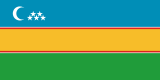
The Republic of Karakalpakstan, in addition to the main state symbols of Uzbekistan, also has its own state symbols: flag , coat of arms and anthem . The republic also has its own constitution and government represented by the Council of Ministers of the Republic of Karakalpakstan and the republican parliament of Zhokargy Kenes of the Republic of Karakalpakstan . The head of the republic is the chairman of the Zhokargy Kenes of the Republic of Karakalpakstan, currently it is M.T. Yerniyazov .
The head of the Government of the Republic of Kazakhstan is the Chairman of the Council of Ministers of the Republic of Kazakhstan.
In accordance with Article 74, Chapter XVII of the Constitution of the Republic of Uzbekistan , the Republic of Karakalpakstan has the right to remain or withdraw from the Republic of Uzbekistan on the basis of a general referendum of the people of Karakalpakstan [2] .
One of the vice-chairmen of the Senate of the Oliy Majlis of the Republic of Uzbekistan is the representative of the Republic of Karakalpakstan (Section Five, Chapter XVIII, Article 86 of the Constitution of the Republic of Uzbekistan).
The Cabinet of Ministers includes the head of government of the Republic of Karakalpakstan (section five, chapter XIX, article 98 of the Constitution of the Republic of Uzbekistan). The state currency is Uzbek sum .
Administrative device
The Republic of Karakalpakstan independently solves the issues of its administrative-territorial structure [3] .
The administrative center of Karakalpakstan is the city of Nukus . There are 12 cities and 25 urban settlements in the republic. RK is divided into 14 districts. State power in each district is represented by a hakim .
Geography
Karakalpakstan is located on the Turan lowland . The Karakum desert adjoins it closely from the south-west, the Ustyurt plateau is located in the north-west, and the Kyzylkum desert in the north-east. The territory of Karakalpakstan also includes the southern half of the former Aral Sea , on the dry bottom of which the new Aralkum solonchak desert is now formed, and the drying lower reaches of the Amudarya River .
In Karakalpakstan, deserts occupy more than 13.67 million ha (more than 80% of the territory). The Aral Sea region slowly descended for a long time and was the scene of accumulation of sediments of the Mesozoic-Cenozoic seas and alluvial strata demolished from the mountains. This contributed to the formation of vast stratum and alluvial plains. Cretaceous, tertiary and Quaternary deposits take part in their structure. Cretaceous rocks are composed of marine and continental formations in the form of sand and clay on the peninsulas of Tokmakat and Kulanda; Cape Aktumsyk, Beltau, Kuskanatau, Sultanuizdag, etc., are composed of the Paleozoic and Mesozoic strata and outcrops of crystalline rocks. The northwestern parts of the desert are significantly younger geologically: the Ustyurt plateau is of late Tertiary age.
In the south it borders with the Dashoguz and Balkan provinces of Turkmenistan , in the west - with the Karakiy , Mangistau and Beineu district of Mangistau region of Kazakhstan , in the north - with the Baigan region of Aktobe region of Kazakhstan , in the north-east of the Kazalinsky and Karmakshy region of Kyzylorda region of Kazakhstan - with the Khorezm and Bukhara regions, in the east - with the Navoi region.
A peculiar form of the desert is sand dunes.
Karakalpakstan is a zone of ecological disaster due to the drying up of the Aral Sea .
In the 1980s, in the north-west of Karakalpakstan (in the vicinity of the village of Zhaslyk ) there was a military training ground "The Eighth Chemical Defense Station" designed to test chemical weapons and means of protection against them. The landfill was used by servicemen from military units stationed in Nukus : a chemical test regiment (military unit 44105) and a center for the development of means of protection against chemical weapons (military unit 26382). The landfill was closed in the early 1990s, and military units were withdrawn to Russia .
From 1942 to 1992, on the Renaissance island in the Aral Sea (on the part of the island that is part of the Muynak region of Karakalpakstan), a military biochemical training ground with the code name "Barkhan" operated. The official name is the 52nd Field Research Laboratory (PNIL-52).
History
According to historical sources, people in the territory of Karakalpakstan lived already in the Neolithic era. On the territory of the Kara-Kalpak Autonomous Soviet Socialist Republic in the region of the old channel of Akchadarya in 1954, the Khorezm expedition found a large burial ground of Kokcha 3 . On the right-bank territory of the Amu Darya, S. P. Tolstov distinguished two cultures of the Bronze Age: the Tazabagyab and Suyargan ( en: Suyarganovo culture ), which existed simultaneously for a long time. The burial ground dates from the XIII-XI centuries BC. e. and refers to the time when the sites of two different cultures coexisted. This also indicates a diverse ethnic composition. The predominance of the Tazabagyab element in the culture of the Kokcha 3 site allowed S.P. Tolstov to attribute this monument to the Tazabagyab culture and draw parallels with the Andronov culture of northern Kazakhstan and southern Trans-Urals, and the felling-Khvalyn culture of the Volga region. The origin of Suyargan culture, in turn, is associated with the southern regions of Central, and also, possibly, Asia Minor or Northern India .
Suyargan tribes belonged, possibly, to the indodravoid type, which was widespread in antiquity much more widely - from India to Asia Minor [4] .
On tombstones of the grave of Darius I , dating back to the 5th century BC. e., it is said that on the territory of the Aral Sea region and the lower reaches of the Syr Darya (the territory of modern Karakalpakstan) lived “ Saki tigrahauda ” (“Saki in pointed caps”).
In the II-VI centuries BC. e. there was a migration of Turkic tribes from the territory of Altai and East Turkestan. There was an assimilation of the nomadic Turkic and indigenous Saki population, as a result of which two new ethnic communities appeared - Pechenegs and Oguzes . It was the Pecheneg tribes that formed the basis of the ethnic formation of the Karakalpaks.
Karakalpak statehood begins with the Nogai Khanate , formed at the end of the XIV century under the leadership of Idigu (Edygei), the leader of the Nogai (Mangyts). After the death of Idigu in 1419, the struggle for the throne intensifies, the khanate loses its strength. In the second half of the XVI century, the Nogai Khanate is divided into three parts - the Horde of six uluses, the Small Horde and the Big Horde.
At the beginning of the XVII century, the Nogais were defeated by the Kalmyks, who captured the areas of the Volga and Yaik . The Nogais were forced to relocate to Crimea , and the Karakalpaks, which became part of the Horde of six uluses, left in the Aral Sea region, on the banks of the Syr Darya, and settled there.
In the public life of the Karakalpaks, the Beks and Batyrs (military leaders) played an important role. Beks were the leaders of the Karakalpak clans: they solved the problems associated with law and economy. The Beks also acted as representatives of a kind or tribe in relations with neighboring peoples. In the sixteenth and seventeenth centuries, the Karakalpaks were subordinate to either the Bukhara khan or the Khiva khans.
By the beginning of the 18th century, the Karakalpaks living on the banks of the Syr Darya sought to unite. An important role in uniting the Karakalpaks was played by Kuchukkhan, Sultan Taburchak, Sultan Chaib. As a result, the Syr Darya Karakalpaks led by Eshmuhammad (Echkimkhan) united into the Karakalpak Khanate. The borders of this state passed along the upper reaches of the Syr Darya . The state also coexisted with the Kalmyks of the Volga region, the Bashkir ulus and the Kazakh Junior Zhuz.
In 1723, when the Kalmyks captured the middle part of the Syr Darya, the Karakalpaks were again forced to flee. The escaping Karakalpaks were divided into two groups. The first group went to the upper reaches of the Syr Darya, towards Tashkent ; the second group settled down the Syr Darya. Thus, the Karakalpaks were divided into “upper” and “lower” Karakalpaks. The lower Karakalpaks settled on the free lands between the Syr Darya and Amu Darya and were engaged in agriculture here, irrigating them with water from Kuvandarya.
Until 1873, in the main composition of the Khiva Khanate , then in the Amudarya department of the Syrdarya region. After the establishment of Soviet power in 1918 - as part of the Khorezm People's Soviet Republic and the Turkestan ASSR.
In 1924, the Kara-Kalpak Autonomous Region was formed with its center in Turtkul , occupying the territory of the Amu Darya region of the Turkestan ASSR and the Khojeyli and Kungrad regions of the Khorezm Socialist Soviet Republic .
On February 12-19, 1925, the First Constituent Congress of dekhkan, farm laborers, and Red Army deputies was held, at which the Kara-Kalpak Autonomous Region was officially established on February 16 as part of the Kyrgyz Autonomous Soviet Socialist Republic (1920-1925) (later renamed the Kazakh Autonomous Soviet Socialist Republic ).
On July 20, 1930, the Kara-Kalpak Autonomous Region was withdrawn from the Kazakh Autonomous Soviet Socialist Republic and transferred directly to the RSFSR ; on March 20, 1932 it was transformed into the Kara-Kalpak Autonomous Soviet Socialist Republic (KKASSR, as part of the RSFSR).
In 1932, the city of Nukus became the capital of the Kara-Kalpak Autonomous Soviet Socialist Republic.
On December 5, 1936, the Kara-Kalpak Autonomous Soviet Socialist Republic (KKASSR) became part of the Uzbek SSR .
In 1964 it was renamed the Karakalpak Autonomous Soviet Socialist Republic (KKASSR).
On December 14, 1990 (later Kazakhstan and Uzbekistan , but earlier than Kyrgyzstan), at the session of the Supreme Council of the Karakalpak Autonomous Soviet Socialist Republic, a Declaration on State Sovereignty was signed, implying full independence of the state, which could be achieved through a nationwide referendum.
January 9, 1992 transformed into the Republic of Karakalpakstan.
In 1993, an interstate agreement was signed for a period of 20 years on the entry of the Republic of Karakalpakstan into Uzbekistan. The agreement stipulates the right of an autonomous republic to leave Uzbekistan through a referendum [5] .
The territory of the modern Republic of Karakalpakstan is a kind of “archaeological reserve”. On this territory today there are over 300 archaeological sites. In ancient times, this territory, along with the modern Khorezm region and the adjacent regions of Turkmenistan, constituted Khorezm .
Administrative Division
History
In 1931, the Karakalpak Autonomous District was divided into 11 districts:
- Kara-Uzyak, center - Kara-Uzyak village;
- Kegeyli, the center is the village of Nukus (Kegaili village);
- Kipchak, center - Kipchak village;
- Kungradsky, the center is the village of Kungrad;
- Muinak, the center is the village of Muinak;
- Tamdynsky, center - Tamdy-Bulak aul;
- Takhtakupyrsky, center - Takhtakupyr village;
- Turtkul, the center is the city of Turtkul (the village of Shurahan);
- Khojeylinsky, center - Khojeyli village;
- Chimbay, the center is the city of Chimbay;
- Shabaz, the center is the village of Sheikh Abaz.
In 1936, the Kuybyshevsky District was formed [6] .
In 1943, the Tamdynsky district was transferred to the Bukhara region .
In 1950, the Shumanai district was formed, and in 1952 - Kenessky.
In 1957, the enlargement of areas began. The Kenes and Kipchak districts were the first to be abolished. In the same year, the Amudarya district was formed, and the Shabbaz district was renamed Biruninsky. In 1959, the Kara-Uzyak and Kuibyshev districts were abolished.
In 1963, the Biruni, Kungradsky, Muynaksky, Takhta-Kupyrsky and Shumanai districts were abolished. At the same time, the Muynak industrial region was formed, but the very next year it was transformed into a “regular” region.
In 1964, a gradual increase in the number of districts began. So, in 1964, the Biruni and Kungradsky districts were formed, in 1965 - Takhtakupyrsky, in 1967 - Shumanay, in 1968 - Nukus, in 1970 - Leninabad (now Kanlykul), in 1975 - Karauzyak, in 1977 - Ellikkalinsky, and in 1979 - Bozataus district .
The Bozataus district was abolished in 1988, but in 1990 it was rebuilt [7] . In 2004, the district was abolished again [8] .
On August 9, 2017, the Takhiatash region was formed by allocating part of the Khojeyli region [9] [10] .
Modern Administrative Division
Modern administrative division [11] :
| No. | Area | Uzbek title | Karakalpak title | Administrative Centre | Square thousand km 2 | Population January 1, 2014 thousand inhabitants | Population July 1, 2016 thousand inhabitants [12] |
|---|---|---|---|---|---|---|---|
| one | Amu Darya | Amudaryo | Ámiwdárya | Mangit | 1,02 | 179.1 | 186.8 |
| 2 | Berunian | Beruniy | Beruniy | Beruni | 3.95 | 170.3 | 178.5 |
| ten | Karauzyak | Qoraoʻzak | Qaraóek | Carauzyak | 5.89 | 49,6 | 51,2 |
| five | Kegeulian | Kegeyli | Kegeyli | Kegaili | 2.21 | 84,8 | 87.4 |
| 9 | Kungradsky | Qoʻng'irot | Qońırat | Kungrad | 76.0 | 120.1 | 124,4 |
| eight | Kanlykulsky | Qanlikoʻl | Qanlıkól | Kanlykul | 0.74 | 46.9 | 48.7 |
| 6 | Muinaksky | Moʻynoq | Moynaq | Muynak | 37.88 | 29.4 | 30,4 |
| 7 | Nukus | Nukus | Nokis | Akmangit | 0.95 | 44,4 | 46.5 |
| Takhiatashsky | Taxiatosh | Taqıyatas | Tahiatash | 0.16 | - | - | |
| 12 | Takhtakupyrsky | Taxtakoʻpir | Taxtakópir | Takhtakupyr | 21.12 | 38.7 | 39.2 |
| 13 | Turtkul | Toʻrtkoʻl | Tortkúl | Turtkul | 7.48 | 192.6 | 201,2 |
| 14 | Khojeyliysky | Xoʻjayli | Xójeli | Khojeyli | 0.57 | 183.5 | 188.3 |
| 3 | Chimbay | Chimboy | Shımbay | Chimbay | 2.20 | 108.3 | 111.8 |
| eleven | Shumanay | Shumanoy | Shomanay | Shumanai | 0.78 | 53.1 | 54,4 |
| four | Ellikkalinsky | Ellikqalʼa | Ellikqala | Bustan | 5.42 | 140.5 | 148.0 |
| Nukus | Nukus | Nokis | 0.22 | 295.2 | 305.6 |
Economy
The main agricultural sectors of the Republic of Karakalpakstan are grain growing (wheat and raw rice production), cotton growing, animal husbandry and sericulture. In 2016, the Ustyurt MCC began to operate. The Ustyurt Gas Chemical Complex is one of the largest oil and gas projects in the world. In 2012, the international publication Project Finance International recognized the project financial agreement for this project as the best in the petrochemical and gas chemical sectors. The project also won international awards for the Best Deal of 2012 from Trade Finance Magazine and the Global Trade Review . On March 13, 2014, another international publication, the Infrastructure Journal, awarded the 2014 Global Transaction in the Oil and Gas Industry Award to the construction project.
Population
As of the beginning of 2017, the population of Karakalpakstan is 1 million 817.5 thousand people. For the period January – December 2016, the birth rate was 39,427, the mortality rate was 8,396. At the same time, 307.4 thousand people live in the capital [13] .
According to official data for 2013, the total population is 1711.8 thousand people [14] [15] . The urban population (2011) - 49.8%, and the region was almost not affected by the nationwide mass transfer of villages to urban settlements (in 2008, citizens accounted for 48.5% of the population of Karakalpakstan) [16] .
The website of the Embassy of the Republic of Uzbekistan in Ukraine [17] reports that “mostly Uzbeks (32.8%) and Karakalpaks (32.1%) live in Karakalpakstan,” which reflects the 1989 census.
In independent Uzbekistan, general population censuses have never been conducted; current population counts are carried out by registry offices. Information on ethnic composition by official statistical bodies is published only for the country as a whole [18] .
According to Bradley Mayhew (2007) [19] , the total population was estimated at 1.2 million people, of which the Karakalpaks amounted to about 400 thousand, Uzbeks - about 400 thousand, and Kazakhs - about 300 thousand people, which corresponds to (with rounding) the 1989 census (Uzbeks - 398 thousand, Karakalpaks - 389 thousand, Kazakhs - 319 thousand).
Approximately half of the population lives in cities and urban-type settlements, the rest - in rural areas.
- The dynamics of the size and ethnic composition of the population of Karakalpakia according to the All-Union Censuses of 1926-1989
| Nationality | 1926 [20] people | % | 1939 [21] people | % | 1959 [22] people | % | 1970 [23] people | % | 1979 [24] people | % | 1989 [25] people | % |
|---|---|---|---|---|---|---|---|---|---|---|---|---|
| Total | 304539 | 100.00% | 469702 | 100.00% | 510101 | 100.00% | 702264 | 100.00% | 905500 | 100.00% | 1212207 | 100.00% |
| Uzbeks | 84099 | 27.62% | 116054 | 24.71% | 146783 | 28.78% | 212597 | 30.27% | 285400 | 31.52% | 397826 | 32.82% |
| karakalpaki | 116125 | 38.13% | 158615 | 33.77% | 155999 | 30.58% | 217505 | 30.97% | 281809 | 31.12% | 389146 | 32.10% |
| Kazakhs | 85782 | 28.17% | 129677 | 27.61% | 133844 | 26.24% | 186038 | 26.49% | 243926 | 26.94% | 318739 | 26.29% |
| Turkmens | 9686 | 3.18% | 23259 | 4.95% | 29225 | 5.73% | 37547 | 5.35% | 48655 | 5.37% | 60244 | 4.97% |
| Russians | 4924 | 1.62% | 24969 | 5.32% | 22966 | 4.50% | 25165 | 3.58% | 21287 | 2.35% | 19846 | 1.64% |
| Koreans | 7347 | 1.56% | 9956 | 1.95% | 8958 | 1.28% | 8081 | 0.89% | 9174 | 0.76% | ||
| Tatars | 884 | 0.29% | 4162 | 0.89% | 6177 | 1.21% | 7619 | 1.08% | 7617 | 0.84% | 7767 | 0.64% |
| Ukrainians | 621 | 0.20% | 3130 | 0.67% | 2201 | 0.43% | 2316 | 0.33% | 2005 | 0.22% | 2271 | 0.19% |
| Bashkirs | 29th | 0.01% | 381 | 0.08% | 571 | 0.11% | 854 | 0.12% | 920 | 0.10% | 1090 | 0.09% |
| Kyrgyz | 277 | 0.09% | 181 | 0.04% | 177 | 0.03% | 400 | 0.06% | 1955 | 0.22% | 867 | 0.07% |
| Moldavians | ten | 0.00% | sixteen | 0.00% | 57 | 0.01% | 343 | 0.04% | 632 | 0.05% | ||
| Belarusians | thirty | 0.01% | 214 | 0.05% | 328 | 0.06% | 517 | 0.07% | 852 | 0.09% | 567 | 0.05% |
| other | 2072 | 0.68% | 1697 | 0.36% | 1874 | 0.37% | 2691 | 0.38% | 2650 | 0.29% | 4038 | 0.33% |
Health
Since the Soviet times, the region has had an extremely unfavorable situation with tuberculosis: the incidence rate is about twice as high as the average for Uzbekistan. In 2009, the incidence rate of tuberculosis in Karakalpakstan was 135.5 people per 100 thousand people, while the average for Uzbekistan in 2009 was only 63.7 people, the mortality rates from tuberculosis were 18.1 and 6, respectively. 1 [26] . The peak incidence of tuberculosis in Karakalpakstan (as well as throughout the country) fell at the beginning of the 2000s, when the incidence rate in the region reached 182.8 people per 100 thousand people, but then the situation improved somewhat thanks to the measures taken by the authorities [26] .
Universities of Karakalpakstan
- Karakalpak State University
- Nukus State Pedagogical Institute
- Branch of the Tashkent Medical Institute.
- Nukus branch of Tashkent University of Information Technology [27]
- Branch of Tashkent State Agrarian University
- Branch of the State Institute of Arts and Culture
Chairmen of the Council of Ministers
- Tajiev Amin Hamraevich - July 1989 - January 1992.
- Yuldashev, Recepbay - 1992-1995
- Dzhumaniyazov, Bahram Satymbaevich - February - December 1995.
- Avezmatov, Saparbay - 1995-1998
- Tajiev Amin Hamraevich - October 1998 - 10/7/2002 [28] .
- Tanirbergenov Tursynbay Tleubanovich - 2002-2006
- Yangibaev, Bahadir Yangibaevich - 2006-2016 [29] [30] .
- Kahraman Sariev - from 2016 to today
Notes
- ↑ Constitution of the Republic of Karakalpakstan - Article 1 . The official website of the Zhokarga Kenes of the Republic of Karakalpakstan is parliamentrk.gov.uz. Date of treatment November 3, 2018.
- ↑ Constitution of the Republic of Uzbekistan, art. 74
- ↑ Constitution of the Republic of Uzbekistan 73
- ↑ Anthropological types of the ancient population in the USSR. M., 1988
- ↑ Independent Karakalpakstan: a dream or a political program? (inaccessible link) . Deutsche Welle (May 21, 2015). Date of treatment March 2, 2019. Archived on August 18, 2018.
- ↑ About the new network of districts of the Kara-Kalpak Autonomous Soviet Socialist Republic
- ↑ Decree of the Presidium of the Supreme Council of the Uzbek SSR "On the restoration of certain areas within the Uzbek SSR" // Truth of the East: newspaper. - 1990. - February 28 ( issue 22216 ( No. 50 ). - S. 1 .
- ↑ World Historical Project
- ↑ Қoraқalpoғistonda Takhiatosh fogi tuzildi (Uzbek) . kruz.uz (August 14, 2017). Date of treatment June 23, 2018.
- ↑ A new Takhiatash region formed in Karakalpakstan (inaccessible link) . Uzbekistan News (August 14, 2017). Date accessed June 23, 2018. Archived June 23, 2018.
- ↑ Qala ha'm rayonlar . sovminrk.gov.uz. The appeal date is March 2, 2019.
- ↑ Information on the population of the Republic of Karakalpakstan
- ↑ Қaraқalpaқstanda halyқ sana қansha? . Qaraqalpaqstan Xabar Agentligi . The appeal date is March 2, 2019.
- ↑ State Committee of the Republic of Uzbekistan on Statistics (Inaccessible link) . Date of treatment November 18, 2011. Archived July 15, 2012.
- ↑ State Committee of the Republic of Uzbekistan on Statistics (Inaccessible link) . Date of treatment February 20, 2014. Archived October 21, 2013.
- ↑ Kurbanov Sh. B. Development of urban settlements and the problem of urbanization of the lower administrative regions of Uzbekistan // Socio-economic geography. Bulletin of the Association of Russian geographers-social scientists. - 2014. - No. 3. - S. 104
- ↑ Uzbekistan → Administrative regions . Embassy of the Republic of Uzbekistan in Ukraine. Date of appeal April 15, 2016.
- ↑ DEMOGRAPHIC SITUATION IN THE REPUBLIC OF UZBEKISTAN
- ↑ Bradley Mayhew. Central Asia . - Lonely planet. - 2007. - S. 258. - ISBN 1741046149 . - ISBN 9781741046144 .
- ↑ All-Union Population Census of 1926. The national composition of the population in the regions of the RSFSR (Kazak Autonomous Soviet Socialist Republic, Kara-Kalpak Autonomous Okrug) Demoscope
- ↑ 1939 All-Union Population Census. Distribution of urban and rural population of the regions of the Union republics by nationality and gender Demoscope
- All-Union census of 1959. Urban and rural population of regions of the republics of the USSR (except the RSFSR) by sex and nationality Demoscope
- ↑ 1970 All-Union Census. Urban and rural population of regions of the republics of the USSR (except the RSFSR) by sex and nationality Demoscope
- ↑ 1979 All-Union Census. Urban and rural population of regions of the republics of the USSR (except the RSFSR) by sex and nationality Demoscope
- ↑ 1989 All-Union Population Census. Distribution of urban and rural population of the regions of the republics of the USSR by gender and nationality Demoscope
- ↑ 1 2 Ubaidullaev A.M., Absadykova F.T., Tashpulatova F.K. Tuberculosis in Uzbekistan // Tuberculosis and lung diseases. - 2011. - T. 88. - No. 11. - P. 11
- ↑ Website of Nukus branch of Tashkent University of Information Technologies
- ↑ TAJIYEV (TOZHIEV) A. & 124; CenterAsia
- ↑ Recent history of Karakalpakstan . FREE KARAKALPAK-YERKIN KARAKALPAK (November 11, 2007). The appeal date is March 2, 2019.
- ↑ REPUBLIC OF KARAKALPAKSTAN unopened (inaccessible link) . Date of treatment March 2, 2019. Archived December 23, 2010.