Candelaria Church ( port. Igreja de Nossa Senhora da Candelária ) is a Catholic church in the center of Rio de Janeiro , Brazil . One of the main religious monuments of the city. National Monument (ID 51).
| Church | |
| Candelaria church | |
|---|---|
| Igreja de Nossa Senhora da Candelária | |
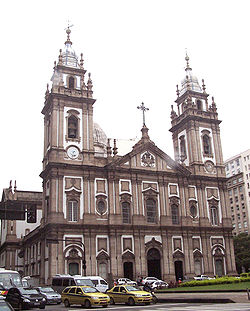 | |
| A country |  Brazil Brazil |
| City | Rio de Janeiro |
| Denomination | Roman catholic church |
| Diocese | |
| Architectural style | |
| Construction | 1609 - 1877 |
| Status | acts |
Content
- 1 Origin
- 2 XVIII century
- 3 XIX century
- 4 Interior
- 5 Value
- 6 See also
- 7 Source
- 8 References
Origin
According to the legend about the origin of the name of the church, in the XVII century a sea storm almost sank the ship “Candelaria”, on which two Spaniards sailed, who vowed to build a temple if they were saved. In 1609, they built a small chapel in Rio de Janeiro.
18th century
In 1710, the chapel was transformed into a full parish. Soon the need arose to expand the parish, in 1775 the construction of a new church building from the temple began. In 1811, in the presence of the regent, the future king of Portugal, Juan VI , the unfinished church was consecrated. At that time the church had one nave .
XIX century
Some time after the opening, two more naves were added to the church. After the construction of the dome in 1877, the Candelaria Church became the tallest building in Rio de Janeiro. Various parts of the dome were made in Lisbon, as well as several statues.
Interior
Since 1878, the interior of the church began to be decorated in the style of the Italian Neo-Renaissance . The interior painting of the temple was performed by various Brazilian and European artists.
Value
Candelaria Church is one of the main monuments of the colonial architecture of Brazil.
See also
- Killing Teens at Candelaria Church
Source
- Guia da Arquitetura Colonial, Neoclássica e Romântica no Rio de Janeiro . Editora Casa da Palavra. 2000.
- Introduction to the colonial architecture of Rio de Janeiro
Links
- Wikirio (port.)