Diparinae (lat.) - a subfamily of parasitic riders from the family Pteromalidae ( Chalcidoidea ) of the order Hymenoptera insects . Over 100 species. Cosmopolitans .
Diparinae | ||||||||||||||||
|---|---|---|---|---|---|---|---|---|---|---|---|---|---|---|---|---|
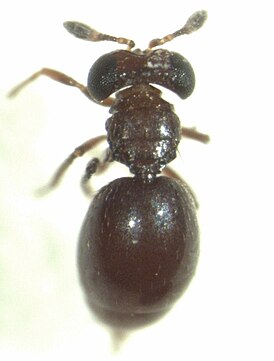 Pseudoceraphron sp. (female) | ||||||||||||||||
| Scientific classification | ||||||||||||||||
| ||||||||||||||||
| Latin name | ||||||||||||||||
| Diparinae Thomson , 1876 | ||||||||||||||||
| Tribes | ||||||||||||||||
|
Content
- 1 Description
- 2 Distribution
- 3 Systematics
- 4 notes
- 5 Literature
- 6 References
Description
Sexual dimorphism is characteristic : females, mainly short-winged or wingless, outwardly similar to ants ; with club-shaped antennae. Males are macropterous with normally developed wings and long antennae. Formula of antenna segments: 1-1-1-7-3 [1] . Biology remains almost unexplored, presumably parasitizing on insect larvae that live in wood or in the litter layer [2] . There is evidence of parasitization on weevil beetles ( Curculionidae ), and representatives of the genus Myrmicolelaps have been bred from the oedema of mantis and puparia mujecie ( Glossinidae : Glossina ) [1] .
Distribution
They are found around the world, most abundantly represented in lowland and mountain rainforests. The greatest diversity at the generic level is observed in Australia and South Africa [1] .
Systematics
From 16 [3] to more than 30 genera and more than 100 species are distinguished [2] . During their recent revision (Desjardins, 2007), most of the generic taxa were synonymous or excluded from the subfamily ( Lieparini ). Some representatives are so unusual that, for example, the genus Pseudoceraphron Dodd, 1924 was originally described as part of another family ( Ceraphronidae ) [1] .
- Cerodipara Desjardins, 2007
- Chimaerolelaps Desjardins, 2007
- Conodipara Hedqvist , 1972
- Conophorisca Hedqvist, 1969
- Dipara Walker , 1833
- = Africesa, Afrolelaps, Alloterra, Apterolaelaps, Apterolelaps, Diparomorpha, Emersonia, Epilelaps, Grahamisia, Grahamislia, Hispanolelaps, Parurios, Pondia, Pseudipara, Pseudiparella, Trichoryphus, Tricoryphus, Trimoleps
- Dozodipara Desjardins, 2007
- Hedqvistina Koçak, Hüseyinoglu & Kemal, 2008
- Lelaps Walker, 1843
- Mesolelaps Ashmead, 1901
- Myrmicolelaps Hedqvist, 1969
- Neapterolelaps Girault, 1913
- Neolelaps Ashmead, 1901
- Netomocera Boucek, 1954
- Nosodipara Boucek, 1988
- Pseudoceraphron Dodd, 1924
- Pyramidophoriella Hedqvist, 1969
Notes
- ↑ 1 2 3 4 Desjardins, CA Phylogenetics and classification of the world genera of Diparinae (Hymenoptera: Pteromalidae) (Eng.) // Zootaxa . - 2007. - Vol. 1647 . - P. 1-88 .
- ↑ 1 2 Notes on families: Pteromalidae (English) . Universal Chalcidoidea Database . Nhm.ac.uk. Date of treatment November 17, 2012. Archived January 9, 2013.
- ↑ Genera in subfamily Diparinae (English) . Universal Chalcidoidea Database . Nhm.ac.uk. Date of treatment November 17, 2012. Archived January 9, 2013.
Literature
- Desjardins, CA (2007). Phylogenetics and classification of the world genera of Diparinae (Hymenoptera: Pteromalidae). - Zootaxa , 1647: 1-88. abstract
- Yoshimoto, CM (1977). Revision of the Diparinae (Pteromalidae: Chalcidoidea) from America north of Mexico. - Canadian Entomologist , 109, 1035-1056.