“Gadfly” ( The Gadfly ) is a revolutionary romantic novel, the work most famous for the Russian-speaking reader of the English, later American writer Ethel Lilian Voynich . First released in 1897 in the United States .
| Gadfly | |
|---|---|
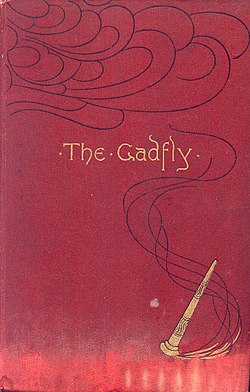 Cover of the first edition of 1897 | |
| Genre | |
| Author | |
| Original language | |
| Date of first publication | |
| Publishing house | |
Content
Contents
The novel reflects the activities of participants in the underground revolutionary organization Young Italy in the first half of the 19th century ; Christianity is sharply criticized. The novel tells the story of a young, naive, in love, full of ideas and romantic illusions of Arthur Burton. He found himself deceived, slandered and rejected by all. He disappears, imitating suicide, and later returns to his homeland 13 years later under a different name, a man with a mutilated appearance, a warped fate and a fierce heart. He appeared in front of people whom he once loved and knew, a mocking cynic with the journalistic pseudonym Ovod.
Characters
- Gadfly (Arthur Burton, Felice Rivares) - revolutionary, protagonist of the novel
- Lorenzo Montanelli - Cardinal, the real father of Arthur
- Gemma Warren (Jennifer, Jim, after the marriage of Signor Ball) - beloved Arthur (Gadfly)
- James Burton - Arthur's stepbrother
- Julie Burton - wife of James Burton
- Giovanni Boll - love rival, friend Arthur, the dead husband of Gemma
- Cesare Martini - love rival, friend Gadfly
- Riccardo - Professor, Doctor
- Grassini - companion Ovoda
- Galli - Gadfly's friend
- Zita Reni - gypsy dancer , lover of Gadfly
- Colonel Ferrari - commander of the garrison in Brisighella
Gadfly Prototype
Polish literature scholars categorically argued that the real prototypes of the Gadfly were the figures of the Polish social revolutionary party "Proletariat", while Russian readers immediately after the release of the Gadfly in Russia recognized the familiar features of the Russian revolutionaries. Some researchers believe that in the image of the Gadfly it is easy to detect the features of Mazzini and Garibaldi [1] .
In 1955, Soviet writers managed to track down E. L. Voynich, who lived in New York, and began to maintain close contact with her. In a letter to B. N. Polevoy (New York, January 11, 14, 1957), she wrote about the prototypes of Arthur (Gadfly) and other heroes [2] :
You ask me if Arthur’s real prototype existed in life. People without creative imagination often have questions of this kind. But I don’t understand how a novelist can ask me about this. Of course, the images in the novel do not always have prototypes of real people; whether they are a kind of result of a complex process taking place in the author’s imagination under the influence of factors such as:
- 1) personal experience of the author,
- 2) the experience of those people with whom the writer or writer meets, and
- 3) a lot of well-read (which is true in my case).
The only image in Gadfly that I can partly consider a portrait - and even in this case a very fragmented portrait - is Gemma, whose image was to some extent written off - especially her personal appearance - from my dear friend Charlotte Wilson, so Kropotkin helped a lot in his work. She edited the Freedom newspaper in London, and she introduced me to Stepnyak.
From early youth I was greatly influenced by the biography and works of Mazzini, and later (1885-1886) - the life and works of Abbot Lamenne, whose "Words of the Believer" I know almost by heart. The Bible and the works of Shakespeare, Milton, Shelley and Blake (his poems “Happy fly, whether I live, or die”, which I knew since childhood) most of all seem to have influenced my youthful mind. Personality Lamenne, it seems to me, partly had a certain influence on the creation of the image of Montanelli.
The origin of the image of Arthur is due to my long-standing interest in Mazzini and to the portrait of an unknown young man in black, located in the Louvre, which I first saw in 1885. The fact that the novel sees a reflection of Russian or Polish influence, as Ms. Taratuta points out in her introduction to the new Russian edition of Gadfly, is natural and understandable. Where, besides Eastern Europe and among Russian and Polish emigrants in London and Western Europe, could I directly get acquainted with the conditions that to one degree or another existed in Italy during the youthful period of Mazzini's life? On the other hand, Anna Nill, who had just re-read the biographical notes preceding Mazzini's book “Human Responsibilities and Other Essays,” pointed out to me numerous details that, in her opinion, could have influenced the creation of Arthur’s image.
As for your novel "Gold", now it’s clear to me why this end came about, and I understand now that we have completely opposite ideas about the process of creating the novel. Of course, if the prototypes of your heroes are living people, you cannot allow yourself to be treated freely!
The nickname "Gadfly" is probably a reference to Socrates , who denounces the vices of the Athenians, whom Plato compared with a gadfly that stings a leisurely horse, and thereby encourages action.
Popularity in Russia
The novel was popular in England (until 1920 - 18 editions), pre-revolutionary Russia and the USA, later in the USSR and other socialist countries. The year the novel was published in Russia - 1898 - was the year of the 1st Congress of the Russian Social Democratic Labor Party . The translation of the novel “Gadfly” first appeared in the form of an appendix to the magazine “ Peace of God ” for 1898. In 1898, Gadfly came out as a separate publication. It was distributed by G. M. Krzhizhanovsky , E. D. Stasova , Grigory Petrovsky , I. V. Babushkin , Ya. M. Sverdlov , M. Gorky . This book was loved by P. A. Zalomov , who served Gorky as a prototype of the hero of the novel “ Mother ”. Fond of the "Gadfly" G. I. Kotovsky , N. A. Ostrovsky , A. P. Gaidar , M. I. Kalinin , Zoya Kosmodemyanskaya . The 1988 edition (edition of Pravda ) states that Gadfly was Yu. A. Gagarin's favorite book. They were fond of “Gadfly” in other countries, including those where it was clearly not encouraged. The writer and actress Lyudmila Andreevna Yamshchikova, daughter of M. V. Yamshchikova, who wrote under the pseudonym Al. Altayev ”, took in honor of the hero Voynich literary pseudonym Art Felice. It is read by the heroes of the novel of modern Iranian writer Mahbod Seraj “Roofs of Tehran”. In Nikolai Alekseevich Ostrovsky’s novel “How Steel Was Tempered,” the main character, Pavka Korchagin, refers several times to the novel “Gadfly,” and in one episode he reads aloud a fragment of it to the Red Army soldiers.
Films
Three films based on the novel were shot in the USSR.
- Gadfly (film, 1928) , USSR, starring Iliko Merabishvili .
- Gadfly (film, 1955) , USSR, starring Oleg Strizhenov .
- Gadfly (film, 1980) , USSR, starring Andrey Kharitonov .
In 1985, at the Leningrad State Theater. The Lenin Komsomol director Gennady Egorov directed a rock musical based on the plot of the novel to the music of Alexander Kolker “Gadfly” with Mikhail Boyarsky as Rivares-Gadfly.
In 1982, according to the plot of the novel, a ballet called “ Rivares ” was put to music by Sulkhan Tsintsadze , and in 1987 at the film studio Georgia-Film a ballet film of the same name was shot, choreography by Alexei Chichinadze , director of the film Bidzina Chkheidze, in the title role ( ballet) artist of the MAMT ballet troupe Vadim Tedeev .
In 2003, the filming of the film “Gadfly” was reported by the Chinese director Wu Tianming, together with the movie studio named after A. Dovzhenko in Ukraine. [3] .
See also
- en: Social gadfly - the image of a gadfly in ancient literature
Notes
- ↑ E.L. Voynich. Selected works in two volumes. M., "Fiction Publishing House", 1958. p.14 (preface - E. Taratuta)
- ↑ E.L. Voynich. Selected works in two volumes. M., "Fiction Publishing House", 1958. p. 426-427
- ↑ In Ukraine, for the Chinese, they are filming the series “Gadfly” . NEWSru (June 21, 2003). Date of treatment February 25, 2013. Archived February 26, 2013.