Battleships of the Normandie type ( French Normandie - Normandy ) are a series of French battleships scheduled for construction in the 1910s . They were the development of battleships of the "Brittany" type . Represented an attempt by French designers to create ships that are not inferior to battleships of other countries in firepower, with limited displacement, which was dictated by the size of the French dry docks. For the first time in the world, four-gun turrets of the main caliber were used. In total, it was planned to build 5 battleships of this type: Normandy, Languedoc, Gascony, Flanders, Bearn.
| Line ships of the Normandy type | |
|---|---|
| Classe normandie | |
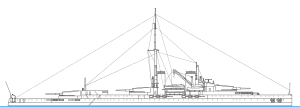 The battleship Normandy | |
| Project | |
| A country |
|
| Preceding type | Brittany |
| Subsequent type | Lyon |
| Scheduled | five |
| Built | 0 |
| Canceled | four |
| Main characteristics | |
| Displacement | 25,230 t |
| Length | 176.6 m maximum |
| Width | 27 m |
| Draft | 8.65 m |
| Reservation | belt: 120-300 mm deck: 50 + 50 mm towers GK: 250-340 mm GK barbets: 284 mm PMK casemates: 160-180 mm conning tower: 300 mm |
| Engines | 2 PM + 2 turbines 21-28 boilers |
| Power | 32 000 h.p. |
| Mover | 4 screws |
| Speed | 21 knots |
| Sailing range | 6,500 miles at 12 knots 1800 miles at 21 knots |
| Crew | 1200 people |
| Armament | |
| Artillery | 3 × 4 - 340 mm / 45 24 × 1 - 138.6 mm / 55 6 × 1 - 47 mm |
| Mine torpedo armament | 6 × 450 mm submarine SLT [1] |

The first four were laid in 1913 , the last in 1914 . Three ships were launched in 1914, the Languedoc in 1916 . However, the events of the First World War forced to stop the completion of the battleships. The last ship of this type - Bearn was launched already in 1920 . Under the terms of the Washington Sea Treaty, the construction of all battleships was discontinued, but the terms of the agreement allowed France to rebuild the Bearn into an aircraft carrier , which was completed in 1923-1927 .
Further development of the project was to become battleships of the Lyon type .
Design History
On December 5, 1911, the Technical Department of the French Ministry of the Sea prepared an analysis of the Brittany -type battleships laid down under the 1912 program. The technical department regretted that its specialists were not involved in the development of the design of these ships. The document said that the location of the towers in the central part of the ship in the diametrical plane had already been tested on the armadillos of the 1886 program, Formidable and Amiral Baudin , and was found to be unsuccessful. The guns arranged in this way had limited angles of fire, and firing from them caused damage to the superstructures. According to the authors of the document, by virtue of the above, one should abandon such an arrangement of towers on the battleships of the 1913 program. The Director of the Design Department introduced the analysis of the Minister of the Sea and the Supreme Council of the Fleet. On January 5, 1912, the Minister of the Sea raised the question of developing technical specifications for the battleships of 1913, during the discussion of which the audience had an understanding that the new battleships should differ in design from ships of the "Brittany" type. It was required to determine the displacement and speed, as well as the placement of weapons - in two-, three- or four- gun tower installations . The technical department urgently developed a number of conceptual designs that were submitted for consideration on February 1, 1912 [2] .
A number of technical limitations were imposed on the project. So, based on the depths of French ports , anchorage and the size of the available docks , it turned out that the length of future ships was limited by a limit of 170-172 meters, width - about 27.5 meters, draft - 8.8 meters. With such measurements, the normal displacement was to be about 25,000 tons. This figure included only 700 tons of coal in silos, with 2700 tons of coal and 300 tons of oil with full displacement . Displacement compared to the "Brittany" increased by 1,500 tons and was considered by many as the ultimate. Meanwhile, abroad, this displacement has already been exceeded. In the UK, battleships of the Iron Duke type (25,000 tons, 10 × 343 mm) were laid, in Germany, battleships of the König type (26,575 tons, 10 × 305 mm) in the USA, battleships of the Pennsylvania type (31,400 t, 10 × 356 mm). In the UK, Queen Elizabeth type battleships (27,500 t, 8 × 381 mm) were planned to be laid, and even in Italy, work began on the creation of Karachollo type battleships with a displacement of 29,500 tons [3] .
With a normal displacement of 25,000 tons, it was possible to create a battleship with armaments like the Brittany’s and a speed of 21 knots. With a decrease in speed to 20 knots, it became possible to place 12,340 mm guns. The guns were arranged in a linearly elevated pattern — at each end, one four-gun and one elevated two-gun towers. The option of placing 12,340 mm guns in three four-gun turrets was considered. The third was located in the central part - an option so criticized by the technical department. Another option was the armament of 16 305 mm guns - four four-gun turrets according to a linearly elevated scheme. The idea of using four-gun towers was not new and was already proposed by Dupont ( Eng. M. Dupont ), an engineer at a weapons factory in Saint-Chamonix ( Eng. Compagnie des forges et aciéries de la marine et d'Homécourt ). A pair of guns were located in two cradles . A pair of guns was therefore charged and fired simultaneously. To reduce the likelihood of failure of four guns with one shell, the tower was divided by a vertical 40-mm partition into two half-towers. A protection scheme different from Brittany was proposed, but details about it were not preserved. Particular attention was paid to increasing the range of navigation. Direct drive turbine ships on the shaft had low efficiency on cruising moves. Therefore, a variant of a four-screw combined installation with a capacity of 32,000 - 35,000 hp was proposed. The inner pair of shafts was driven by turbines, without reverse gear. And the outer pair of shafts was driven by steam engines with a capacity of 16,000 - 16,800 hp. Steam engines were supposed to provide cruising speed up to 16 knots and provide reverse gear of the ship. Such a combined installation with a capacity of 47,000 hp In particular, it was installed on the Olympic and Titanic liners [3] . However, there were differences in the settings for battleships and liners. On the Normandy, steam after the steam engines was not supposed to enter the turbines. The liners were mainly operated at the same constant speed, and for the battleships a multi-mode power plant was needed. Therefore, the contours of steam engines and steam turbines were separate [4] .
The French fleet seriously lagged behind the fleets of Great Britain and Germany. By 1911, battleships of the Danton type entered service. By this time, the first ten dreadnought and five battlecruisers had been added to the fleet in Great Britain and the Orion type dreadnought had been laid. The Germans built eight dreadnoughts and one battlecruiser. Even the Americans, who were not considered a great sea power at the beginning of the 20th century, commissioned six dreadnoughts. An even greater number of new large ships were under construction. Against this background, the laying in France in 1910–1911 of four dreadnoughts of the Courbet type and in 1913 of three of the Brittany type was insufficient. On March 30, 1912, an ambitious program for the development of the 1912 fleet ( French Statut naval ) was adopted. According to it, by 1920, the French fleet was to include 28 battleships. In addition to the relatively new battleships of the Republik , Verite , Danton types, the Kurbay dreadnought and the Brittany superdreadnought, it was necessary to lay 10 more ships. In 1913 and 1914, two Normandy dreadnoughts were to be laid, in 1914 four Lyon dreadnoughts with a displacement of 29,000 tons, and in 1917 two new dreadnoughts of a new type. Soon, the program was revised with the aim of obtaining by 1918 12 superdreadnoughts in the fleet. In 1913, four battleships of the Normandy type should have been laid, in 1914 the fifth ship of the same type with them, and in 1915, four battleships of the Lyon type [5] .
The General Staff on March 26, 1912 announced their vision of the future battleships. Caliber guns 340 mm. It was recommended to refuse the three-gun installations proposed by the Saint-Chamon plant. A linearly elevated arrangement of two four- and two two-gun turrets was proposed. It provided the maximum number of guns with minimal displacement. If during further calculations it turns out that the extremities will be heavily overloaded, it was recommended to return to the Brittany scheme with two-gun towers. The ships were supposed to carry a 300-tonne supply of oil, so it was recommended that the battleships be equipped with a system of refueling in the sea of new, completely 800-ton destroyers . The power plant was proposed turbine, as more suitable for wartime and the only one capable of providing a speed of 21 knots. The maximum draft should not exceed 9 meters. The Supreme Council of the Fleet at the meetings on April 3 and 4 came to the following decisions:
- The basis is the layout of the 340-mm guns as in the Brittany, until the design department can issue a workable design of the four-gun turret
- Combined powerplant accepted
- The new protection scheme is not accepted. A protection scheme is used as in "Brittany" with a possible increase in the thickness of the belt and the protection of the conning tower.
- For auxiliary artillery, instead of the originally considered 22 138.6 mm installations, two calibers - 18 138.6 mm and 12 100 mm.
- The proposal for the use of towers or paired installations of 138.6 mm guns is rejected. They did not provide fast and flexible transfer of fire over a wide range of angles of fire. And, most importantly, manual loading of the guns was difficult, ensuring that at that time was considered one of the important requirements [6] .
The technical council began work on two projects. In the A7 project, the armament consisted of ten 340 mm guns in two-gun towers. In the A7 bis project, it was proposed to place 12,340 mm guns in three four-gun turrets. This made it possible to obtain a battleship with 12,340-mm guns and a speed of 21 knots within the framework of the 25,000 t limit. Compared to the two- and four-gun turrets, the weight savings were 240 tons. The progress of the Saint-Chamonix plant in the development of the four-gun tower project allowed the Minister to approve the plant’s proposals on April 6 and sign an agreement on the development of installations on July 20. At the same time, the technical department announced that it would not have time to develop and set up production of 100 mm guns in the allotted time, therefore, by a decision of the Minister on May 23, it was decided to use only 138.6 mm guns. On June 26, the projects lay on the table to Rear Admiral in charge of naval development. On July 5, the projects were submitted to the Supreme Council. With the recommendation to accept the project A7 bis, as having the best weapons and protection. The same choice was supported by the head of the technical department. Three days later, at a meeting of the Supreme Council of the Fleet, this recommendation was approved. Project A7 bis was then submitted and approved by the Technical Committee on October 26, 1912. The most criticized was the location of a single mast behind the chimney. Tests of the " Lyon " showed that such an arrangement makes it impossible to be at command-range posts (KDP) due to hot gases. It also leads to difficulty in recognizing flag signals hidden in smoke. Moving the mast forward of the chimney was difficult due to the fact that radio antennas were exposed to gases in this case. Therefore, the committee recommended placing two signal masts, which made it possible to remove the CDP in front of the nasal tube and acceptable to place the radio antenna [6] .
Four ships of the 1913 program, the future Normandy type, were to form one division. They received a combined power plant [7] . The fifth ship, Bearn, was to form one division with three ships of the Brittany type. Therefore, he received a purely turbine unit [8] .
Design
| Design articles of weight load, t [9] | |
|---|---|
| Equipped housing | 6969.61 |
| Reservation | 7637.37 |
| Case accessories and stationary equipment | 5213.84 |
| Nominal load (stocks and mobile equipment) | 5,222.04 |
| Displacement reserve | 187.91 |
| Total normal displacement | 25,230.77 |
Corps
Battleships should have a length between perpendiculars of 170.6, a waterline of 175, the largest - 176.4 m. The width should have been 27.0 m, draft - 8.65 m. Displacement at full load should have been 25,230.77 tons The hull had a straight stem , with smooth rounding in the underwater part. The decks were flat, without rising to the bow . The height of the freeboard at the stem was 6.85 m, on the stern - 4.6 m. The sides did not have a blockage inward, and in the bow they had a small camber outward. In the aft end there were two parallel semi-balanced steering wheels . The battleships had an extended forecastle and a nasal superstructure with a lower tier from side to side. Thanks to this, the bow tower of the main caliber had a great height above the waterline , which should have made it possible to use it in fresh weather. The ships had two chimneys and a high main mast . The total weight of the ship's hull was 6969.61 tons [8] .
Compared to the Brittany type, the shape of the stern was changed in order to install two parallel rudders [6] . "Brittany" flooded heavily in the wave. In comparison with her, the ends of the Normandy were less loaded, therefore, problems with seaworthiness should not have arisen. It also turned out to improve stability indicators - the calculated metacentric height was to be 1.45 m [9] .
The watercraft included two 10-meter steam boats , three 11-meter motor boats for the admiral and officers, two 13-meter boats , two 11-meter working boats, two 8.5-meter whaleboats , two 5-meter yals , two 3.5-meter flat-bottomed boats and two 5.6-meter folding sailboats [10] .
The crew consisted of 41 officers, 124 foremen, 996 sailors, 22 civilian and 18 musicians. It was possible to place the admiral with his headquarters [10] .
Booking
The booking scheme as a whole repeated that at Brittany, with an increase in the thickness of the armor in some places. The total protection weight was 7637.365 tons, or slightly more than 30% of the total displacement. The armor belt protected almost the entire board along the waterline, absent in a small area at the aft end [8] . The main armor belt was made of cemented armor and in the area of the citadel had a thickness of 280 mm. Through a teak lining, it was attached to the skin of two layers of shipbuilding steel 10 mm thick [11] [approx. 1] . In the underwater part, in the place where the projectile needed to go through the still water column, the belt had thinning to the bottom. At the tip, the main belt continued with belts of smaller thickness - in the stern of 120 mm and in the bow 180 mm [12] . In the area of the citadel, from the second tower of the main caliber to the stern casemate of the medium artillery, the upper belt went. It was made of plates, the lower edge of which had a thickness of 280 mm, and upwards they gradually narrowed to 240 mm [11] . Between the barbets of the second and middle towers of the main caliber, the medium artillery casemate was covered with plates of 180-160 mm thickness. Battleships had two armored decks . Both had a thickness of 50 mm. The lower one had bevels 70 mm thick, which went to the lower edge of the main armor belt [12] .
The main caliber artillery defense was designed to withstand its own shells [12] . The main caliber towers had a 300 mm front plate on two 20 mm steel layers [13] , 250 mm thick side walls and a 100 mm thick roof. Barbets had a thickness of 280 mm. The conning tower was protected by 300 mm of armor. The anti-torpedo protection in the midsection had a depth of about 3 m and included one anti-torpedo bulkhead of three 10 mm steel layers [12] .
Armament
The main caliber of the battleships of the Normandy type is the twelve 340-mm 45-caliber guns of the 1912 model , housed in three four- gun turret installations . Башни располагались по линейно-возвышенной схеме — по одной в оконечностях и одна в центре по диаметральной плоскости [12] . Высота осей цапф носовой башни относительно ватерлинии составляла 11,1 м, у средней башни — 9,8 м, у кормовой — 7,5 м. Углы обстрела составляли 140, 150 и 135 градусов на каждый борт соответственно [14] .
340-мм орудие образца 1912 года весило 66 950 кг [12] . Затвор поршневой , системы Велина. Заряд пороха массой 153,5 кг состоял из четырёх картузов [15] . Бронебойный снаряд имел массу 555 кг, фугасный — 465 кг. Начальная скорость бронебойного снаряда составляла 800 м/с. При максимальном угле возвышения орудий в 18° максимальная дальность стрельбы этим снарядом должна была составить 18 000 м [12] .
Каждая башня делилась броневой перегородкой на две «полубашни». Каждая полубашня имела собственные снарядные и зарядные погреба и систему подачи. Пара орудий в каждой полубашне находилась в общей люльке и могли вести огонь и перезарядку только совместно. Скорострельность должна была составить 2 выстрела в минуту на орудие. Боезапас должен был составить по 100 снарядов на ствол [12] .
Для управления огнём главного калибра предназначались пять 3,66-м дальномеров . Два из них располагались на крыше боевой рубки, ещё по одному — на каждой башне. Управление стрельбой каждой башни могло осуществляться как с центрального поста, так и индивидуально. Также каждая башня могла служить в качестве резервного поста управления стрельбой. Для ведения ночной стрельбы предназначались пять боевых 90-см прожекторов [14] .
The anti-mine caliber consisted of twenty-four 138.6-mm guns of the 1910 model with a barrel length of 55 calibers. The gun had a separate-shell loading and elevation angles of −7 ° / + 15 °. The mass of the powder charge is 10.4 kg [16] . A high-explosive projectile weighing 31.5 kg was reported with an initial speed of 840 m / s, which ensured a maximum range of 15,100 m. The rate of fire was 5-6 rounds per minute. Mine artillery was located in eight three-gun casemates - four casemates from each side. The nasal pair of casemates was located in the nasal superstructure in front of the middle tower of the main caliber. Aft pair of casemates were located one deck below the upper deck. The remaining casemates were located on the upper deck in the central part. Ammunition was 275 shots per gun [14] .
The armament was supplemented by the 47-mm guns of Hotchkiss model of 1902. They were located on anti-aircraft firing machines on the deck of the forecastle in the region of the second chimney. Mine-torpedo armament consisted of six 450-mm torpedo tubes located on-board in the conning area (two on the starboard side and one on the port side) and under the aft superstructure (two on the port side and one on the starboard side). The total ammunition was 36 torpedoes [14] .
Power plant
Power plant battleship type "Normandy" with a capacity of 32,000 liters. with. provided a speed of 21 knots. For a short time at the afterburner, the power plant could develop 45,000 liters. sec., which should have been enough to achieve a speed of 22 knots [8] [approx. 2] . All ships of this type were equipped with four propellers. The first four battleships of the series received a combined power plant consisting of two four - cylinder triple expansion steam engines driven by a spring pair of shafts and steam turbines directly driven by an internal pair of shafts. The cylinder diameters of steam engines were slightly different depending on the manufacturer. The first high-pressure cylinder had a piston diameter of 1.16-1.18 m, the second medium-pressure cylinder had a diameter of 1.66-1.73 m, followed by two low-pressure cylinders with a piston diameter of 1.98 m. A set of turbines included high and low pressure turbines. The Parsons turbines were on the Normandy and Flanders, the Rato-Brittany systems on the Gascony, and the Schneider-Zolly systems on the Languedoc [13] .
The outer pair of four-blade propellers had a diameter of 5.2 m in increments of 6.37 m at a speed of 115 rpm in full swing. The inner pair of screws was three-bladed with a diameter of 3.34 m and a pitch of 3.1 m at a maximum speed of 280 rpm. The turbines did not have reverse gears. For this and for a cruising of 16 knots, steam engines were used. On the fifth ship of the series - Bearn, there was a four-shaft installation with four sets of Parsons turbines with direct four-shaft drive. Despite the fact that the destroyer was ordered in France in 1913 [approx.] 3] with a gear reducer, they did not dare to put the turbo gear unit on the Bearn, which was founded in 1914,. The turbines driven by internal shafts were the same as on the rest of the ships of the series. A set of turbines driven by external shafts included a high pressure turbine and two low pressure turbines. Together with each TND stood a cruising turbine. The turbines were located in three parallel compartments. Central occupied by low pressure turbines. Steam was supplied first to the theater, then to one of the high pressure pumps. All screws were three-blade with a diameter of 3.34 m in increments of 3.1 m [13] .
The ships were provided with steam by vertical boilers with small diameter pipes with a vapor pressure of 20 kg / cm² [13] . The number and type of steam boilers also varied across the ships of the series. "Normandy" and "Gascony" each had 21 water-tube boilers Guyot-du-Tampla, "Flanders" and "Languedoc" - 28 boilers Belleville, "Bearn" - 21 boiler Nikloss. All boilers had mixed heating [8] . For battleships with 21 boilers, boiler rooms No. 1 and No. 2 with six boilers in each went first from the bow, then a cellar of 138-mm guns, then a boiler room No. 3 with 9 boilers, a turret compartment of the middle main tower and a compartment of steam condensers [8] .
Fuel consumption during 10 hour tests at a speed of 21 knots was 180 kg of coal or 135 kg of oil per 1 m² of grate . When forcing the power in three-hour tests, the coal consumption was 225 kg per 1 m². The normal fuel supply was 900 tons. The total fuel supply was 2700 tons of coal and 300 tons of oil. For ships with a combined power plant, a full fuel reserve should have been sufficient for a range of 1800 miles at full speed, and when using only steam engines, 3375 miles at 16 knots and 6500-6600 miles at 12 knots [13] [8] .
Four 400 kW turbogenerators were used to generate electricity, providing an on-board power supply network with a voltage of 220 V. The turbogenerators were located around the middle tower of the main caliber and each was equipped with its own steam condenser [13] [8] .
Building and Fate
| Representatives [6] | |||||
|---|---|---|---|---|---|
| Ship | Original the names | Shipyard | Bookmark Date | Launch date to water | Planned date commissioning |
| Normandy | Normandie | Ateliers et Chantiers de la Loire, Saint-Nazaire | April 18, 1913 | October 19, 1914 | March 1916 |
| "Languedoc" | Languagesedoc | Forges et Chantiers de la Gironde, Bordeaux | April 18, 1913 | May 01, 1915 | March 1916 |
| Flander | Flandre | Naval shipyard in Brest | October 01, 1913 | October 20, 1914 | June 1917 |
| Gascony | Gascogne | Naval shipyard in Lorient | October 01, 1913 | September 20, 1914 | June 1917 |
| Bearn | Bearn | Forges et Chantiers de la Mediterrenee, La Saint-sur-Mer | January 1914 | April 1920 | 1917 [approx. four] |
After the construction of a series of five battleships of the Normandy type, the French fleet was to receive two divisions of four-ship superdreadnoughts. The construction of the first four battleships was included in the 1913 program. The order for Normandy and Flanders was issued on December 12, 1912, for Gascony and Languedoc on July 30, 1913. The fifth ship was built under the program of 1914. At first he bore the name "Wande", but then it was changed to "Bearn." An order was issued on December 3, 1913. Its contract value without weapons amounted to 57,165 million francs. Bearn was laid on January 5, 1914 at the slipway No. 1 of the shipyard of the private company Forge e Chantier de la Mediterran in La Seyne with factory number 1071 [17] .
With the beginning of World War I, work on battleships was suspended, since all resources were directed to the needs of the army. In order to free the slipways, the first four ships were launched from August 1914 to May 1915. On July 23, 1915, the naval leadership suspended all work on them, since they considered their construction a low priority task. Shipyard hulls were mothballed. At the end of July 1915, work on weapons systems was suspended. Four ready-made 340-mm guns were mounted on railway installations and remade the army. Another 9 guns made for the Languedoc were converted into railroads after the war in 1919. Several manufactured 138.6 mm guns were also used on land. By the time Normandy stopped working, the readiness for the hull was 65%, for the power plant - 70%, for armament - 40%. The boilers designed for it were used in the construction of Avanturie type destroyers. Languedoc had a 49% readiness for the corps, 26% for armament and 73% for the power plant. His boilers were used in the construction of anti-submarine memos [17] .
For Flanders, the readiness for the hull was 65%, the mechanisms 60% and the tower systems of the main caliber - 51%. For Gascony, 60%, 44% and 75%, respectively. The Bearn work was in its infancy. Readiness for the building was 8-10%, for turbines - 25%, for boilers - 17%, for tower installations - 20%. In January 1918, an order was issued for dreadnoughts of the Normandy type, according to which the work remained frozen, but the materials prepared by the shipyards should remain ready for the resumption of work. True, according to Gascony, 3086 tons of sheet material have already been used for other needs [17] .
A few days after the armistice with Germany , on November 22, 1918, the design department sent a request to the headquarters to receive requirements for a project for the modification of battleships of the Normandy type. The General Staff on November 29 formulated the following requirements: speed of 26-28 knots, a significant increase in protection, more powerful weapons. In response, the design department prepared a report signed by the head of the technical department, Doyer, addressed to the minister. The report said that the requirements expressed by the General Staff are not feasible for budgetary constraints and timelines. Technical restrictions in 1919 did not differ much from those in 1913. The capabilities of the shipyards were still limited by the dimensions of the Normandy and Lille types, especially in width. Dredging in the ports and modernization of their infrastructure was also not completed and went with great delays. Only one dry dock in Brest could accept ships up to 250 m long and 36 m wide. The completion of two more docks in Toulon was expected no earlier than in a year. The expected completion dates for the docks in Lorient and Bizert were even greater. All this led to the fact that the width should not exceed a value of 29.5 m. This imposed significant restrictions on the possibility of anti-torpedo protection, the effectiveness of which greatly depended on its depth. Ultimately, on February 25, 1919, the General Staff gave its conclusion that in the next 6-7 years new battleships could not be built taking into account the experience of the past war. Therefore, four battleships of the Normandy type should be completed. The guns from the fifth - “Bearna”, were supposed to be used instead of those captured for the “Gasconi” captured by the Germans in Lille. The General Staff and the Design Department agreed on the following points [18] :
- 1) The completion of the ships is with the existing power plant. To increase the speed from 21 to 24 knots, it is necessary to find an additional 80,000 hp, which requires too large alterations [18] .
- 2) Anti-torpedo protection is enhanced. All unoccupied compartments before the anti-torpedo bulkhead should be filled with cork chips. The installation of external bullets with a width of 1 m will make it possible to raise the displacement to 27,000 tons. According to the calculations, the protection of the initial Normandy project withstood the explosion of only 100 kg of torpedo warhead. The measures taken should increase the resistance of PTZ to 200 kg of TNT [18] .
- 3) The General Staff hoped that it would be possible to abandon the middle tower of the main caliber and return to the scheme with two four-gun and two elevated two-gun towers at the ends. In any case, the elevation angle of the guns should be increased to 23-24 °. This will increase the maximum firing range from 16,000 m to 25,000 m. The French were very wrong in their calculations on the expected distance of the battles [18] . According to their pre-war calculations, visibility conditions at sea would limit the firing distance to 15,000 m. Based on this, the elevation angles of the guns and the possibilities of rangefinders were planned. But the battles between the German and British fleets in the North Sea began with a distance of 20,000 m [19] .
- 4) Due to the increased battle distances, the horizontal defense should be reviewed. At large distances, shells fell already at a fairly large angle and began to hit the decks. The total thickness of the decks should be increased to 120 mm, and the roof of the towers to 200 mm [19] .
- 5) Dismantling of underwater torpedo tubes with replacing them with six 550-mm surface ones. Ammunition for 4 torpedoes per vehicle, if possible place them over the casemate of 138-mm guns [19] .
- 6) Since the freed up compartments of the torpedo tubes were well protected and were behind the anti-torpedo bulkhead, each of them should have one electric generator. Each of them should be able to independently supply the necessary devices for the battle [19] .
- 7) Installation of command and rangefinding posts with directors of fire control on tripod masts, two directors for 138.6 mm guns, installation on the conning tower of a rotating unit with three rangefinders with a wide base and three central fire control stations (two for the main gun and one for the mine artillery) [19] .
- 8) Add a torpedo fire control center, radio equipment for artillery fire control systems and six or eight 90-cm floodlights with external control from observation posts [19] .
- 9) To provide reserves for a two-seat reconnaissance aircraft and a single-seat fighter, but without the installation of take-off platforms [19] .
Bearn was the least prepared, so a more extensive modernization program was offered to him. In addition to works similar to the other four ships of the series, a modification of the power plant and main-caliber guns was proposed. Niklass boilers were transferred to the Flanders, and eight oil boilers were installed on it, similar to those installed on destroyers. New turbine unit with a capacity of 80,000 liters. with. had to provide a speed of 24-25 knots. Either four-gun 340 mm towers with an increased elevation angle, or new two-gun 420 mm installations [19] were considered as armaments.
The Bearn decision was delayed, so in April 1920 his hull was launched to release the slipway. Ultimately, from 1923, work began on it to be converted into an aircraft carrier [19] . The decision on battleships of the Normandy type was delayed. The cost of their completion in 1919 was estimated at 200-250 million francs . As a result, the French fleet in four to five years would have received a division of homogeneous battleships, which in their characteristics could well be compared with at least 50 capital ships of other countries [19] . But they were inferior to the best representatives of foreign fleets. As Doyer himself noted, one should not expect too much from them, these are “ships for today”, not for the future [20] .
On February 25, 1919, Captain Wandier ( French de Vaisseau Vandier ) became the coordinator for the Normandy project between the technical department and the General Staff. He spent 18 months as a French observer at the British Grand Fleet and could evaluate the proposed changes in terms of practical experience in using the British fleet. Research by the technical department showed that by lengthening the Normandy hull by 15 meters, it was possible to increase the speed to 26 knots and the General Staff on March 4 ordered a more detailed study of this option. Meanwhile, the issue of new battleships was becoming increasingly relevant. To replace the order of worn out ships during the four years of the war, a program was approved for the construction of six light cruisers, ten destroyers and 20 submarines. July 19, 1919 Admiral Ronarc ( fr. Ronarc ) in a note addressed to the Minister noted that the French fleet should maintain an advantage over the Italian. And since Italians are reportedly resuming work on battleships of the Karachiollo type with 381 mm guns, the completion of the Normandy should be considered. In total, three options were proposed [21] :
- 1) Completion of an existing project. That was estimated at 430 million francs. Construction period from 30 to 36 months
- 2) Completion with a number of improvements. A bulge 1 m wide was added, the elevation angles of the guns increased, the protection improved. The cost increased to 482 million francs, the terms of work are approximately the same as in the first version
- 3) Lengthening the hull, fitting up a 2.7-meter-wide bullet, increasing the power plant capacity to 80,000 hp. and speeds up to 26 knots. The cost of more than 700 million francs. The term of the work is 54-60 months [21] .
According to information received from Rome, Italians did not plan to build more than one battleship of the “Karachiollo” type. In addition, the economy of France, exhausted by the war, was in a difficult situation. Therefore, in a note dated August 4, 1919, Admiral Ronark already wrote that he sees no reason for completing battleships of the Normandy type. On September 12, 1919, a very modest naval program was proposed for consideration by the government, from which even submarines were excluded. In a cover note, Ronark wrote that you should abandon the idea of completing the five battleships of the Normandy type. At least until the government approves naval policy. And although the press of that time still flashed projects for the completion of battleships of the Normandy type, the naval leadership actually accepted the refusal to build them [21] .
They considered options for completing them as passenger liners , cargo ships and tankers and even non-self-propelled floating tanks. But all of them were not implemented. After the ratification of the Washington Treaty on April 18, 1922, the first four ships were removed from the fleet lists, and their equipment was used to complete the Bearn and the cruisers of the 1922 program. Equipment was dismantled from the ships, and the hulls were sold for scrap. Normandy was sold for 1.8 million francs to an Italian company and dismantled for metal in 1924-1925. The Languedoc was towed to Port Brook. In May 1925, he sank after a storm due to widening seams. Был впоследствии поднят и к июню 1929 года разобран на металл. «Фландр» был разделан в Тулоне с июля по октябрь 1924 года, «Гасконь» в Лорьяне в 1923—1924 годах [22] .
Project Evaluation
Проект линкоров типа «Норманди» обладал недостатками, во многом связанными с неспособностью Франции строить и обслуживать корабли водоизмещением свыше 25 000 т. У руководителя технического отдела Дойера ( фр. М. Doyere ), сменившего в 1911 году Лиссе ( фр. М. Lyasse ), не было недостатка в критиках. Будучи умным человеком с критическим складом ума, он, тем не менее, не всегда вел себя доброжелательно, поэтому нажил много недоброжелателей. Тем не менее, Дойер сам признавал защиту «Нормандии» недостаточной, особенно — подводную защиту [23] .
Французы много внимания уделили защите от снарядов средней артиллерии. Вертикальная защита французских дредноутов закрывала большую часть борта, при этом входивший в неё главный броневой пояс был сравнительно тонким. Главный пояс в 280 мм занимал два межпалубных пространства и продолжался в оконечности поясами 180-мм толщины. Защитой на уровне ватерлинии не был прикрыт только очень небольшой отрезок в кормовой оконечности. Над главным поясом располагались верхний пояс в 180 мм и казематы противоминного калибра, защищенные броней толщиной 160—180 мм [24] . Для сравнения, британский дредноут « Айрон Дюк » имел главный пояс толщиной 305 мм [прим. 5] , новейший линкор «Куин Элизабет» — 330 мм, а германский «Кёниг» — все 350 мм при меньшей площади бронирования борта. На момент проектирования своих первых сверхдредноутов французы считали, что для достижения решительных результатов противники должны будут сблизиться на дистанцию в 6000 м и во время боя эта дистанция вряд ли превысит 8000 м [25] . Поэтому вертикальной защите был отдан приоритет над горизонтальной: бронепалубы французских линкоров имели лёгкое бронирование. Две палубы из трёх слоёв стальных листов скорее должны были удерживать осколки от прошедших сквозь пояс снарядов, летевших по настильным траекториям, нежели служить защитой от падающих под большим углом снарядов. Первые же бои Первой мировой войны показали, что дистанции боя значительно превышают спрогнозированные французскими специалистами. В бою у Фолклендских островов огонь открывался на дистанции порядка 15 000 м, а основной бой велся на дистанции 9000 —13 000 м. В сражении у Доггер-банки огонь вёлся на дистанциях 14 500 — 18 000 м, а в Ютландском сражении дневные бои начинались на дальностях 18 000 — 19 000 м [прим. 6] . На таких дистанциях снаряды падали на цель по навесной траектории, чаще попадая в палубы сверху, на что защита французских дредноутов не рассчитывалась [прим. 7] [26] .
Дойера, как ответственного за проект, критиковали за выбор орудий 340-мм калибра, в то время как флоты других стран уже переходили на орудия калибром 356 мм и 381 мм. Однако выбор 340-мм калибра был связан не только с ограничениями водоизмещения, но и с опасением задержки сроков разработки новых орудий. В любом случае, Генеральный штаб отмечал, что для 25 000-т корабля двенадцать 340-мм орудий давали бортовой залп, массой превосходивший таковые у большинства современных линкоров [23] .
Критиковался и выбор комбинированной установки вместо турбин прямого действия или турбозубчатых агрегатов. Между тем, турбины прямого действия обладали слишком низкой экономичностью, а редуктор турбозубчатого агрегата был по тем временам новой и ещё не проверенной технологией. Намучившись в своё время с установкой турбин неотработанной конструкции на «Дантонах», французы предпочли второй раз не рисковать [23] . На этот шаг пошли, понимая, что комбинированная установка должна привести к сложностям при эксплуатации. Необходимо было обучать персонал работе с двумя разноплановыми установками и хранить запчасти к ним обеим [26] .
| « Бретань » [27] | «Норманди» [27] | « Айрон Дюк » [28] | « Куин Элизабет » [29] [30] | « Кёниг » [31] | « Байерн » [32] | « Невада » [33] | « Фусо » [34] | « Карачолло » | |
|---|---|---|---|---|---|---|---|---|---|
| Закладка | 1912 | 1913 | 1912 | 1912 | 1911 | 1913 | 1912 | 1912 | 1914 |
| Ввод в строй | 1916 | - | 1914 | 1916 | 1914 | 1916 | 1916 | 1915 | - |
| Длина×ширина | 166×27 | 177,6×27 | 190×27,5 | 197×27,6 | 175,4×29,5 | 179,8×30,8 | 177,7×29,1 | 202,7×28,7 | 212×29,6 |
| Нормальное водоизмещение , т | 23,500 | 25,200 | 26 100 дл. t | 32 000 дл. t | 25 390 | 28 074 | 27 500 дл. t | 30,600 | 31 400 |
| Скорость, узлы | 20 | 21 | 21,25 | 24 | 21 | 22 | 20.5 | 22.5 | 25 |
| Armament | 10×340-мм 22×138-мм | 12×340-мм 24×138-мм | 10×343-мм 12×152-мм | 8×381-мм 14×152-мм | 10×305-мм 14×150-мм | 8×380-мм 14×150-мм | 10×356-мм 21×127-мм | 12×356-мм 16×152-мм | 8×381-мм 12×152-мм |
| Пояс, мм | 250 | 280 | 305 | 330 | 350 | 350 | 343 | 305 | 300 |
| Схема размещения вооружения |
Notes
- ↑ У Патянина и Ле Массона указана толщина пояса 300 мм. Но для сравнения они дают толщину пояса на «Бретани» в 270 мм. Но на «Бретани» пояс имел толщину 250 мм брони на обшивке из двух слоев стали по 10 мм. Включением обшивки в толщину пояса очевидно и объясняется разница в цифрах между данными Джордана/Дюма и Ле Массоном / Патяниным
- ↑ По данным Ле Массона, стр 414, при форсировании до мощности 40 000 л. with. скорость — 21,5 узла, при мощности в 45 000 л. with. — 22,5 узла
- ↑ Его закладка произошла только в июне 1914 года, на пять месяцев позже «Беарна».
- ↑ По предварительному плану
- ↑ У «Айрон Дюка» главный пояс состоял из двух слоев плит. Только нижний, выступавший при нормальном водоизмещении над водой на 2 фута (610 мм), имел толщину 305 мм. Верхний уровень плит имел толщину 229 мм
- ↑ Джордан и Дюма несколько завысили цифры по Ютландскому сражению. В работе Campbell John Jutland: An Analysis of the Fighting. — Lyons Press, 1998. — ISBN 1-55821-759-2 . в первых двух дневных фазах сражения британские линейные крейсера с 343-мм орудиями открывали огонь на дистанции порядка 18 500 ярдов (16 900 м). Британские линкоры типа «Куин Элизабет», вооружённые 381-мм орудиями, вели огонь на дистанциях 19 000 — 19 200 ярдов (17 400 — 17 600 м). Германские корабли с орудиями 280-мм и 305-мм открывали огонь с несколько меньших дистанций.
- ↑ Справедливости ради следует отметить, что рост дистанции боев до 14 000 — 18 000 м до войны не прогнозировался ни в одной стране. В итоге при сильной вертикальной защите бронепалубы линкоров имели относительно небольшую толщину. Поэтому на британских кораблях после Ютландского сражения в срочном порядке бронепалубы были услилены в наиболее уязвимых месте в районе погребов. Углы возвышения орудий, там где они не могли обеспечивать такую дальность, пришлось увеличивать. Эти работы были проведены на британских кораблях с 305-мм орудиями, равно как и на германских с 280-мм и 305-мм орудиями. Новейшие британские и германские линкоры с 343-мм, 380- и 381-мм орудиями изначально могли вести огонь на таких дистанциях. Работы по увеличению максимального угла возвышения орудий главного калибра с 12° до 18° были проведены и на французских линкорах типа «Бретань».
References and sources
- ↑ Conway's All the World's Fighting Ships, 1906—1921. — Annapolis, Maryland, USA: Naval Institute Press, 1985. — P. 198. — ISBN 0-87021-907-3 .
- ↑ Le Masson, 1984 , p. 409.
- ↑ 1 2 Le Masson, 1984 , p. 410.
- ↑ Le Masson, 1984 , p. 411.
- ↑ Jordan, Dumas. French Battleships. — P. 8.
- ↑ 1 2 3 4 Le Masson, 1984 , p. 412.
- ↑ Патянин. Французские авианосцы ВМВ, 2013 , с. five.
- ↑ 1 2 3 4 5 6 7 8 Патянин. Французские авианосцы ВМВ, 2013 , с. 6.
- ↑ 1 2 Le Masson, 1984 , p. 413.
- ↑ 1 2 Патянин. Французские авианосцы ВМВ, 2013 , с. eleven.
- ↑ 1 2 Jordan, Dumas. French Battleships. — P. 13.
- ↑ 1 2 3 4 5 6 7 8 Патянин. Французские авианосцы ВМВ, 2013 , с. 7.
- ↑ 1 2 3 4 5 6 Le Masson, 1984 , p. 414.
- ↑ 1 2 3 4 Патянин. Французские авианосцы ВМВ, 2013 , с. 8.
- ↑ DiGiulian, Tony. France. 340 mm/45 (13.4") Model 1912 (англ.) . сайт navweaps.com . — Описание орудия 340-мм/45 модели 1912 года. Дата обращения 1 апреля 2015.
- ↑ DiGiulian, Tony. France. 138.6 mm/55 (5.46") Model 1910 (англ.) . сайт navweaps.com . — Описание орудия 138,6 мм/45 модели 1910 года. Дата обращения 1 апреля 2015.
- ↑ 1 2 3 Патянин. Французские авианосцы ВМВ, 2013 , с. 12.
- ↑ 1 2 3 4 Le Masson, 1984 , p. 416.
- ↑ 1 2 3 4 5 6 7 8 9 10 Le Masson, 1984 , p. 417.
- ↑ Le Masson, 1984 , p. 418.
- ↑ 1 2 3 Le Masson, 1984 , p. 419.
- ↑ Патянин. Французские авианосцы ВМВ, 2013 , с. 14.
- ↑ 1 2 3 Le Masson, 1984 , p. 415.
- ↑ Jordan, Dumas. French Battleships. — P. 12-13.
- ↑ Jordan, Dumas. French Battleships. — P. 12.
- ↑ 1 2 Jordan, Dumas. French Battleships. — P. 10.
- ↑ 1 2 Jordan, Dumas. French Battleships. — P. 11.
- ↑ Conway's, 1906—1921 . — P.31
- ↑ Паркс . Линкоры Британской империи. Том 7. — С. 50.
- ↑ Conway's, 1906—1921 . — P.33
- ↑ Gröner . Band 1. — P.51
- ↑ Gröner . Band 1. — P.52—54
- ↑ Conway's, 1906—1921 . — P.115
- ↑ Conway's, 1906—1921 . — P.229
Literature
- Паркс, Оскар. Линкоры Британской империи. Том 7. Эпоха дредноутов. - SPb. : Галея Принт, 2008. — 116 с. — ISBN 9785817201321 .
- Патянин С. Несостоявшиеся сверхдредноуты Французские линкоры типа «Нормандия» (рус.) // Арсенал-Коллекция : журнал. — 2012. — № 4 (4) . — С. 35—46 .
- Патянин, Сергей. Французские авианосцы второй мировой. Становление палубной авиации.. — Яуза, ЭКСМО, 2013. — P. 409–419. — ISBN 978-5-699-63282-4 .
- All the world's battleships. 1906 to the present. — London: Conway Maritime Press, 1996. — ISBN 0-85177-691-4 .
- Conway's All The Worlds Fighting Ships, 1906-1921 / Gray, Randal (ed.). - London: Conway Maritime Press, 1985 .-- 439 p. - ISBN 0-85177-245-5 .
- Jordan, John. Dumas, Robert. French Battleships 1922-1956. - Barnsley, Yorkshire: Seaforth Publishing, 2009 .-- 224 p. - ISBN 978-1848320345 .
- Gröner, Erich. Die deutschen Kriegsschiffe 1815-1945. Band 1: Panzerschiffe, Linienschiffe, Schlachschiffe, Flugzeugträger, Kreuzer, Kanonenboote. - Bernard & Graefe Verlag, 1982. - 180 p. - ISBN 978-3763748006 .
- Le Masson, Henry. "The Normandie class Battleships with Quadruple Turrets." Warship International / XXI (4). - International Naval Research Organization, 1984. - P. 409-419.