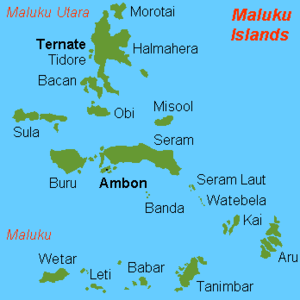
Watubelians (alternative name - watubela , matubela ) - one of the peoples of eastern Indonesia . It lives on the islands of Watubela . Belongs to the group of the Ambon-Timorese peoples of the West Timor area of the gang-geser subgroup . At the end of the 20th century, the number reached 3 thousand people.
| Watubelts | |
|---|---|
| Modern self | vatubela |
| Abundance and area | |
| Total: 3000 | |
 Indonesia Indonesia | |
| Tongue | gesar language, watubel language, watubela |
| Religion | Sunni Muslims , traditional beliefs |
| Enters into | Austronesian language family |
Language
They speak the Gesar language, have their own language related to the Central Maluku languages (Blust 1993: 244) and the same name with the name of the people and the archipelago - watubela . Example: “Kadola” from Watubel means “village”. (Chlenov 1980: 430)
History
From the end of the 7th to the beginning of the 8th century and ending XIV century. are part of the state of Sri Vijaya , whose center was the island of Sumatra. It is also known that in the XV — XVI they were part of the Maluccan Sultanate. Since the middle of the XVIth, the Maluccas, of which the island of Watubela is also a part, the first of all the archipelagos of the future Indonesia, underwent a process of colonization, first by the Portuguese, then by the Dutch who succeeded them. At first they were included in the sphere of influence of the Netherlands East India Company , and from 1782 until 1942 they entered the colonial possessions of the Netherlands crown .
Religion
By religion they are Sunni Muslims .
Life
The main fisheries of the Watubelians are fishing and sago mining. Agriculture is not involved. Sago dominates the diet, they use it boiled, and baked goods are also prepared from them. Settlements of this people are located along the coast, therefore, in order to prevent water from reaching the houses, the dwellings are put on piles, the walls and the roof are made from cuttings of sago palm leaves. In clothing, they prefer Malay fashion, as well as, more recently, European. Women wear massive gold earrings. During government events, the chief's clothing is a tunic and shawl made of satin and decorated with flowers (Wallace 1862: 133). In everyday life, tools made of copper are used, which are of great value to the watubelians (ibid.). In the past, there was a ritual of initiation held to commemorate a member of the people of majority. Lost at the moment.
Society
Clans and lines, consisting of clan associations, are the basis of the division of the society of watubelians. In the past they had a crooked tradition of marriage and experience in bounty hunting. At the moment, these traditions are considered lost.
Literature
Blust R. Central and Central-Eastern Malayo-Polynesian // Oceanic Linguistics. Vol. 32, No. 2 (Winter, 1993), pp. 241–293.
Chlenov MA Cultural vocabulary as an indicator of interethnic relations: Eastern Indonesian evidence // Bijdragen tot de Taal-, Land- en Volkenkunde. Vol. 136, No. 4. (1980), pp. 426–439.
Wallace AR On the Trade of the Eastern Archipelago with New Guinea and Its Islands // Journal of the Royal Geographical Society of London. Vol. 32, (1862) pp. 127–137.
Links
- Blust R. Central and Central-Eastern Malayo-Polynesian // Oceanic Linguistics. Vol. 32, No. 2 (Winter, 1993), pp. 241-293.
- Chlenov MA Cultural vocabulary as an indicator of interethnic relations: Eastern Indonesian evidence // Bijdragen tot de Taal-, Land- en Volkenkunde. Vol. 136, No. 4. (1980), pp. 426-439.
- Wallace AR On the Trade of the Eastern Archipelago with New Guinea and Its Islands // Journal of the Royal Geographical Society of London. Vol. 32, (1862) pp. 127-137.
- Miklouho-Maclay N. N. .. Dictionary of dialect o. Watubella
- The people of Watubel. Indonesia. (inaccessible link)
- Chlenova S. NOTES ON THE LANGUAGE OF GESER-GOROM WITH THE APPLICATION OF THE DICTIONARY