Neurotrophin-3 ( Eng. Neurotrophin-3; NT-3 ) is a protein encoded in humans by the NTF3 gene . [1] [2]
| Neurotrophin-3 | |||||||||||||
|---|---|---|---|---|---|---|---|---|---|---|---|---|---|
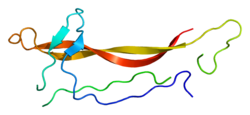 1b8k based PDB rendering. | |||||||||||||
| |||||||||||||
| Identifiers | |||||||||||||
| Symbol | ; HDNF; NGF-2; NGF2; NT3 | ||||||||||||
| External IDs | GeneCards : | ||||||||||||
| |||||||||||||
| RNA expression profile | |||||||||||||
 | |||||||||||||
| Orthologists | |||||||||||||
| View | Person | Mouse | |||||||||||
| Entrez | |||||||||||||
| Ensembl | |||||||||||||
| Uniprot | |||||||||||||
| RefSeq (mRNA) | |||||||||||||
| RefSeq (protein) | |||||||||||||
| Locus (UCSC) | |||||||||||||
| Search PubMed | |||||||||||||
This protein is a neurotrophic factor belonging to the family of neurotrophins NGF (nerve growth factors, nerve growth factors). This is a protein growth factor that acts on specific neurons of the peripheral and central nervous system ; it provides the differentiation and survival of existing neurons, and also supports the growth and differentiation of new neurons and synapses . NT-3 was the third described neurotrophic factor after NGF and BDNF (brain derived neurotrophic factor, brain neurotrophic factor). [3]
In a developing organism, neurotrophins are synthesized by a target cell (for example, a muscle spindle ), diffuse towards a neuron and bind to receptor molecules on its surface, which leads to active axon growth. As a result, the axon reaches the target cell, establishing synaptic contact with it.
Neurotrophin-3 has been studied as a treatment for constipation . In a randomized , double-blind, placebo- controlled phase II study, subcutaneous administration of neurotrophin-3 three times a week significantly increased the frequency of spontaneous complete bowel movements and enhanced the effect of other agents for treating constipation [4] .
Content
- 1 Functions
- 2 mechanism of action
- 2.1 High affinity receptors
- 2.2 Low affinity receptors
- 3 PDB images
- 4 Sources
Functions
Despite the fact that the vast majority of neurons in the brain of mammals are formed before birth, some parts of the brain of an adult animal retain the ability to grow new neurons from neuronal stem cells . This process is known as neurogenesis . Neurotrophins stimulate and control neurogenesis.
NT-3 is unique in that it can potentially stimulate a large number of neurons, given its ability to activate two tyrosine kinase receptors for neurotrophins (TrkC and TrkB - see below).
Mice born without the ability to synthesize NT-3 lacked proprioceptors and a number of mechanoreceptor neurons. [5] [6]
Mechanism of Action
NT-3 binds to three receptors on the surface of cells that can respond to this growth factor:
- TrkC (Track C) is clearly a “physiological” receptor because it binds to NT-3 with the highest affinity . [7] [8]
- However, NT-3 is able to bind and send signals through TrkC-related receptors, TrkB.
- Finally, NT-3 is also able to bind to a second type of receptor other than Trk, called L NGFR (Low Affinity Nerve Growth Factor Receptor - a low affinity nerve growth factor receptor).
High affinity receptors
TrkC is a receptor with tyrosine kinase activity, which means it serves as an intermediary in the actions of NT-3, causing phosphorylation of certain tyrosines on proteins in the cell and activating cell growth.
As already mentioned, there are other Trk receptors: TrkA and TrkB. It was also mentioned that there are other neurotrophic factors structurally similar to NT-3:
- NGF (Nerve Growth Factor)
- BDNF (Brain Derived Neurotrophic Factor, cerebral neurotrophic factor)
- NT-4 (Neurotrophin-4)
While TrkB mediates BDNF, NT-4, and NT-3 reactions, TrkA can be activated by NGF, and TrkC only by NT-3.
Low affinity receptors
The role of another NT-3 receptor, L NGFR , is less clear.
Cells that have both Trk and LNGFR receptors may show greater activity due to increased "microconcentration" of neurotrophin.
However, it was also proved that LNGFR can send a cell a signal for death from apoptosis - which means that cells having only LNGFR receptors in the absence of Trk receptors are more likely to die than survive in the presence of neurotrophins.
PDB Images
1b8k: Human NT-3
BDNF / NT-3 structure (heterodimer)
1nt3: Human NT-3
Sources
- ↑ Maisonpierre PC, Le Beau MM, Espinosa R 3rd, Ip NY, Belluscio L., de la Monte SM, Squinto S., Furth ME, Yancopoulos GD Human and rat brain-derived neurotrophic factor and neurotrophin-3: gene structures, distributions , and chromosomal localizations (Eng.) // Genomics: journal. - 1991 .-- October ( vol. 10 , no. 3 ). - P. 558-568 . - DOI : 10.1016 / 0888-7543 (91) 90436-I . - PMID 1889806 .
- ↑ Entrez Gene: NTF3 neurotrophin 3 .
- ↑ Maisonpierre P., Belluscio L., Squinto S., Ip N., Furth M., Lindsay R., Yancopoulos G. Neurotrophin-3: a neurotrophic factor related to NGF and BDNF (Eng.) // Science: journal. - 1990. - Vol. 247 , no. 4949 Pt 1 . - P. 1446-1451 . - DOI : 10.1126 / science.2321006 . - PMID 2321006 .
- ↑ Parkman H, Rao S, Reynolds J, et al. Neurotrophin-3 improves functional constipation. Am J Gastroenterol 2003; 98: 1338-1347
- ↑ Tessarollo L., Vogel K., Palko M., Reid S., Parada L. Targeted mutation in the neurotrophin-3 gene results in loss of muscle sensory neurons (Eng.) // Proceedings of the National Academy of Sciences of the United States of America : journal. - 1994. - Vol. 91 , no. 25 . - P. 11844-11848 . - DOI : 10.1073 / pnas.91.25.11844 . - PMID 7991545 .
- ↑ Klein R., Silos-Santiago I., Smeyne R., Lira S., Brambilla R., Bryant S., Zhang L., Snider W., Barbacid M. Disruption of the neurotrophin-3 receptor gene trkC eliminates la muscle afferents and results in abnormal movements (English) // Nature: journal. - 1994. - Vol. 368 , no. 6468 . - P. 249-251 . - DOI : 10.1038 / 368249a0 . - PMID 8145824 .
- ↑ Lamballe F., Klein R., Barbacid M. trkC, a new member of the trk family of tyrosine protein kinases, is a receptor for neurotrophin-3 (Eng.) // Cell : journal. - Cell Press 1991. - Vol. 66 , no. 5 . - P. 967-979 . - DOI : 10.1016 / 0092-8674 (91) 90442-2 . - PMID 1653651 .
- ↑ Tessarollo L., Tsoulfas P., Martin-Zanca D., Gilbert D., Jenkins N., Copeland N., Parada L. trkC, a receptor for neurotrophin-3, is widely expressed in the developing nervous system and in non -neuronal tissues (English) // Development: journal. - 1993. - Vol. 118 , no. 2 . - P. 463-475 . - PMID 8223273 .